This is an edition of The Atlantic Daily, a newsletter that guides you through the biggest stories of the day, helps you discover new ideas, and recommends the best in culture. Sign up for it here.
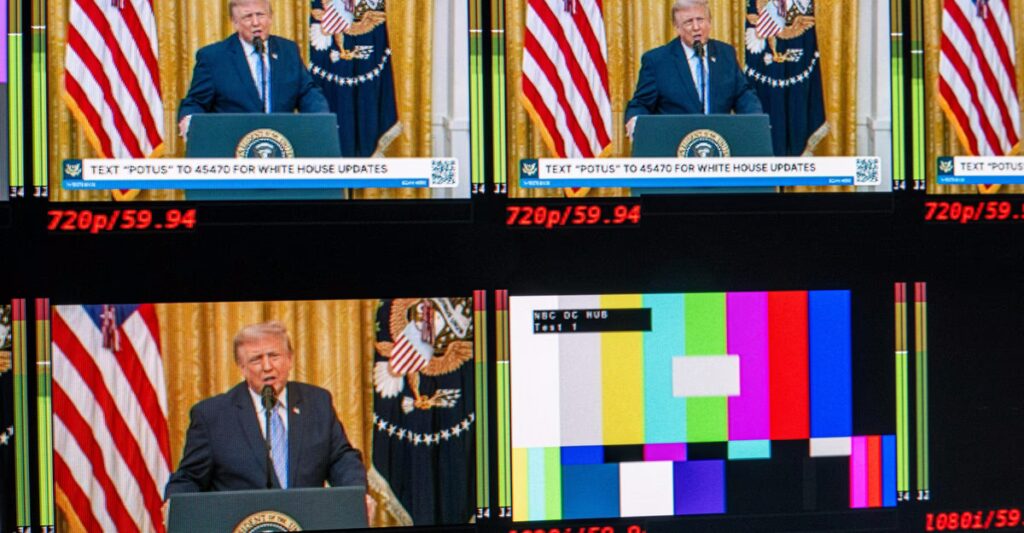
Last night, President Trump delivered a rare prime-time speech, but his address fell well short of the hype. Purportedly, the president was going to make a major statement about election integrity, but in reality the speech was dense and hoarsely delivered. As my colleagues report, he provided no evidence to back up his long-standing lie that the 2020 election was stolen. The White House also released four tranches of documents meant to support the speech, but Trump’s claims were a farrago of recycled information, misrepresentations of evidence, and tendentious claims based on materials too heavily redacted to parse. Major news networks, apparently concerned that Trump would mislead, declined to air the address live.
So why even deliver it? The speech was a sign of desperation. Trump spoke now not only to distract from his sputtering Iran war and its effects on the economy, but also because his attempts to concretely interfere with the 2026 election thus far have almost all failed. As his opportunities to change the rules of the game before November slip away from him, the president is falling back on one of the few tools he has left: attempting to sow chaos and doubt among Americans.
Trump has been remarkably successful in his push to gerrymander ahead of the midterms. Several Republican states have redrawn their districts to add GOP-leaning seats, the Supreme Court’s April decision in Louisiana v. Callais allowed other states to move forward with their own maps, and a state court in Virginia shot down retaliatory gerrymandering that would have assisted Democrats. In all, this has given Republicans several more likely seats.
But nearly everything else has faltered, including the president’s signature legislative initiative to overhaul elections by, in part, requiring votes to provide proof of citizenship. Last week, Trump refused to sign a bipartisan housing bill “in PROTEST over the fact that the United States Senate is not capable of passing THE SAVE AMERICA ACT.” This is a peculiar and ineffective gesture—the housing bill became law anyway—but he’s right about the prospects for the SAVE America Act. Yesterday, Senator Thom Tillis, a retiring Republican from North Carolina, vowed to block the legislation if it comes up again. As Tillis noted, it would now be too late to implement for the midterms anyway.
Most of the subversion methods Trump has tried, however, have been executive actions that don’t require Congress. But the president doesn’t have control over elections—that power is delegated to the states or to Congress. As a result, most of Trump’s big moves have either been blocked by courts or simply ignored by state and local officials.
Federal judges blocked parts of an executive order that purported to instruct states not to accept mail-in ballots after Election Day and to require proof of citizenship. Judges also ruled against an order that would have established a federal database of voting-age citizens, and then would have tried to force states to use the list to screen votes by blocking the U.S. Postal Service from delivering ballots to anyone not included on it. The process was an arcane, possibly unworkable attempt to solve a problem—widespread noncitizen voting—that simply doesn’t exist.
Although some states have voluntarily handed over voter rolls to the federal government, many others have challenged demands in court and won. The Justice Department’s pressure tactics are now also drawing angry reactions even from Republican allies. In Idaho, the state government, which has forwarded alleged cases of noncitizen voting to the federal government, received a threat of prosecution if noncitizens were allowed to vote; GOP leaders were seething over recent communications from the Justice Department.
Earlier this month, Trump fired two members of the Election Assistance Commission, and a third resigned, leaving the body without any leaders. What exactly Trump intends here is a little opaque. The EAC is basically advisory, and hamstringing it will make life harder for local officials, but this also looks like an admission of defeat: Trump had attempted to use the EAC to decertify all existing voting machines and enforce his proof-of-citizenship order. Now he appears to be giving up on it—even though the EAC would be a useful way to help local officials remedy some of the security weaknesses Trump discussed in his speech, such as the computer systems used to run voting processes (though, crucially, no evidence suggests actual ballots or vote totals are vulnerable).
Trump continues to look for evidence of fraud in the 2020 election, but his search remains fruitless, and he didn’t even mount an argument for it last night. The president has been particularly focused on Georgia, but a Trump-appointed federal judge this month blocked the Justice Department from subpoenaing people who worked in Fulton County in that election, and two FBI agents assigned to trawl through old evidence were fired for refusing to do so, MS NOW reported.
What options does this leave Trump? One is trying to create chaos by insisting that fraud exists. That was the apparent goal of last night’s speech. Having come up short on any efforts involving legislation or policy, Trump’s main confederates in his latest push are Bill Pulte, the acting director of national intelligence, an extreme partisan who has no statutory role in elections and also no experience in election administration or security; and John Solomon, a right-wing pundit with a long history of spreading false claims, who has been brought on by the White House to construct narratives like the ones Trump laid out. The second, as I wrote in an in-depth October article about how Trump was already trying to subvert the midterms, is to deploy troops or federal law enforcement around the time of the election.
The danger posed by either of these options should not be dismissed, but there are reasons they were not Trump’s first choices: They are risky and less likely to succeed. Because election officials, experts, and nonprofit organizations have been paying attention to the threat for months, they are now much more prepared for anything the administration might attempt, as the Washington Monthly’s Garrett Epps recently reported.
The greatest defense against subversion, as I wrote last fall, is for Americans to vote. A close election is easier to steal than a decisive one, and Trump’s political failures have produced polling that points in the direction of a strong vote against the Republican Party this fall. (As Representative Thomas Massie, a Republican gadfly, noted this week, squawking about election fraud is an odd choice when your party controls the White House, House, and Senate.) Prime-time addresses that spew grievances and obvious falsehoods may drive voters even further away from the GOP. In an ironic twist, last night’s speech really might help protect the integrity of the 2026 election.
Related:
The post Trump’s Election-Interference Plan Is Failing appeared first on The Atlantic.