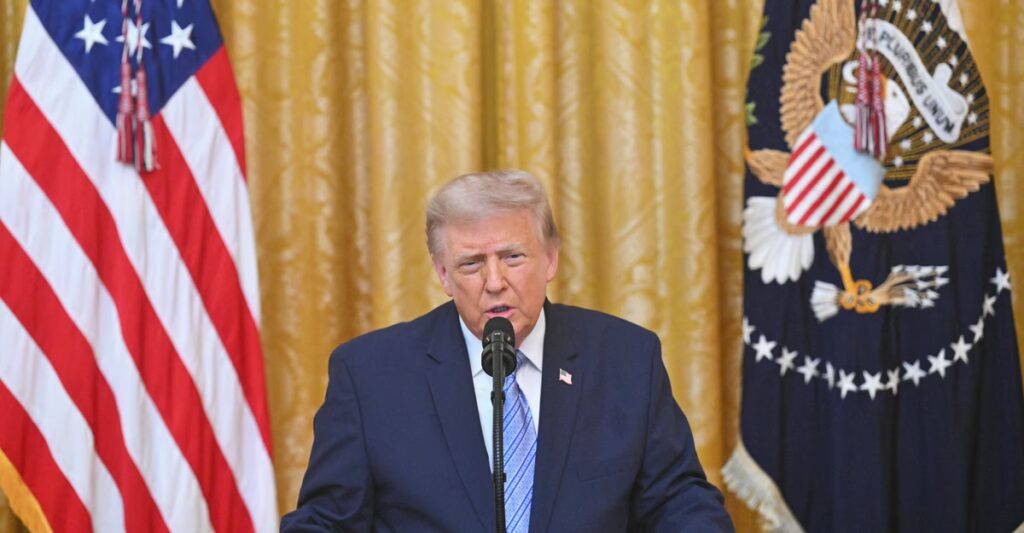
President Trump addressed the American people tonight and told them that their elections are at the mercy of foreign actors—especially China. He called the current situation a “crisis” and vowed to prevent any future elections from being “stolen.” He directed the public to a website where people can peruse documents that he says prove not only that bad actors have influenced U.S. elections, but that all of this was kept from him by “deep state” malefactors during his first term.
Foreign powers do, in fact, try to influence American elections, but that was about all that the president—who seems shocked that other nations have preferences about who wins elected office in the United States—got right. The rest was a mishmash: Much of the previously classified material that Trump just splattered on the internet does not support his accusations, and in some cases, these declassified documents actually undermine and refute his charges.
Trump’s speech tonight rested on a few solid facts submerged in wild, and even somewhat paranoid, extrapolations. It’s true that bad actors have accessed basic data about the names and addresses of voters in several states. It’s also true that China has some pretty strong views about Trump and probably didn’t want him to be reelected in 2020. (The Chinese wanted him out because, Trump said, “I was wise to them,” which does not explain how he was nonetheless hoodwinked.)
From there, however, we slip the surly bonds of Earth and head into the dark and cold of the space of conspiracy theories. Trump strongly implied that in 2018, China was on the attack and trying to influence the outcome of the 2020 election, and that American intelligence operatives plotted to keep that from him while he was in the Oval Office. He said that attempts to rectify all of this have fallen “catastrophically short” but that he will take “swift” action in the coming days.
The documents he offered tonight, though, tell a different story—so different that they raise the question of whether Trump, or anyone else in the White House, actually read them.
For example, one of the memos from the National Intelligence Council (the analytical group within the Office of the Director of National Intelligence) said in 2020 that the group in charge of cyber-issues and threats to U.S. elections “assesses that Beijing has taken at least some low-level, exploratory steps to undermine the President’s reelection chances by denigrating him and shaping voter perceptions.”
That sounds pretty bad. Except that (as often happens in the intelligence community) this group was representing a minority view, as it says in the very next sentence: “Their assessment differs from the IC’s judgment that Beijing has considered but not deployed influence efforts to affect the Presidential election.”
So, which is it? The IC (shorthand for intelligence community) seems to have reached a pretty firm judgment in these documents: “The IC,” one of the memos says (with some passages redacted)
has seen no evidence that Beijing is engaged in an effort to influence the outcome of the presidential election, nor has it observed activity that it assesses is likely the result of such an effort by Beijing. While we have seen Beijing develop other options that could be used to influence the election, we have not seen these capabilities deployed.
Note that what these documents discuss are influence operations—propaganda, proxies who speak for foreign interests, fake stories, and so on—rather than interference, which would involve actual manipulation of data or sabotaging of electoral infrastructure. These classified revelations, despite Trump’s assertions, show that the intelligence community didn’t even agree that China was fully engaged even in these more limited influence operations.
One document says, with more firmness, that the Chinese were attempting to undermine Trump’s chances, and to pressure business partners into withdrawing support for the president’s reelection. This is perfectly plausible behavior from a U.S. adversary. Of course, Trump skipped over the part about other nations, including one where “senior officials” and their leader were seeking to “covertly influence US politicians’ and political candidates’ thinking” about the election.
That nation? Turkey.
On one point, however, the declassified reports are clear. One country, more than any other, actively engaged in operations against the 2020 elections: Russia. And the Russians had a clear preference:
We assess that Russia is using a range of measures to denigrate former Vice President Biden and what it sees as an anti-Russia establishment. For example, it is directing or encouraging proxies to spread claims about Vice President Biden. Some Kremlin-linked actors are also seeking to boost President Trump’s candidacy on social media.
This isn’t news, but Trump carefully cherry-picked his way around it. In charts provided by the White House itself that compare Russia, China, and Iran, only Russia is judged to be actively involved in such efforts.
Trump not only ignored these multiple (and much more categorical judgments), he interpreted the normal in-house fighting that goes on every day in the intelligence community as evidence of some sort of plot against him. He made much of a comment in a group email—these conspirators were pretty relaxed about sending their nefarious ideas around to everyone—about “massaging” the President’s Daily Brief to take out references to the 2020 election. But the conversation was clearly about which product would include such issues, and how strongly the minority view would be stated. Like so much else in the speech and the documents, Trump threw everything he could find at the wall and in the hope that some of it would stick.
So what, then, was the point of Trump’s speech? First, he is almost certainly trying to soothe his wounded ego over the 2020 election. He is clearly obsessed with his loss to Biden and wants to blame it on foreign manipulation. But Trump might also have a darker motive, attacking the integrity of American elections because he wants to delegitimize the coming midterms—and perhaps even create the predicate for interfering in them.
The Chinese, the Russians, the Iranians, the North Koreans, and many other enemies of the United States clearly hope to undermine the faith of every American citizen in their own elections. But no regime, no spies, no saboteurs have yet matched the damage that America’s own president did tonight.
The post Trump Just Did More Damage to Elections Than China appeared first on The Atlantic.