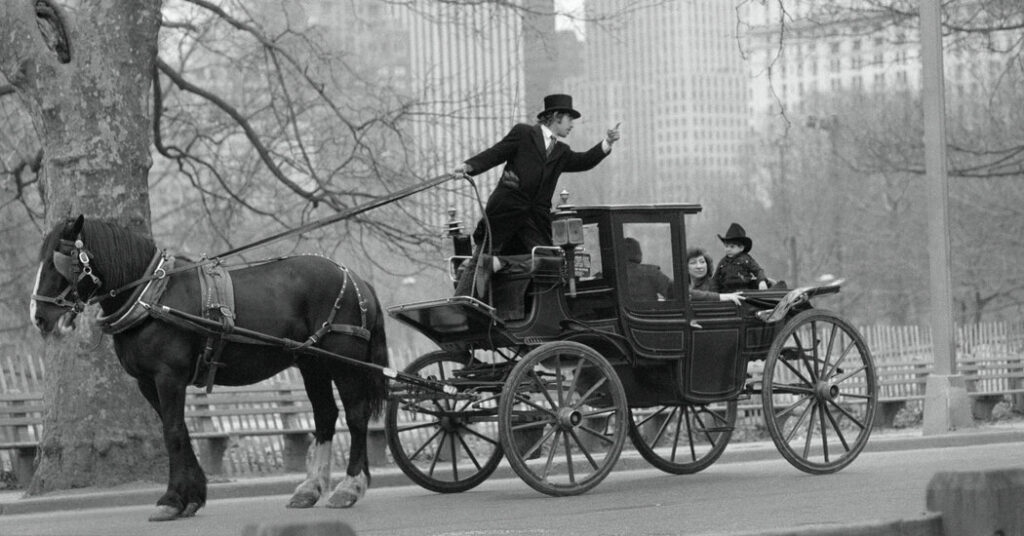
New York’s City Council seemed poised to finally ban carriage horses from Central Park this week, with a strong push from the Council speaker and conditional support from the mayor. If the ban goes through, it will be the end of an era.
That era, of course, is the era of battles over carriage horses in Central Park.
Almost from the day the first ones appeared in the 1860s, critics have sought to ban or regulate them. The American Society for the Prevention of Cruelty to Animals, or A.S.P.C.A., was formed in 1866 after its founder witnessed the mistreatment of a New York carriage horse. Its inaugural seal, which now adorns the founder’s grave at Green-Wood Cemetery in Brooklyn, shows a sword-wielding angel protecting a cart horse from its abusive driver.
Yet for all the controversies around them, the horses and their carriages have remained a part of the iconography of New York — at least in the imagination of tourists, who plop down a city-regulated $72.22 for a 20-minute ride.
After all, what is New York — the imagined New York, that is — if not the romantic wonderland where Robert Redford and Jane Fonda ride a horse-drawn carriage in the opening scene of “Barefoot in the Park”? Or where Alec Baldwin’s character takes his mother for a carriage ride in “30 Rock”? Never mind that the mother, played by Elaine Stritch, dies of a heart attack on the journey, or that the real-life Alec Baldwin declared carriages to be “rolling torture wagons for nature’s most dignified creature.”
Something about horse-drawn carriages inspires people to seek an “authentic” New York experience by engaging in a patently inauthentic one.
Horses were the original mode of transportation in the city, the drivers of industry. They pulled buses and streetcars and hauled building supplies for a growing metropolis. And by 1863 they were pulling leisure rides in Central Park. By the late 19th century, their manure alone — an estimated 100,000 tons a year — filled vacant lots, in piles of up to 40 or 60 feet high. They died in numbers as high as 15,000 a year, their bodies sometimes sitting on the streets for days or weeks. The city created the Department of Sanitation in part to handle all the carcasses.
By the 1870s, New Yorkers had named a small inlet in southern Brooklyn Dead Horse Bay for all the bodies dumped there by the nearby horse rendering plants. (The area is now closed to the public because of high radiation levels — presumably unrelated.)
When gas-powered automobiles began to proliferate in the city in the 1900s, they were welcomed as a less-polluting alternative to horses. They also spurred calls to ban horses from city streets, for the safety of both people and horses.
Yet the horses remained. In the 1930s, they were still the preferred engines for many milk deliveries and other short hauls. A 1931 census estimate put their local population at 22,156 and holding steady.
Animal welfare advocates, including the A.S.P.C.A., established street-side fountains and troughs for the horses to drink from. By midcentury, the organization maintained 43 troughs and even had a designated inspector, John Gauci, whose work afforded a unique perspective on city neighborhoods. Residents on the East Side, he told The New York Times in 1946, used the troughs to do their laundry, leaving a sudsy mess for the horses; in Lower Manhattan, near the fish market, “down-and-outers” used the troughs to wash stolen fish, often leaving a dead fish or two behind. Cigarette smokers and illegal-parkers, then as now, were a blight on the city’s amenities.
But you can’t fight the automobile. Once-essential work horses — predecessors to those supersized Amazon cargo bikes? — faded from city streets, leaving only carriage horses carting tourists on quaintly anachronistic strolls, an industry that peaked in the late 1970s and ’80s.
As concern for the horses took hold among New Yorkers, few of whom actually rode the carriages, the city mandated that the horses get five weeks of vacation a year. It also required them to wear diapers, or “bun bags.” Last year, The New York Post reported that carriage drivers sometimes used the diapers themselves, citing a shortage of open bathrooms or hitching posts.
On Wednesday, at a marathon City Council meeting about the proposal to ban horse-drawn carriages, impassioned voices argued on both sides, including carriage drivers and the parents of Romanch Mahajan, a visitor from India who died trying to save his mother after she was thrown from a runaway carriage.
“For us, every night is a nightmare,” the young man’s father, Deepak Mahajan, testified by video call from India. “We close our eyes and we relive that carriage ride — the screams, the helplessness and the moment our son’s life ended before ours.”
The meeting lasted more than nine hours.
If the Council passes the legislation, now known as Romanch’s Law, it will go into effect in June 2028, ending 165 years of carriage horses in Central Park.
But for the horses, this week was relatively chill, thanks to the heat. By city ordinance, they do not work when the temperature hits 90.
The post Is New York’s Love-Hate Relationship With Horse Carriages Over at Last? appeared first on New York Times.