A coalition of billionaires who could have to pay a proposed wealth tax in California has made its most significant move so far to undermine such a tax: It has reserved nearly $87 million of advertising time across the state to air TV commercials.
The ads, which will begin airing next month, are the opening salvo in what is expected to be an expensive fight that has already riven Silicon Valley and state politics.
A measure on the November ballot, Proposition 40, would assess a one-time tax on California residents with a net worth of at least $1 billion. The specter of the tax has already caused some of California’s wealthiest individuals to flee the state or to spend money on California political campaigns like never before.
Rather than directly oppose the initiative, the billionaire-backed coalition, Building A Better California, has gotten two of its own tax-related measures onto the ballot. Those measures contain provisions that could invalidate the billionaire tax if one of them also passes.
The filings that disclose the advertising plans by Building A Better California do not specify which measures the ads will be about.
“Our coalition is committed to ensuring that all California voters are informed about policies that impact our state’s future and economy,” Abby Lunardini, a spokeswoman for the group, said in a statement. “The measures we support provide important and common-sense protections designed to improve state accountability and governance and protect California families from new taxes on their retirement and savings.”
Ms. Lunardini declined to say whether her group’s ad campaign would be on those two measures, or instead more specifically on encouraging Californians to oppose the proposed wealth tax.
Building a Better California is backing Proposition 41, which would require audits of programs funded by new taxes, and Proposition 42, which would prohibit new taxes on personal property and financial assets. If both the billionaire tax and a countermeasure pass, the one that garners the most “yes” votes would prevail.
The group’s ads are expected to begin next month and will reach about $53 million in September, according to data from AdImpact. The final size of the ad campaign is likely to be much larger than the $86.9 million reserved so far, since the current buy includes only $3.7 million worth of ads in October, typically the heaviest month for political advertising.
The Google co-founder Sergey Brin has put some $82 million into the committee, according to state records, and has emerged as the leader of the pushback effort, recruiting other Silicon Valley personalities to join his coalition. Other major donors include the tech investors John Doerr and Michael Moritz.
The fight over California’s wealth tax proposal is likely to become one of the most expensive campaigns in a state with a history of costly ballot measures. In 2022, gambling interests spent more than $400 million dueling over a pair of measures that sought to allow sports betting in California. In 2020, ride-hailing apps poured more than $200 million into a ballot measure to classify drivers as independent contractors instead of employees.
It has become common in California for opponents of a measure to back a conflicting proposal on the same ballot. The tactic can help defeat a measure simply by creating confusion among voters.
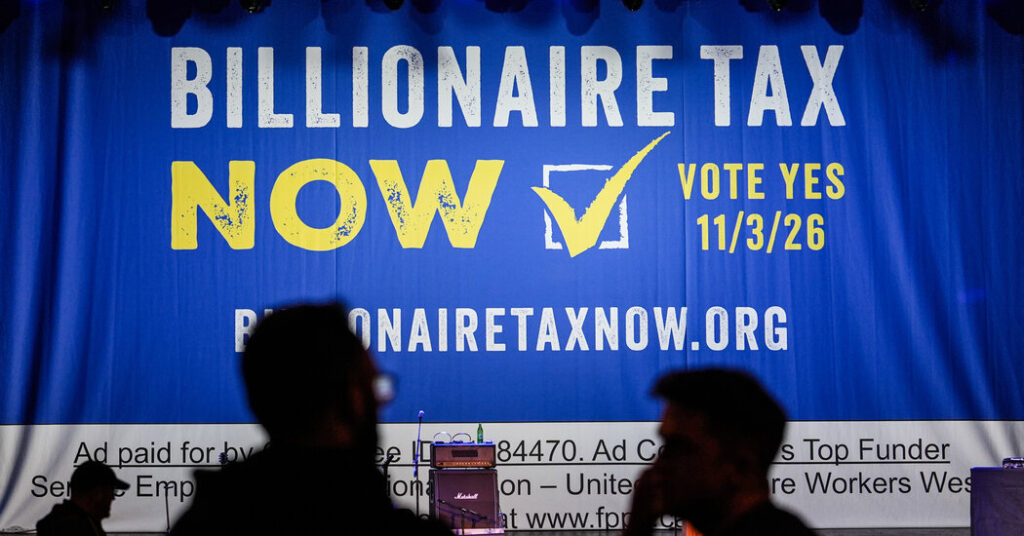
The billionaire tax is sponsored by the Service Employees International Union-United Healthcare Workers West, which spent $31 million to get the measure on the November ballot. The union represents some 120,000 hospital workers who argue that the tax is necessary to offset health care cuts that President Trump signed into law last year.
The measure would require the state to spend 90 percent of the revenue from the billionaire tax on health care. It has attracted support from Senator Bernie Sanders of Vermont, who hailed it as a way for California voters to show billionaires “that we are still living in a democratic society where the people have some power.”
The tax would most likely generate tens of billions of dollars over several years, according to an analysis by California’s nonpartisan legislative analyst. But the analysis found that it could also lead to long-term declines of hundreds of millions of dollars in annual income tax payments from billionaires who leave the state.
Gov. Gavin Newsom says the billionaire tax threatens California’s innovation economy and could cause long-term harm to the state budget.
Numerous other labor unions and groups that lobby for a share of the state budget have also come out against the billionaire tax, arguing that the one-time windfall it would create is not worth the long-term risk to state finances.
The post Billionaires Prepare $87 Million Ad Campaign to Block California Wealth Tax appeared first on New York Times.