For almost two decades, French firefighting pilot Alexandre Jauffret’s routes were mostly contained to the hottest part of mainland France, the area around its southeastern coastline. He generally used his plane to scoop water from the Mediterranean Sea, or rivers and lakes nearby, and dump it on wildfires a short flight from the coast.
Not any more.
This week, he led his squadron of firefighting planes to take water from the Seine River in northern France and drop it on blazes in the forests of Fontainebleau, roughly 30 miles from the French capital.
“We never expected this,” said Mr. Jauffret, 59, a former military pilot who transitioned from fighting wars to fighting fires in 2007. “Before, it was the south that was burning. Now, it’s the whole of France that is burning, or could burn.”
The changes to Mr. Jauffret’s flight patterns reflect the fingerprints of climate change on firefighting in Europe. The continent is warming at more than twice the global average. In France, that has turbocharged the fire season, stretching it into spring and fall, and led to fires in regions of the country that historically were considered wet and lush.
By mid-July, during the country’s third heat-wave of the summer, almost 11,000 fires had already burst across the parched country, devouring nearly 90,000 acres. That was more than burned throughout the entirety of last summer.
More than 900 firefighters, backed up by planes and helicopters, were sent to tackle two blazes in the Fontainebleau forest, just outside Paris. The last time the forest there burned so furiously, Juliette Faivre, the lead government forester in the region, said in a question-and-answer interview with Le Monde, was in 1945, when German occupiers “started fires to flush out the Resistance fighters.”
“We have never seen such a fire,” said President Emmanuel Macron on Thursday, visiting the still-burning forest to thank the firefighters.
“The country has never been confronted with so many episodes, pressures, and fires, all over the territory,” he added.
For decades, France has prided itself on its unique, pre-emptive military-style firefighting strategy that has proved highly successful. It slashed the number of hectares burned each summer by almost three-quarters and largely spared the country from catastrophic blazes that have consumed its neighbors in Italy and Spain.
Now, climate change is forcing the French government to make changes to what was previously a winning strategy.
Over the past four years, it has bought hundreds more fire trucks; ordered four more planes, known as Canadairs, to boost its existing fleet of 12; and introduced a new firefighting military regiment in the country’s southwest, with 600 specialized firefighters. It has also updated its 32-year-old fire defense strategy, acknowledging that it now needs to do even more to pre-empt the fires before they start, and to redesign the landscape to make it harder for fires to spread.
The solution no longer lies only in mobilizing more planes and more firefighters, said Fabrice Chassagne, a senior French firefighting official who helped write the country’s new firefighting strategy.
“It lies in prevention,” he said.
How France Fights Forest Fires
Instead of waiting for fires to break out, France has for decades sent out patrol planes, loaded with retardant, and firefighters with water cannons into the forests deemed at high risk of fire. If a fire does ignite, say from a still smoldering cigarette butt, the goal is to attack it within 10 minutes or before it engulfs more than a few hectares. (Ninety percent of forest fires in France are caused by humans, most by accident, according to government data.)
“The objective is to prevent a small fire that we can easily put out from becoming a large, out-of-control wildfire,” said Julien Marion, general manager of the country’s civil security service, whose duties includes firefighting.
“It’s very easy to put out a fire right as it starts,” he said. “After 10 minutes, it’s much more difficult. After an hour, it’s much, much, much more difficult.”
While much of the strategy was already in place by the 1980s, it was formalized after two devastating summers in 1989 and 1990, when fires engulfed many regions in southern France.
By 2019, the damage caused by the country’s summer fire seasons had dropped from an average of roughly 115,000 burned acres to roughly 28,000, according to a 2019 French Senate report. Between 1980 and 2023, the annual amount of burned hectares in France was, on average, four times less than in Italy and more than six times less than in Spain, according to a French government report.
“We only hear about our defeats, because when we talk about forest fires in France, it’s the ones that got big,” said Jean-Marc Bedogni, director of France’s agency for wildfire prevention and training. “But 95 percent of fires are detected early and remain under five hectares.”
That strategy is implemented from a bunker-like building in an old military base near Nîmes, in southern France. During fire season, Thierry Carret, France’s director for forest fire operations, hosts a meeting there every morning and evening with the country’s top fire commanders, who call in from across the country.
Meteorologists trained in fire prediction pore over maps that divide the country into 255 zones, assessing which are most at risk of fires that day. The regions most at risk have higher temperatures, stronger winds and lower humidity.
Once those regions are identified, planes, loaded with fire retardant, are deployed to patrol the skies over the high-risk areas. On the ground, fire captains send firefighters there too.
If the risk is deemed high enough, Mr. Carret calls for reinforcements from firefighters from other regions — even if there’s no fire yet detected.
In some fire-prone southern regions, commanders double the number of firefighters deployed on the ground.
Unlike other parts of the world — Canada, for instance, where fires are raging this week — much of the forested countryside in Europe is densely populated. “That means we have to put out fires. Otherwise they will immediately hit homes,” said Éric Florès, vice-president of France’s 285,000-member firefighters’ union, who helped with firefighting in Canada in 2022.
When firefighters cannot immediately contain a fire, the commanders send in reinforcements on the ground, along with a second wave of planes.
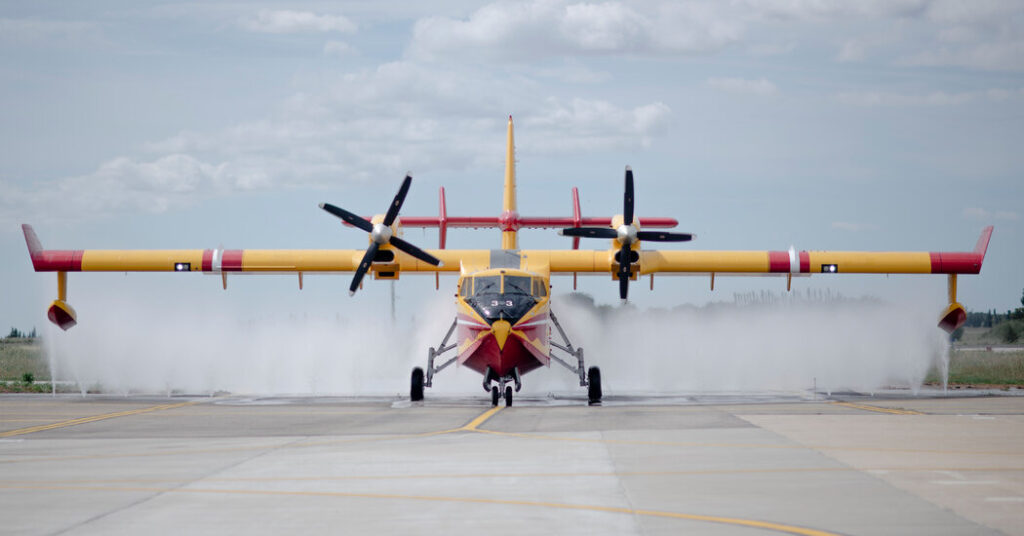
Those include the Canadair planes, which can scoop eight tons of water from rivers, lakes or the Mediterranean in 12 seconds and then drop it on a fire. On big fires, the pilots work in groups, dropping water in tight formation every 15 seconds.
How the Strategy Changed
The wake-up call came in 2022. That year, the number of fires doubled, half of them in the country’s traditionally lush north. For the first time, the leader of the Dash pilots, Benoît Quennepoix, found himself all the way up in Brittany, in the country’s northwest.
“That was something we never thought we’d be doing,” said Mr. Quennepoix, who has flown firefighting planes for 20 years. He saw fires “popping up everywhere, just like the massive days down in the southeast,” he said. “It was pretty shocking.”
Mr. Macron labeled it a “season of hell” and a harbinger of climate change. He pledged 250 million euros, or roughly $285 million, for more fire trucks, aircraft and firefighters.
His administration also more than tripled the number of regions to be monitored for fires, including the entire west of the country.
The French weather service increased its fire forecasters fivefold. Seasoned firefighting veterans were sent up to the north to help develop the fire fighting infrastructure and action plans that were set up decades ago in the south. The national forest firefighting school doubled the number of senior officers it trained annually, according to Mr. Bedogni. And many fire and rescue services installed cameras that use artificial intelligence to detect fires faster than human lookouts.
Last year, the government also released a new forest fire strategy that calls for landscape management to create physical breaks in forests and pastures, so fires will run out of fuel.
As fire prone areas have expanded, so have local rules. Property owners are now required to clear vegetation within 50 meters, or 164 feet of their property, including Fontainebleau.
“We will need more planes, more aerial resources to fight wildfires, probably more ground firefighters as well, more trucks,” said Mr. Marion. “But that won’t be enough.”
Ana Castelain contributed reporting from Paris.
The post As Blazes Spread Near Paris, Extreme Heat Is Changing How France Fights Fires appeared first on New York Times.