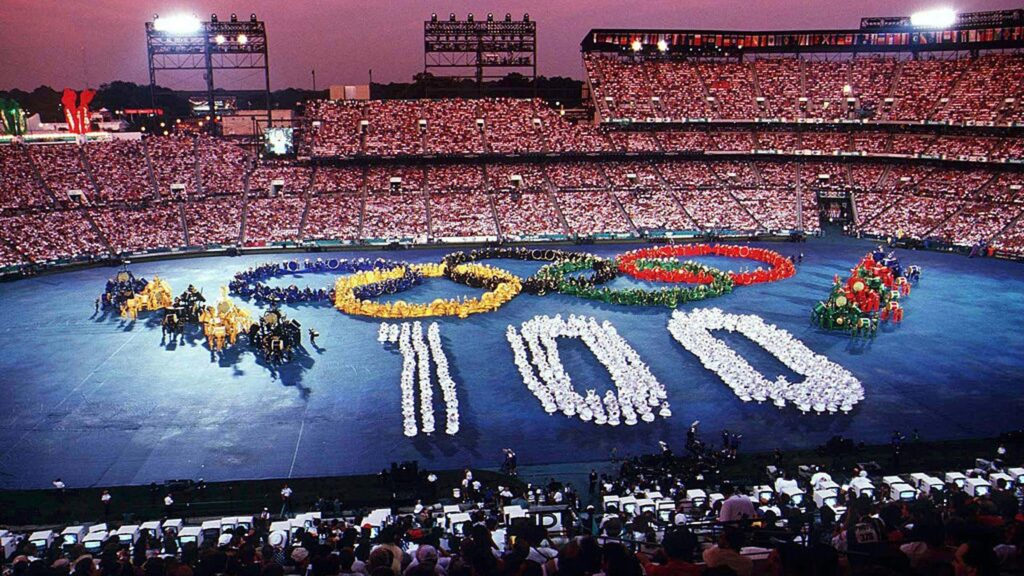
I remember watching Michael Johnson sprint around the track in Atlanta, his gold chain swinging with every stride and his gold shoes flashing under the stadium lights. To a young viewer, he seemed almost larger than life, gliding around the oval with a confidence that made the impossible look effortless. Like millions of Americans, I watched the 1996 Olympics believing I was witnessing not just extraordinary athletic achievement, but a defining moment for a city on the rise.
Thirty years later, I still remember Johnson’s race. What I understand differently is the city that surrounded it.
In the summer of 1996, Atlanta introduced itself to the world as the capital of the New South: modern, diverse, ambitious, and ready to compete with the world’s great cities. By many measures, the Olympics were exactly the success Atlanta’s leaders envisioned.
The Games accelerated investment in downtown, expanded infrastructure, attracted businesses, strengthened tourism, and elevated Atlanta’s international profile. In the decades that followed, the region became one of the fastest-growing metropolitan areas in America. It emerged as a center for film production, technology, logistics, higher education, and Black entrepreneurship. Atlanta solidified its reputation as the nation’s Black cultural capital, home to thriving historically Black colleges and universities, Fortune 500 companies, influential churches, artists, filmmakers, and political leaders.
The Olympics made Atlanta bigger. But they did not make it more equitable. That contradiction has become one of the defining stories of modern Atlanta.
Long before the opening ceremony, the city was transforming itself for a global audience. Entire neighborhoods were redeveloped. Public housing projects were demolished or fundamentally reshaped. Tens of thousands of residents were displaced in the years surrounding the Games, many of them poor and disproportionately Black. The city also intensified efforts to remove homelessness from public view, seeking to present visitors with an image of prosperity and order.
These decisions were not unique to Atlanta. Cities around the world have often used mega-events as catalysts for redevelopment. But in Atlanta, the costs fell heavily on communities that had already spent generations navigating segregation, urban renewal, highway construction, and discriminatory housing policies.
The Olympics did not create these inequalities. They accelerated them. The pattern that emerged has since become familiar across America. Public investment attracts private capital. Property values rise. New restaurants, apartments, offices, and entertainment districts follow. Longtime residents, many of whom endured years of neglect before redevelopment became profitable, suddenly find themselves priced out of the neighborhoods they helped sustain.
Atlanta became wealthier. Many Atlantans did not. Nowhere is this tension more apparent than in the city’s changing demographics. Neighborhoods that were once predominantly Black have experienced rapid gentrification. Some have gained grocery stores, parks, trails, and new investment. They have also lost many of the families who gave those communities their identity.
The question is not whether Atlanta improved. It clearly did. The question is: improved for whom?
That question deserves particular attention because Atlanta occupies a unique place in the American imagination.
For generations, it has represented possibility for Black Americans. It became the headquarters of the modern civil rights movement. It nurtured generations of Black political leadership. It offered opportunities unavailable in many other major cities. Its universities educated national leaders. Its churches shaped public life. Its businesses helped build one of the largest Black middle classes in the country.
That legacy remains real. So does another. The same city celebrated as a Black Mecca has also witnessed widening inequality, rising housing costs, and the displacement of many Black residents from neighborhoods their families called home for decades.
Both stories are true. One does not erase the other. Three decades since the Olympics, Atlanta offers an important lesson for cities preparing to host major international events or pursue large-scale redevelopment projects.
Growth, by itself, is not the same as shared prosperity. A city can become more famous without becoming more affordable.
It can attract billions of dollars in investment while longtime residents struggle to remain. It can build world-class stadiums, parks, and entertainment districts while leaving many of the people who built the city wondering whether there is still a place for them.
Let me be clear: Atlanta’s experience should not be viewed as a reason to reject growth. Cities need investment. Infrastructure matters. Economic development creates opportunities that benefit entire regions.
But growth should not be measured only by skylines, corporate headquarters, or international rankings. It should also be measured by whether teachers, nurses, sanitation workers, retirees, and families who have lived in a neighborhood for generations can still afford to call that neighborhood home.
Thirty years later, Atlanta stands as one of America’s great success stories. It is more globally connected than anyone could have imagined in 1996.
Yet the anniversary of the Olympic Games should invite more than celebration. It should also invite reflection. The greatest legacy of the Olympics was not simply the stadiums they left behind or the tourists they attracted. It was the model of urban transformation they accelerated.
As Los Angeles prepares to host the 2028 Olympics, and as cities across America compete for major events, technology campuses, sports franchises, and billion-dollar redevelopment projects, Atlanta reminds us that success should not be judged solely by what gets built. It should also be judged by who gets to stay.
The Olympics made Atlanta bigger. The next generation of civic leadership should make it more equitable.
The post 30 Years Later: The 1996 Olympics Made Atlanta Bigger, But Not More Equitable appeared first on TIME.