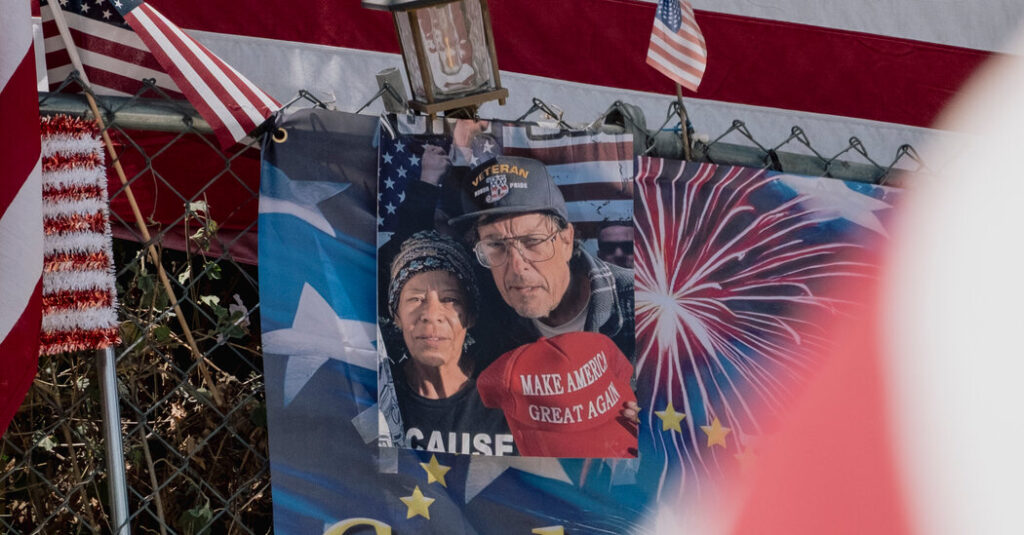
The show of political preference cropped up outside a modest terra-cotta home a few years ago, a spectacle of American flags, banners and flowers in veneration of Donald Trump.
Residents of Escondido, Calif., could not miss the plethora of unfurled flags tethered to the home’s fence, some oversized and perched along its rail, their staffs rising high. Alongside them were placards with brazen declarations, such as “Open Border Welcomes Death and Destruction to America.”
Situated on Mission Avenue, a corridor of north San Diego County, the display had a daily audience within a sea of swift-moving traffic.
The longtime owners of the home were Kerry Sheron and his wife, Maria Garcia. During rush hour, they could be found outside waving and nodding to those who passed.
Most drivers hurtled on by, but those who engaged reflected a city whose politics tend to be divided down the middle. A typical day yielded honks of approval as well as shouts of profanity and disgust.
Mr. Sheron paid little mind to the latter. His décor was brash, but he had a reputation for being uninterested in confrontation, saying things like “God bless you” if someone agitated for a lengthier dispute.
At 69 years old, Mr. Sheron was an Army veteran who worked as a cook at a senior living center in town. Neighbors knew him to be affable and generous with the kitchen’s leftovers, knocking on doors to offer up packages of cookies, often with a Bud Light in his hand.
A bout with bone marrow cancer had weakened him in recent years, but Mr. Sheron continued to make appearances beside the bustling street, his thin frame folded into a chair, a MAGA hat on his head. He enjoyed when neighbors or friends stopped by and was especially pleased when a stranger wanted to meet him.
“I used to honk, but one day I just decided to pull over and stop and talk to him,” recalled Gwen Vodang, 51, a Marine veteran who lives in Escondido. “He was the friendliest guy, so personal. He loved to talk and chitchat, to know about you. Since then, I stopped and talked many times.”
Mr. Sheron, however, was far from a public figure. While most across the city knew of his house, only a small circle had heard his name.
That would change in late May when it suddenly rippled across news outlets nationwide.
Mr. Sheron had been violently attacked outside his home and was in critical condition. Footage from a neighbor’s security camera appeared to show the assailant — a man who had struggled with mental illness — stomping on his head until a bystander intervened. Mr. Sheron’s limp body lay prone on the pavement. He would die four days later.
President Trump has stirred a passion in his supporters that manifests in unprecedented ways. The rallies that resemble religious revivals, the ubiquitous red MAGA hats, the hundreds of millions of dollars spent on branded memecoins and crypto. Even the once-standard yard sign in support of a politician has been taken to new levels in his honor.
The grand gestures have included a residence in Pennsylvania painted entirely in red, white and blue; a 16-foot “T” erected on a Staten Island lawn; a luxury Florida beach home adorned with huge pro-Trump banners. More common are the rustic homages — the ones festooned with an excess of flags, handwritten signs and yard ornaments.
These so-called “Trump houses” scream to be seen as they transform the notion of home as a private domain into an exhibit of pride and provocation. The owners become objects of curiosity, both embraced and dismissed as caricatures. They are also possible targets for a different kind of attention.
Mr. Sheron and Ms. Garcia bought their three-bedroom home in 2009, using part of their retirement savings for the down payment. Both were staunch Republicans, but they kept a low profile until their fervor for politics was sparked by the 2020 presidential election. They believed it had been rigged. The documentary “2000 Mules,” which made false claims about ballot trafficking, fueled their conspiracy theories. So did the Justice Department’s investigation into Mr. Trump’s Mar-a-Lago property.
A family that lived cater-corner from them had a yard blanketed with whimsical, America-inspired trinkets. But Mr. Sheron and Ms. Garcia wanted to express their support on a more imposing scale.
Up went the flags, the banners, the images of Mr. Trump. They racked up piles of cardboard, inscribing on them contentious messages. “Illegals Are Paid to Invade America.” “Biden is a dirty rat.” “Wake Up No Mask!” At night, strings of lights cast a glow across it all.
They heard few complaints from within their neighborhood, which is mostly working class and conservative. Some people confided that they wished they had the courage to do the same.
“Kerry told me his house has been vandalized 30 times,” said their neighbor Scott Angeli, 62. “He had his truck window smashed out, he’s had all his flags ripped down. And yet he still just kept putting them out.”
Mr. Sheron believed deeply in freedom of speech, but he also sought the limelight. He published photos and videos of his display on social media. “I think I’m up to 90 for the amount of flags,” he can be heard saying on a 2023 Facebook video as he pans across his home. “We all know Trump won; the Democrats are such crooks. This is my house. We’re out here every day spreading the word.”
He liked hearing his place used as a point of reference. It would be a dream, he told people, to be interviewed about it by a news station. “One day Donnie is going to come by and tell me, ‘Good job,’” he would joke, as if he and Mr. Trump were tight.
His sister, Lyle Schreiber, said he had brought up the notion during a recent phone conversation. “He said, ‘You know, if Trump could see my house and see me on TV, he could see how strongly we feel,’” she said. “He was so proud of what he was portraying.”
Mr. Sheron was raised with three siblings in Southbury, Conn., a rural town and Republican stronghold at the time. His mother, Georgia, was a well-known photographer, while his father, Robert, was a project manager for a pool company.
After high school, Mr. Sheron took culinary classes, and then joined the Army in 1977. He spent most of his service as a cook and was stationed in Germany for a couple of years, according to military records. After his discharge in 1983, he decided to head to Southern California with childhood friends, shipping out his Suzuki GS1100 motorcycle first.
Bouncing around San Diego County, Mr. Sheron primarily worked as a cook and spent decades in the kitchens of retirement communities. Co-workers saw him as quirky and loquacious with a dry sense of humor. Residents adored his homemade spaghetti sauce and bread pudding and how he would make sure to ask them about their meals afterward.
“He loved the feedback, he just cared to make sure his food was good no matter what,” said Dylan Bower, his boss at Escondido Senior Living.
The job sometimes took a toll. Mr. Sheron struggled when residents died.
“He had a huge heart,” said his friend Michael Mason, 57, who grew up with Mr. Sheron and also relocated to Escondido.
In his free time, Mr. Sheron volunteered at fish fries with the Knights of Columbus and helped build homes for Habitat for Humanity. He also liked to tinker with his blue 1965 Ford Falcon and participate in classic car events.
He met Ms. Garcia when he was in his 40s and she was cleaning rooms at a retirement community in Encinitas. She had four children from a previous marriage and was unsure about a new relationship. But Mr. Sheron wooed her with what she saw as a surprising tenderness, bringing her soup when she was sick and comforting her when her mother died. Once, Mr. Sheron celebrated every day of her birthday month, leaving her little gifts of chocolate, earrings, a watch.
“He loved me a lot,” Ms. Garcia recalled.
Born in Mexico, Ms. Garcia had arrived in the United States as a young woman and was still struggling to master English. She and Mr. Sheron muddled through the language barrier and married in 2006. They liked to go to the casino and the swap meet and take walks with their dogs.
Ms. Garcia worked for a while in a variety of jobs, doing traffic control, laying concrete and landscaping, until she was sidelined with a leg injury. She helped care for her husband as he battled cancer before he returned to work last winter.
“My husband was a good man,” she said.
On May 20, just after 2 p.m., police officers responded to a report of an assault at the corner of Mission Avenue and Buchanan Street. By the driveway of his home, Mr. Sheron’s body lay motionless, his eyes swollen shut.
A suspect matching the assailant’s description was found nearby. His name was Thomas Butler, and he was a 32-year-old veteran of the Navy. Ms. Garcia would later tell The New York Times that she recognized him as someone she had spoken with a couple of months earlier outside her home. She recalled he had been holding an anti-Trump sign. Mr. Butler pleaded not guilty to an initial charge of attempted murder.
It was easy to imagine a political motivation. But the authorities focused on the fateful punch of the attacker and did not speculate on what led up to it. Mr. Butler also appeared to be a troubled individual.
Raised in upstate New York, he had enlisted in the Navy in 2011 and went on to become an information systems technician, earning multiple awards and achievements, including qualifying as a surface warfare specialist, according to military records. He left in 2023.
Last year, Mr. Butler’s wife, Breanna Butler, requested temporary full custody of their 20-month-old daughter, court filings show. “Thomas has been diagnosed through the V.A. with depression and PTSD,” she wrote. “He has not stayed with our child overnight since she was born due to lack of mental stability and patience issues.”
Ms. Butler added that her husband was on medication and that he had become physically violent toward himself and others, and referred to two incidents of domestic violence. She noted that police had been called for a wellness check on him at least twice and that Mr. Butler had been placed on an involuntary psychiatric hold last year. She declined to comment to The Times.
According to state records, Mr. Butler had been registered as a Republican in New York. Records from the San Diego County Registrar of Voters show that Mr. Butler registered as a Democrat in 2023. He requested an absentee ballot for the 2024 presidential primary election, although did not end up voting. He did vote in the general election later that year.
In June, a hearing in the murder trial was canceled after Mr. Butler refused to leave his jail cell to appear in court. A judge later ordered him to be evaluated by a doctor and scheduled a hearing to determine whether Mr. Butler was competent to stand trial. He is represented by the public defender’s office, which did not respond to a request for comment from The Times.
The paused proceedings and an uncertainty about Mr. Butler’s politics have perhaps softened what might have been a more widespread fury around the case. But time has allowed for something else.
A throng of Mr. Sheron’s friends and neighbors and newfound acquaintances have taken care to embrace Ms. Garcia, arriving daily to offer food, to clean her garage, to stand beside her as she continues to hoist Trump signs.
Her supporters are, of course, upset, holding rallies and fund-raisers and demanding justice. But even Ms. Garcia said she could not help but have some compassion for Mr. Butler.
In death, the nuances of Mr. Sheron’s life have surfaced to the wider public. He was, in fact, not as one-sided as his house.
“He was a patriot first — I mean, he was a Trump supporter, but he didn’t believe in all of the policies that Trump had,” said Mr. Sheron’s friend Jim Gillie.
“He had a Mexican flag out here for a while. He’s like, ‘You know, I’m not so sure that I like the way immigration is coming in and disrupting things.’”
Up close, Mr. Sheron did not feel the need to proselytize. “He was just a friend, he would talk about family and cars and ask how we were doing,” said Daisy Morales, 43, who is politically on the fence, but grew close with him and Ms. Garcia.
And although he felt that President Trump was doing good things for the country, Mr. Sheron sometimes questioned the leader’s moral character and communication skills, said his neighbor Steve Bridwell, a retired minister.
Mr. Bridwell, 76, lived two houses down and was a rare Democrat in the area, baffling those around him with his Kamala Harris and No Kings signs. At one point, he wrote weekly letters to his congressman, each time inviting him to be prepared to impeach President Trump.
Mr. Bridwell decided to introduce himself to Mr. Sheron a few years ago, and the two forged an unlikely connection.
“I discovered he was someone who was very willing to talk and very open about his opinions without being strident about them,” he said. “Some of the people that I am closest to, I think, were somewhat taken aback that Kerry was not the terrible, awful ogre that they assumed he was.”
Since his death, those who knew Mr. Sheron have grown accustomed to talking about him to the public, wanting to ensure that his contributions are made known. They have done so with a regretful recognition of what it all means — that the news spotlight Mr. Sheron hoped would one day shine on his home came only after he was killed beside it.
The post The Army Veteran Killed Outside His ‘Trump House’ appeared first on New York Times.