Recently, I received a strange text from a new acquaintance. “You have your own biography???” it read. “How did you neglect to tell me this?”
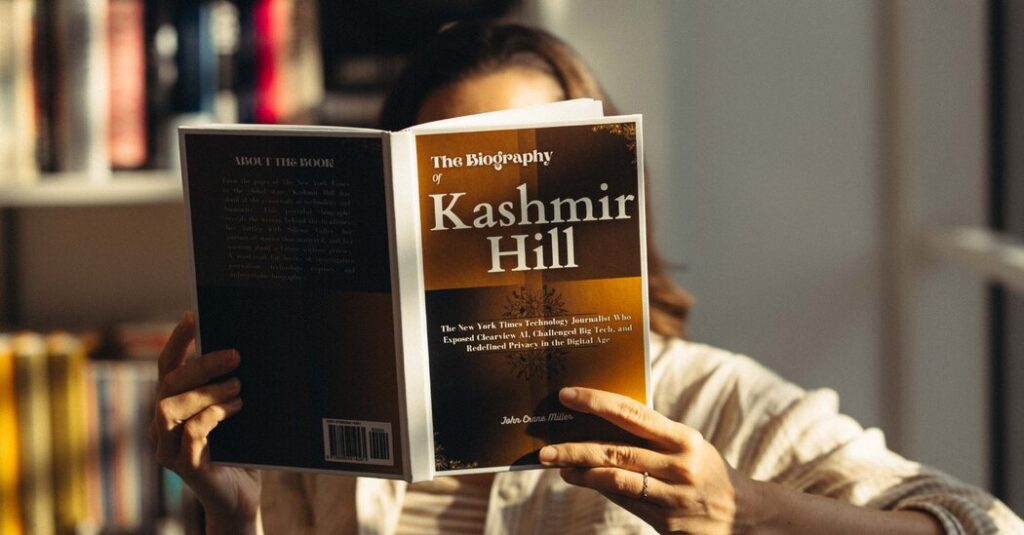
This was news to me. I went to Amazon to investigate. There it was. A biography of Kashmir Hill — title: “The Biography of Kashmir Hill” — had been released nearly a year earlier, in August 2025. My life story had a mottled brown cover and a publisher I’d never heard of before. It had no reviews until I wrote one, asking, as the subject of this work, if I could please speak to the author. The hardcover cost $26.99, which seemed a bit steep, but my editor splurged on a copy and I was forced to read it.
My biography is 90 pages long and should be shorter. It combines facts about me that are widely available on the internet, such as where I grew up, with generic insights that could be true of anyone, like a horoscope spread over dozens of pages. “You cannot understand Kashmir Hill without understanding her contradictions,” my biographer wrote, along with an excruciatingly long description of my elaborate coffee-making ritual. (Fact check: My husband does it.)
The book is flattering, fabricated and absolutely packed with em dashes. It bears all the signs of A.I. slop. I clicked on the author, one John Crane Miller. His bio page described him as a “seasoned biographer and cultural analyst,” and his portrait was a widely used stock photo of a white man in a suit speaking at a conference. “The Biography of Kashmir Hill: The New York Times Technology Journalist Who Exposed Clearview AI, Challenged Big Tech and Redefined Privacy in the Digital Age” was one of 10 biographies that Mr. Miller had published in a single week, all of them about journalists, including my Times colleague Mike Isaac; Jeffrey Goldberg, the editor of The Atlantic; and Jake Tapper of CNN.
Clocking my interest in journalist hagiography, Amazon’s recommendation algorithm suggested I check out “Dan Rather: Truth and Tenacity,” by a wildly prolific author named Diane W. Gray. She published 60 biographies last summer about a diverse cast of celebrities, including Joe Rogan, Celine Dion and the Italian soccer star Paolo Maldini. (That last one had a single, one-star review. “A.I. SLOP,” the person wrote. “DO NOT BUY.”)
Like me, Mr. Rather had discovered the existence of his biography. Diane W. Gray had never attempted to speak with the longtime newscaster, Mr. Rather wrote in a Facebook post last August. But in a plot twist that surprised me and many of his followers, he said he had read and enjoyed it. “The book is available on Amazon for anyone interested,” he added. (Mr. Rather declined an interview about this.)
More than 20,000 people liked his post. As an author myself, I am all too aware that “likes” don’t necessarily translate to sales, but surely a few bought the Rather book. And that, of course, is the hope of the people creating these. Make-money-fast influencers and passive-income enthusiasts on Reddit have been spreading the word for some time: Use A.I. to write a book. If it sells, it’s free money.
Amazon does not mind if people hawk A.I.-generated books on its platform, unless they are truly and deeply terrible. “Charlie Kirk: An Inspiring Journey of Young Political Conservative and Activist Who Fights for America,” published in February 2025, became an Amazon best seller after Mr. Kirk was killed last September — which means it probably sold thousands of copies. But after dozens of scathing reviews called it “mind-numbing,” “a scam” and “a disgrace,” Amazon took it down.
A spokesman for Amazon, Josh Pflug, declined to comment on the book about Mr. Kirk, but said the company invested “significant time and resources to ensure our guidelines are followed,” and would “remove books that do not adhere to these guidelines.”
Among the reasons for removal is “poor customer experience.” That is certainly what I felt paging through my biography and reading that my love for my husband “unfolded with the kind of slow certainty that tends to last” during “the easy exchange of book recommendations.” Boring and wrong. (It happened while singing karaoke.)
Two business school professors, curious about A.I. books and whether anyone actually likes them, gathered data about 10 million books published on Amazon over the last five years. They found that the number of e-books published per month had tripled since the release of ChatGPT, to more than 300,000 at the end of last year, from around 100,000 in 2022. (Amazon said that its internal metrics did not show that level of growth, but would not share its figures.)
Because romance sells, the professors thought it would be the genre most susceptible to A.I. intervention, but instead it was nonfiction — a term that should probably be used loosely in this context. While A.I.-assisted books received lower customer ratings than human-made ones, they deemed A.I.’s entry into the market a positive development, because the books were selling, if modestly. As economists, they told me, they’re less concerned with literary quality or customer satisfaction than revenue growth and market expansion.
“‘Fifty Shades of Grey’ is a wonderful book to economists because it brings a lot of value to consumers,” said one of the authors, Imke Reimers of Cornell University, by way of explanation. My biography was no “Fifty Shades.” The only punishing part was reading it.
I wanted to find out who was writing these A.I. books and how much money they were making doing it. But there was a problem: My biographer did not want to talk to me.
A Man Behind the A.I.
John Crane Miller had no contact information or revealing details in his bio. Knowing he combined “meticulous research with compelling storytelling” was no help in tracking him down. Mr. Pflug, of Amazon, said the company did not provide contact information for sellers to protect their privacy. So I left that review politely asking the author who had invaded my privacy to be in touch.
While I waited for a response, I kept hunting, and came across yet another A.I. biographer, named Bill Johns. In a news article, Mr. Johns had been identified as a “made-up person” by a bona fide, best-selling human author who was frustrated that A.I.-generated imitations — including a book by Bill Johns — were competing with his own extensively reported book.
But Bill Johns, 70, was not made up. He lived on the Chesapeake Bay in Maryland and, unlike my biographer, was willing to chat.
Mr. Johns, who has long curly white hair and the bronzed skin of someone who spends a considerable amount of time outside, retired in 2024 from his work as a cybersecurity consultant. Divorced and living alone with two Shih Tzus, he suddenly had a lot of time on his hands. He was curious about A.I. and decided to experiment with it.
“Almost everyone I know says they want to write a book,” he said. “It’s a very romantic concept to sit down and toil, page after page and paragraph after paragraph, but it doesn’t make economic sense.”
It is hard to disagree with that, though I can’t say I agree with Mr. Johns’s solution: Have an A.I. chatbot do it instead. He spent a couple of weeks and $20 on ChatGPT to help him write about the history of hacking and published his first book, a whopping 651-pager, in March 2025.
Of course, that was possible only because OpenAI, the company that created ChatGPT, had ingested the work of those romantic toilers — Wikipedia editors, Reddit commenters, book authors and reporters like me. (I must mention here that The Times has an ongoing copyright lawsuit against OpenAI, though the A.I. firm says it is “without merit.”)
Mr. Johns’s book on hacking, “Ghosts in the Machine,” sold only a couple of copies, but he was hooked.
‘Bar Money’
Mr. Johns now has 445 books for sale on Amazon. He orders a paperback copy of each one and keeps them on four rotating white bookshelves that are crowded awkwardly next to a couch in his living room. They all feature a photo of him in a serious dark suit — which is A.I. generated. “It was either that or put on a suit and take selfies,” he said.
The books are roughly organized by topic: sports, eccentric geniuses, famous bridges, alcohol, the Chesapeake Bay. These are topics that interest the eccentric Mr. Johns, who has a view of that bay from the well-stocked tiki bar he built in his backyard. It features a large-screen television, ideal for watching sporting events.
“A lot of books never sell a copy,” he conceded during an interview at his home in June. But he does sell a few hundred books per month, each earning him roughly $7. A majority of his sales are physical books, which Amazon prints on demand, though I’d wager that the people buying them do not realize that.
The holiday gift-giving season was good to Mr. Johns: He sold 821 books for a profit of almost $6,000, per the Amazon sales report he showed me. “I wouldn’t characterize them as flying off the shelves,” he said, “but it’s bar money at least.”
I wondered how many drinks my biography had bought for John Crane Miller, but he still hadn’t replied to me. I had taken “The Biography of Kashmir Hill” with me to Maryland and asked Mr. Johns what he thought of it. He flipped through the thin volume and scoffed. “There’s not a lot of content here,” he said. “I could do this one by noon.”
He said I deserved a “400-page book” and, although he generally makes books only about dead people, offered to write it. I laughed, maybe a little hysterically, and declined.
We went into his home office, which had two curved screen monitors and a mechanical keyboard with snazzy rainbow backlighting. Mr. Johns sat down and showed me how he would typically start writing a book.
Into ChatGPT he typed: “If I were to write a book about Kashmir Hill, what would you recommend as a frame?” He then asked for a table of contents as I looked on, nervously.
Usually, he said, he does a little more research first, gathering links to relevant websites, giving those to ChatGPT and asking it to identify historical, economic and cultural “anchors” for a book. He has ChatGPT draft each chapter, but bit by bit, because if you ask for too many words in one go, he said, it starts “drifting and hallucinating.” He used to have ChatGPT create endnotes with citations until he noticed that it was falsely claiming he had actually interviewed people. (My biographer had no such qualms. He claimed to have read my childhood diary and spoken with people who know me well “and those who wish they didn’t.”)
Mr. Johns reads what ChatGPT produces, pushes back if he thinks it needs changes and then copies and pastes the text into a Word doc. He aims for 10 to 15 chapters, which work out to around 300 pages, and then uses Amazon’s Kindle Create app to convert the text into an e-book manuscript. He has ChatGPT generate a cover image — generally vastly superior to the plain one on my biography — and then uploads it all to Amazon, which does not charge for the privilege. His goal has been to write 10 books per week, which is the maximum Amazon allows.
I asked if he had read his books. “That’s a funny question,” he said. “I certainly read them as they’re being written.”
I flipped through a few while visiting, but I found Bill Johns, the person, much more interesting than his books.
When he uploads a book to Amazon, it asks whether A.I. tools were used to create it. He always says yes, for the “entire work, with extensive editing.” (Perhaps a stretch of the word “extensive.”) Buyers of his books might like to know about that A.I. use, but Amazon does not reveal it to them.
The Authors Guild has been lobbying Amazon since 2023 to label A.I.-generated books, said Mary Rasenberger, the group’s chief executive. Amazon is resistant, she said, because it does not want to punish those who are honest about using A.I. while rewarding people who lie about it. (Amazon declined to comment.)
Ms. Rasenberger herself inadvertently bought an A.I. slop book on Amazon about the art of conversation.
“There was not a single interesting point that the book made,” she said. “A.I. is just a word prediction machine. There’s no thinking, no real creativity, no soul behind it.”
The New Kitsch?
A group of academics recently made a provocative argument: What if A.I. slop is good?
Eamon Duede, a philosopher of science at Purdue University and one of the authors of a paper called “Why Slop Matters,” said A.I. brought joy to people who wanted to create something that very few other people would find interesting — like images of their friends in historical scenes.
“People get an enormous amount of enjoyment and satisfaction out of creating stuff if it’s low effort,” he said. People who want to be creative, but might not be very good at it, can turn to A.I. and find “a bunch of barriers removed.”
The paper also suggests that maybe A.I. content isn’t — or isn’t always — the aesthetic abomination critics make it out to be. Most people complain about A.I. writing, but when given blind tests of a few paragraphs they have sometimes been found to prefer it. (This could also be a result of what’s called a “sip test fallacy,” the phenomenon that explains why people prefer the sweeter Pepsi to Coke in a quick taste test, but reverse their choice when they have to consume an entire can.)
Anti-slop criticism, the academics argue, resembles that levied a century ago against “kitsch” — mass-produced, commercial art like magazine covers and comics. Maybe A.I. slop will one day be held in higher regard, in the same way Norman Rockwell’s Saturday Evening Post illustrations are now appreciated despite having once been viewed by the elite as soulless and tacky (a description that might serve as an accurate blurb of my biography).
I was curious what readers thought of Mr. Johns’s A.I. kitsch. He got five stars from one reviewer, but she had not read the book. It had been a gift for her husband, and he, possibly a five-star spouse who did not want to hurt her feelings, “seems to enjoy it,” she wrote. The reviews from people who had actually read the books were brutal.
“One of the worst books I’ve ever purchased,” said one reader. “Boring, verbose and repetitive,” said another. “If you are looking for a great College Football book, this is not it,” said a buyer of Mr. Johns’s “College Football Dynasties,” one of his most popular books over the holidays. “This book is littered with mistakes throughout and the author tends to ramble on and be very repetitive.”
Mr. Johns says if he reads a one-star review and decides “that guy is right,” he’ll take the book down. “I don’t take them personally,” he said of such reviews.
Why would he? He didn’t, technically speaking, write the book.
My own biographer did not seem to like my review asking him to contact me. Soon after I posted it, “The Biography of Kashmir Hill” disappeared from Amazon, as did all of his other biographies.
Everything by John Crane Miller is gone from Amazon. Only his author page remains.
Kitty Bennett and Aaron Krolik contributed research.
The post I Got Slopped appeared first on New York Times.