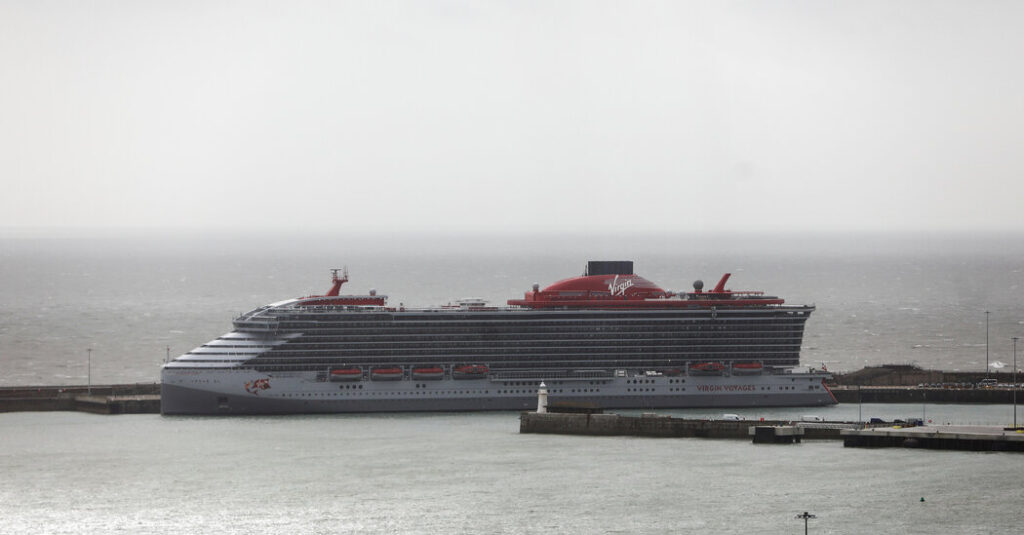
A cruise catering to gay passengers found itself circling the Mediterranean last week after two Muslim countries denied the ship permission to dock in their waters, with the Turkish authorities citing “moral values.”
The Scarlet Lady, chartered by Atlantis Events, an L.G.B.T.Q. vacation company, had been scheduled to stop on July 7 in Kusadasi, a resort town on Turkey’s Aegean coast, but was told it could not as it prepared to set sail from Athens, said Rich Campbell, the company’s president. As an alternative, it got approval to dock in Egypt on July 9, he said — but then was denied entry when just four hours from the intended port, Alexandria.
Local officials of the Aydin province in Turkey said the cruise had been “planned by groups known for behaviors that do not align with the structure of our society” and “caused great discomfort” to Turks. Egypt did not offer a reason, Mr. Campbell said, but he suspected it was similar.
The Egyptian Consulate did not respond to a request for comment.
In the end, the cruise spent a day at sea and then went on to Crete, in Greece, a previously scheduled stop.
Egypt and Turkey are both Muslim-majority countries whose governments have in recent years stepped up campaigns of exclusion against gay people, forcing much of gay life to be low-profile, if not underground.
The Scarlet Lady, which was carrying 1,900 passengers, mostly American and predominantly gay men, is known for its costume parties and for drawing big names in L.G.B.T.Q. entertainment. Other stops on the 10-day Mediterranean cruise were Dubrovnik, Croatia, and Trieste, Italy.
On the face of it, the choice of destinations made for a potential clash of cultures — but Mr. Campbell said that did not need to be the case. “Conservatism and tourism can coexist,” he said. “They should not be mutually exclusive.”
Mr. Campbell said his company’s cruises catering to gay passengers had previously stopped in those countries, and this was the first time they had been denied permission on seemingly political grounds.
For the operators of the cruise and some of its passengers, the rebuff appeared not just exclusionary but also illogical. Both Egypt and Turkey rely on tourism economically, and the war in the Middle East has disrupted travel to the region since February.
That has taken a toll on small tour operators.
“People in Turkey knew we were coming; it would have been a huge impact on the economy,” said Randy Slovacek, a journalist and a passenger on the Scarlet Lady. “So many of us scheduled paid excursions.”
“That’s not so smart,” Mr. Slovacek said of the decision to deny entry.
Patti Lupone, the prominent Broadway actress and singer, was on the cruise to perform, and took to social media to express her view.
“I am shocked,” she said in her post. “A ship — a magnificent ship — full of gay men. And me. Denied entry to Turkey simply because of who is on board. I am furious, but I am sailing.”
There have been occasional cases before of similar cruises being denied permission to dock. In 2012, Morocco’s interior ministry forbid a cruise to stop in Casablanca amid concerns that it would set off conservative protests. And in 1998, the Cayman Islands denied entry to an Atlantis Events cruise carrying 900 passengers, most of them gay; the ship instead went to Belize.
Virgin Voyages, the owner of the Scarlet Lady, describes the Mediterranean excursion as a “hyper-social, endlessly interactive” experience that changes “everything you thought about playing on the ocean.” There were plans for a party called “It’s Bazaar” to show off finds from a day hitting the Turkish markets.
Mr. Slovacek said, however, that parties were just one aspect of the cruise, even if the Turks and the Egyptians had the impression that the ship “was going to bring some debauchery.”
In any case, he said, he is moving on.
“No marginalized community wants to be kicked at the curb,” Mr. Slovacek said. “We have laughed about it. I will not be going to Turkey or Egypt. I will remember that this is the way I’ve been treated.”
The post Gay-Themed Mediterranean Cruise Turned Away From Turkey and Then Egypt appeared first on New York Times.