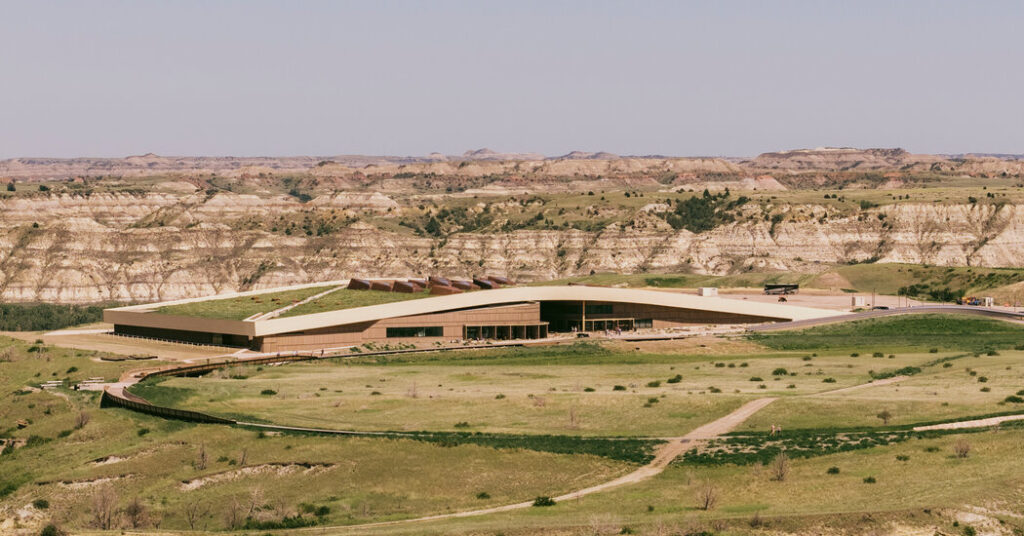
You’d be hard-pressed not to like the new $450 million Theodore Roosevelt Presidential Library. It’s an easy charmer and a spectacular work of ecologically minded architecture in the drop-dead gorgeous North Dakota Badlands.
The firm Snohetta in New York designed it. The building is 93,000 square feet of mass-timber and rammed-earth — a huge Hobbit house hugging the precipice of a grassy butte overlooking the tiny town of Medora, N.D.
Theodore Roosevelt National Park is five minutes away.
Presidential libraries are all the rage, if you hadn’t noticed. The podcasters on Dezeen Weekly joked that they’re arriving like buses now: you wait for one and three of them come at the same time.
Barack Obama’s $850 million presidential center opened last month on the South Side of Chicago in a glowering granite tower housing a museum but with no actual library of presidential records. Obama’s records are stored with the National Archives in Maryland and his papers are in the process of being digitized.
President Trump has announced plans for a “library” that he imagines as a skyscraper in downtown Miami containing a Trump-themed museum and luxury hotel but no library, either.
Now along comes Roosevelt’s museum — backed by a private nonprofit unconnected to the National Archives and Records Administration. It’s a presidential library in name only, because Theodore Roosevelt’s physical papers were scattered before presidential libraries even existed. Franklin D. Roosevelt established the first one in the early 1940s, giving his archives to the nation as a gift and building a modest home for them on his estate in the Hudson Valley.
The idea was to serve public history and scholarship. Over time the institution has morphed into more of an architectural show pony, shrine and museum, lionizing chief-executive-sized egos. It helps that Theodore Roosevelt has been dead since 1919. The library in Medora had no ego to stroke.
Why Medora?
In 1884, grieving his wife and mother, who died hours apart on Valentine’s Day, Roosevelt boarded a train out of New York for the Little Missouri River Valley. He left behind his newborn daughter and debarked below the butte to hunt, ranch and build himself a log cabin that’s at the entrance to the park.
The solace he found there inspired him as president to conserve millions of acres of American wilderness — and occasionally displace Native Americans who lived on those acres — creating public monuments, preserves and forests.
The Roosevelt library foundation picked Snohetta among the architectural practices competing for the job because of how it translated Roosevelt’s conservationist legacy into a building that blends gracefully into the Badlands.
Craig Dykers runs Snohetta’s New York office. Camping on the butte for inspiration, he came upon a pair of stones under a leaf. What resulted was a plan that splits the library into two pavilions, one housing a museum and restaurant, the other an auditorium, offices and classrooms. The two pavilions share a walkable roof.
Walkable roofs have been Snohetta’s signature move since the firm made its bones in the architecture world a couple of decades ago designing the Oslo opera house. The Roosevelt roof is big enough to park a pair of 747s.
From some angles, it can put you in mind of Eero Saarinen’s whale-shaped skating rink at Yale. But its sod floor and planted beds of prairie grasses also suggest earth lodges that tribal nations built across the Great Plains.
The roof’s curves and steel outcroppings for skylights make the building nearly disappear in a landscape of hills and hoodoos.
Up on the butte the library sits to one side, ceding center stage to an expanse of green about the size of an N.F.L. stadium, ringed by a boardwalk. Dykers and his colleagues started collecting and cataloging seeds of local genetic origin to plant on the butte and on the roof before construction began.
The Native Plant Project, as it is called, enlisted volunteers at North Dakota State University to grow plugs and makes the library a showcase petri dish for regenerative ecologies extinguished across the Great Plains by mono-cropping and overgrazing.
The rammed-earth walls inside the library arise from a similar aspiration, resurfacing a resilient, preindustrial construction method shared by European settlers and Native peoples. They could hardly make a more convincing and eye-popping case for the technology’s renaissance.
Towering, muscular, tactile and thick, with wavy, striated bands of colored soil, they’re like modernist abstractions, echoing the geology of the Badlands.
Landscape restoration and climate resilience weren’t on Trump’s agenda when he trekked to North Dakota and cut the ribbon on the library early this month. He was joined by Douglas Burgum, his interior secretary, who championed the project while he was North Dakota’s governor and praised the president profusely in Medora.
Trump lauded Roosevelt for being a “he-man” who built the Panama Canal, which Trump now wants back. He called the library a “new national treasure.” But he sidestepped conservation.
Last week the White House reversed decades of federal protections and opened habitats for endangered species up to drilling, mining and real estate development. This week it shrank national monuments in Utah, and it has siphoned National Park Service funds to subsidize the president’s building projects in the capital.
Western North Dakota is Trump country, as Shawn McCreesh reported in The Times while observing the president on his trip. The crowd in Medora cheered him and celebrated the library’s opening. But I spoke with locals who worry about its impact.
A 2024 census put Medora’s population at 160. Real estate prices are now rising and new houses going up in the hills, in part, I was told, because the library is expected to entice more tourists to make the Great American Road Trip to Yellowstone, Mount Rushmore and Roosevelt Park.
Ed O’Keefe, the library’s chief executive, said he is hoping that 280,000 people a year will visit.
Its museum may be as close as we can get today to presidential retrospection. The Roosevelt foundation organized a board of independent scholars to vet the content. The library consulted with the Mandan, Hidatsa and Arikara Nation on the architecture and exhibition, which lionizes Roosevelt but also calls him out on his imperialism and racism, and dives into his troubled relations with Native peoples.
I leave it to Roosevelt experts to assess the particulars, but the exhibition is a multimedia extravaganza and hugely clever romp. The statue of Roosevelt on horseback, towering over an African man and a Native American man, moved from outside the American Museum of Natural History in New York into the library’s storage, is nowhere to be seen. An A.I. hologram of Roosevelt, designed by Microsoft, steals the show.
Trump toured the exhibition and asked the hologram if Roosevelt considered his greatest achievement to be the Panama Canal.
“The canal stands as one of my proudest battles, no question, but greatness is a strange thing,” A.I. Teddy responded. “I measure my greatest work by the lives improved, parks set aside, food and drugs made safe, the square deal given to all, not just to a few.”
As I said, clever.
Visitors move between the museum and that boardwalk I mentioned earlier — a slender, compressed-ashwood ribbon, woven into the butte’s undulating plateau, connecting to a snaking path zigzagging across the roof. Benches, trellises, outlooks and bleachers let visitors pause and take in the views. There’s a rope trampoline over a precipice to tempt children and give parents heart attacks.
I spotted a pronghorn eating wildflowers and saw muddy animal tracks on the roof. Then I settled into one of Snohetta’s rocking chairs on the veranda at the end of a soaring breezeway between the timber pavilions.
Roosevelt’s cabin was off in the distance. The Badlands stretched under wispy clouds toward infinity. I tried to imagine what the young Roosevelt must have felt, a million miles away from all the noise and the political arena, listening to the wind.
It was bliss.
The post A Spectacular Theodore Roosevelt Library Deep in the Badlands appeared first on New York Times.