The victims were brandishing a gun, “weaponizing” a car or attacking with a shovel. But these explanations, which federal immigration officials gave for shooting people, were swiftly undercut or contradicted by video evidence.
Now, local officials and some members of the public are meeting the Department of Homeland Security’s accounts of the fatal shootings this month in Houston and Biddeford, Maine, with intense skepticism. In Maine on Monday, an Immigration and Customs Enforcement officer killed Joan Sebastian Guerrero, a Colombian living in Biddeford. The department said little more than that he had tried to flee a traffic stop and that an officer, “fearing for public safety,” had fired at him.
Videos that capture the shooting have not surfaced. Maine officials have called for state law enforcement officials to help determine what occurred.
“The people of Maine are not going to buy an investigation that’s strictly run by the F.B.I. or D.H.S.,” Senator Angus King, an independent, told MS Now. “I’m sorry. They just don’t have the credibility.”
The Department of Homeland Security’s terse statements recall a previous era, before bystander video of the police killing of George Floyd in 2020 exposed how misleading the initial version of events released by Minneapolis authorities had been.
Trust in the police plummeted, and many local departments embraced a new strategy: fast, frequent and factual updates. Experts say that federal officials are ignoring an opportunity to learn from them.
“There’s a big difference between what local law enforcement has learned over the years and policies at the federal level — that’s just night and day,” said Chuck Wexler, the executive director of the Police Executive Research Forum, a think tank.
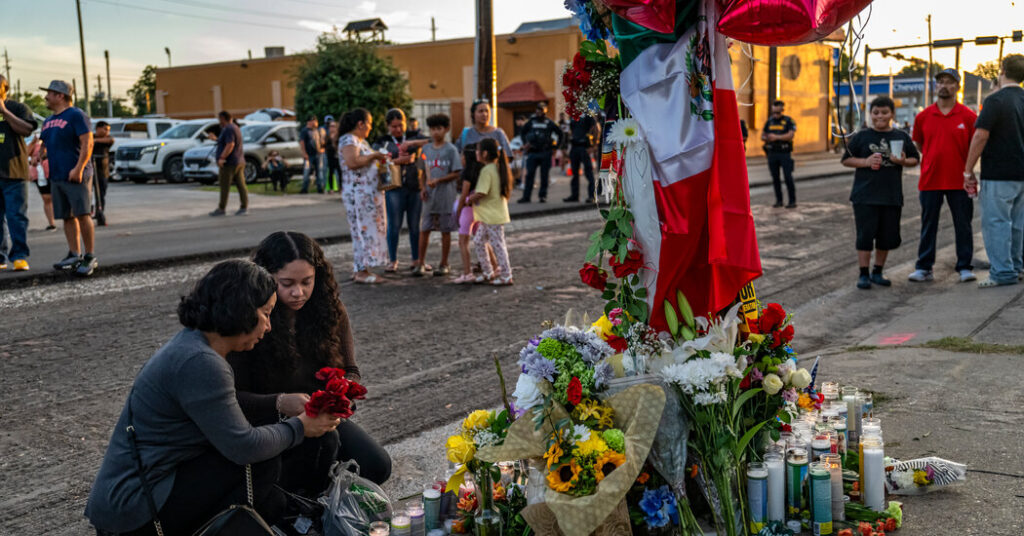
The Maine killing came days after the fatal shooting of Lorenzo Salgado Araujo, a Mexican immigrant, in Houston on July 7. Federal officials said that Mr. Salgado Araujo, driving a white van, “rammed an ICE law enforcement vehicle, refused to follow multiple verbal commands, and weaponized his vehicle in an attempt to run over an ICE law enforcement officer.”
No video has emerged to support that, and passengers in the van said that Mr. Salgado Araujo did not use his vehicle as a weapon and that no officer had been in front of the vehicle.
Nishta Mehra, 43, a writer and teacher who lives near the neighborhood where Mr. Salgado Araujo was killed, said that ICE’s credibility problems begin far upstream of the immediate response. The agency’s claim that it is protecting the public is belied by data showing that few detainees have criminal records, she said.
Immigration officials did not respond to requests for comment Wednesday.
“There’s no institutional integrity,” she said. “Between stated mission and actions, there’s been many contradictions.”
Others say their doubt is fed by basic aspects of ICE’s operations: the lack of a standard uniform, the fact that officers are permitted to conceal their identities and the lack of body cameras in both Maine and Houston.
“ICE agents should ride around in marked vehicles, in marked uniforms, with no masks and wearing body cams,” said Moss Disston, 80, a retired investment counselor who summers in Maine and blames former President Joseph R. Biden Jr. for causing the immigration problems that ICE is now tasked with rectifying. “You would have some video evidence of the circumstances around these tragedies.”
Immigration officials have said that ICE officers can wear masks to protect themselves from harassment and violence. But the practice makes for a stark contrast with local deputies in coastal Maine, whom residents know on sight.
“Why trust someone you don’t know or can’t see?” asked Peter Collins, 68, a retired fisherman in Deer Isle, Maine. His wife, Carol, 73, said it was hard to credit the idea that people are using their “lousy cars” as deadly weapons.
For police departments, transparency came the hard way, spurred by beatings and killings that had provoked public fury. The nadir of public relations in American policing might have come in May 2020, when the Minneapolis Police Department issued a bulletin saying that a man had died after a “medical incident during police interaction.”
The man was Mr. Floyd, who asphyxiated when police officers pinned him on the pavement for more than nine minutes. Bystander video, posted within hours, set off worldwide protests.
The department’s bulletin would not be issued today, said Medaria Arradondo, who was the Minneapolis police chief when Mr. Floyd was killed. Officials have learned to begin news conferences by advising that information is preliminary and the investigation is ongoing. They are well aware that video is likely to surface and be compared with their accounts.
Damage done by a misrepresentation can be “almost impossible to repair,” said Mr. Arradondo, who is now a leadership consultant. “Trust is earned in droplets, but it’s lost in buckets.”
Most police shootings are ruled justified, but when officers may have committed misconduct, officials have learned that it is better to acknowledge that early. A crisis guide published by the Police Executive Research Forum even offers a suggested script: “We’ve seen the video. The community has questions. I have questions. As always, there will be a thorough investigation.”
After Mr. Floyd’s death, New York City began to require the release of body camera footage within 30 days when police officers seriously hurt or kill someone. When officers shot a man with a knife on a subway platform in 2024, wounding the suspect and two bystanders, body camera footage was made public in five days.
In Sacramento, the police post narrated “summary videos” that even include trigger warnings. After officers shot a man wielding a knife on an elementary school campus in March, the police department released “one narrated video, twenty-one officer body-worn camera videos, six officer in-car camera videos, one helicopter video from the Sacramento County Sheriff’s Office, twelve surveillance videos, three witness cell phone videos, one 9-1-1 call recording, and three dispatch radio recordings.”
Mr. Floyd’s death was a watershed, but many departments had already begun to embrace transparency even earlier.
In 2013, Las Vegas established practices like releasing the names of officers involved in critical incidents as part of a collaborative reform process guided by the Justice Department. The changes were put in place in response to “growing community concern” over what civil libertarians called a pattern of excessive force, false arrests and costly legal settlements.
When Las Vegas officers are involved in a shooting today, a captain gives media briefings at the scene and the department aims to offer a more complete account within 72 hours, said Sgt. Jakob Shallenberger, a department spokesman.
“We always want to get in front of the camera as quickly as possible,” he said. “Being transparent and being open about all of our officer-involved shootings is helping maintain that trust.”
Maria Cramer contributed reporting.
The post Video Pushed Local Police to Come Clean. D.H.S. Is Ignoring the Lessons. appeared first on New York Times.