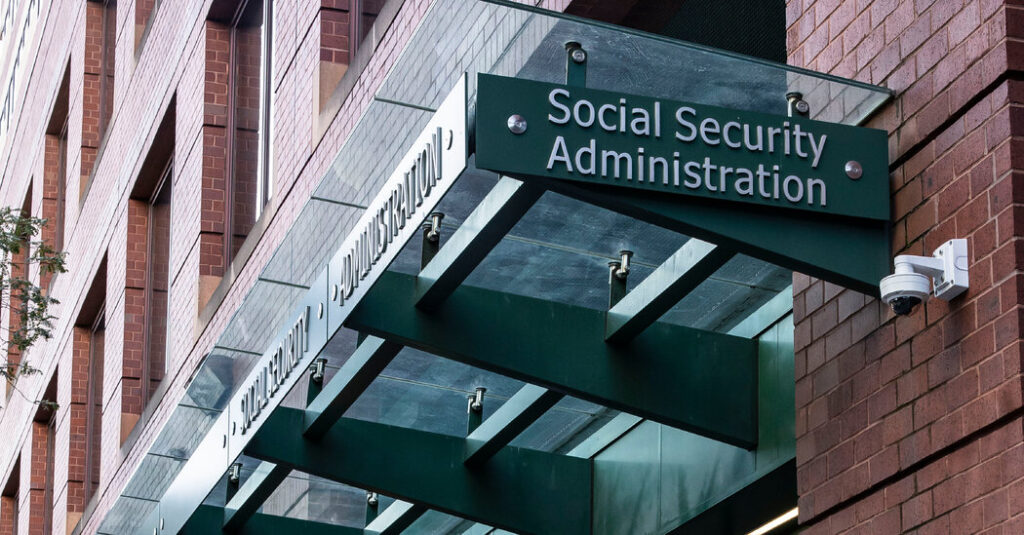
It has been more than a year since Elon Musk’s cost-cutting squad focused on the Social Security Administration and its vast amounts of data, spread falsehoods about widespread fraud and tried to use the agency to enforce the Trump administration’s immigration agenda.
But one change from the Department of Government Efficiency era left a more lasting mark: the loss of roughly 14 percent of Social Security’s work force, which oversees the retirement, survivor and disability benefits paid to 75 million people each month.
Today, the agency is in transition. Its commissioner, Frank Bisignano, who took the helm after the DOGE-led reductions, is pursuing major changes to the way the agency interacts with Americans and processes their claims. He recently said technology improvements would ultimately save Social Security the work-hour equivalent of 2,500 full-time employees. The agency is also hiring and has open requests for 1,000 human positions.
But the hole left by the departure of about 7,800 staff members continues to test those who remain, current and former employees said. For the public, that has made it more challenging to secure appointment slots compared with a year ago, and has led to other service-related delays, frontline workers said.
“The look on everybody’s face is they’re beat down, they are demoralized, they’re tired,” said Chris Delaney, a local union president in Hudson, N.Y., who represents Social Security workers and works for the agency as a claims specialist.
Reshuffling Workers
The job cuts touched the vast majority of Social Security’s 1,200 field offices across the country, most of which lost at least 10 percent of their staff, according to an analysis from AFGE Council 220, which represents field office employees.
For the past year, the agency has tried to fill the gap, at least in part, by reshuffling workers to the front lines. This included pulling field office workers from their regular jobs and assigning them to answer calls at the 800 number, in an effort to improve the often hourslong wait times. On July 6, 1,500 field office workers were reassigned to work shifts on the 800 number, according to internal agency data, but 2,500 have been redeployed from across the agency overall.
That move, coupled with an upgrade to the agency’s phone system, has improved service. The “average speed of answer” on the 800 number declined to five minutes in May, from 11 minutes a year ago, but beneficiaries who accept a callback later are counted as having a zero wait time, reducing the average. The average callback time also improved, but the agency stopped reporting that metric on its performance website last summer.
“I’d like to make this more complicated, but it’s not. It’s putting people where the work is,” Mr. Bisignano, who also serves as chief executive officer of the Internal Revenue Service, said during a congressional hearing last month. “It’s building technology in a modern-day fashion.”
With more field officers working the 800 number, there is less time for in-person and phone appointments, staff members say, so fewer time slots are available. As of July 6, 64.6 percent of appointments for initial claims were scheduled within 30 days, according to internal agency data, down from 78.1 percent a year ago. Other regional averages were recently far lower, below 45 percent.
But reshuffling field office workers has had ripple effects, union representatives and workers said, exacerbating shortfalls elsewhere. “It’s extremely disruptive to the workloads,” said Jeremy Maske, a local union president representing frontline employees in field offices in Iowa and Nebraska. “If you’re assigned to the 800 number once a week, that’s taking a fifth of your time to answer those phones.”
During the hearing last month, Mr. Bisignano highlighted statistics illustrating where the agency was making progress, including shorter waits inside field offices for people who have appointments, declining backlogs in processing centers and improved processing time for disability claims.
“Since Frank Bisignano became the commissioner in May 2025, the Social Security Administration has delivered on the promise of Social Security for the more than 330 million Americans we serve with better, faster, higher-quality service through technology and process improvements,” said Barton Mackey, a press officer for the agency. “Our hiring efforts this year are aligned with the commissioner’s goal to transform service delivery across all channels.”
Mounting Workloads
But agency employees working on the front lines say the numbers don’t capture the entire picture. “If you don’t come into the field office at 7 a.m. — so that from 7 to 9 you can work the back-end workloads — it is a rarity to get time during the day to be able to process back-end work,” said Angela Digeronimo, a claims specialist and a union leader in New Jersey. Those workloads feel even heavier, she said, when the agency chips away at workers’ contractual rights, especially rights to flexible work policies.
The agency is trying to distribute the workloads across the country more evenly. In one of the most significant shifts, it plans to centralize customer service appointments at a national level, whereas now most beneficiaries generally contact their local field offices directly. This shift, being testing in Tennessee and Nevada, could make things more efficient. But there is some concern among advocates and staff, who worry beneficiaries will have trouble resolving problems specific to their state given the expertise of local offices’ staff.
The agency set a goal of reducing field office visits by half, by redirecting certain transactions — like getting a replacement card — online. But Mr. Bisignano has pledged that the agency would not close any offices, allowing beneficiaries to choose whether they want to interact with the agency online, by phone or in person.
The agency is also moving swiftly in other areas, such as automating the processing of certain Medicare claims, and providing new ways for beneficiaries to learn the status of their cases, which some advocates praised.
Advocates who work with disabled and low-income beneficiaries are tracking the changes, from a more automated phone system to increasing online transactions, carefully. Those recipients’ needs are different and their situations are often more complicated, making it easier for them to fall through the cracks — especially at an agency that was chronically understaffed even before the DOGE reductions.
“You can’t lose that many people in that haphazard of a manner without an impact on services,” said Devin O’Connor, a senior fellow at the Center on Budget and Policy Priorities, a nonpartisan research group. “The question is where or when the harm will be felt.”
The post Social Security Is Trying to Stabilize a Year After DOGE Cuts appeared first on New York Times.