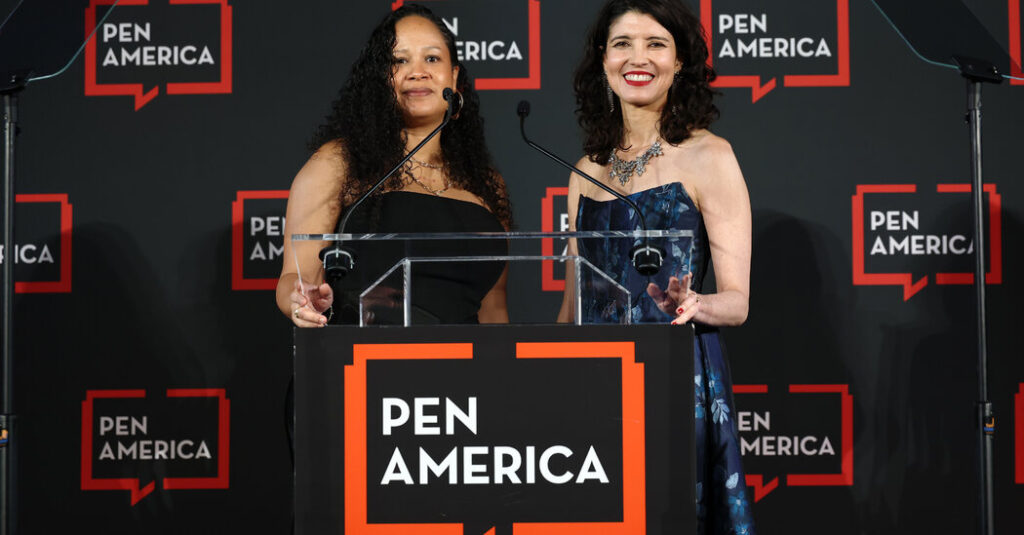
The senior leadership of the free expression organization PEN America defended an article the group published about Israeli and Jewish authors that led to the resignation of its president last week.
Summer Lopez, who with Clarisse Rosaz Shariyf is a co-chief executive of PEN America, said in an interview that the article was part of “a decade and more of our work defending free expression.”
The chief executives knew the article could be controversial, Lopez said, but the idea for it had come out of conversations with writers starting last year, and it felt “critical” to pursue.
“When we hear from writers in our community that they’re feeling chilled or silenced in some way, that’s really what PEN America is here for,” Lopez said.
The article, “A Silent Moratorium,” explores the harassment and professional challenges that Israeli and Jewish authors have experienced since the Hamas-led attacks on Israel on Oct. 7, 2023, and Israel’s retaliation in Gaza. It also outlines PEN America’s opposition to cultural boycotts, which it argues represent a threat to writers’ free expression rights.
After the article was published on Thursday, the novelist Dinaw Mengestu resigned as PEN America’s president. At the time, he told The New York Times that “A Silent Moratorium” continued the group’s “approach toward defending some rights while not defending others.”
The article, Mengestu said, could portray what is known as the Boycott, Divestment and Sanctions movement, which seeks to isolate Israel economically because of its treatment of Palestinians, as discriminatory conduct — and that might “restrict or limit or suppress what is constitutionally protected speech.”
In a statement posted to Instagram on Sunday, Mengestu added that the central issue was “PEN America’s ongoing failure to defend free expression fairly and equitably, and about its production of work that supports suppression through bigotry and indifference.” He cited a PEN report from 2016 that he said had minimized the Palestinian experience and presented the B.D.S. movement as an “assault on the identity of Jewish students.”
Tracy Higgins, a law professor and the executive vice president of PEN America’s board, has been announced as the board’s interim president.
In a statement posted to PEN America’s website on Wednesday, Lopez and Rosaz Shariyf reaffirmed their view that the article aligns with PEN America’s mission to promote the right of free expression. They rejected interpretations that the article was arguing that cultural boycotts are discrimination rather than protected speech.
The statement referred to a 2025 report from PEN America examining cultural destruction in Gaza, and said the group had a long track record of supporting Palestinian writers and “defending all voices on campuses.”
“A Silent Moratorium” was written by Lisa Tolin, then PEN America’s editorial director; Geraldine Baum, until recently the group’s chief communications officer; and Malka Margolies, a media consultant. Baum, who left her position two days before the article was published, said her departure was unrelated to the publication. Tolin is now the group’s interim chief communications officer.
PEN America’s reports often involve extensive research and analysis before concluding with a set of policy recommendations. But, according to Lopez, “that sort of scope was never the intent here.”
Formal interviews for the article began in March, she said, and the piece was discussed with the group’s board at several meetings. Lopez and Rosaz Shariyf shared a final version with the board two days before it was published.
She also said that the nonprofit’s senior leadership team, composed of staff members from across the organization, participated in an internal review of the article before it was released.
According to Mengestu, many board members did not have a strong grasp of the article’s details before it was published. One senior member of PEN America’s staff, who was granted anonymity to discuss private conversations, said that a staff meeting the day after publication centered on the high level of secrecy that employees, including those who work on Israeli and Palestinian issues, felt had uncharacteristically surrounded the article’s production.
The author George Packer, who is a member of PEN America’s board, said board members were notified about the article at least several weeks before publication.
“No one should have been surprised,” he said.
Packer added that both the article and the organization’s report last year on the cultural destruction in Gaza are examples of the group living up to its mission.
“It’s very strange to me that PEN doing what PEN is supposed to do, standing up for writers’ free expression, has caused outrage, even in such a mild form,” he said. The article, he added, “has triggered something in some writers that shows that PEN’s mission turns out to be something that they don’t believe in.”
Phil Klay, another writer and board member, called the article “strong,” saying its intent to document the suppression of Jewish and Israeli voices “should not be controversial.”
“One always needs to be sensitive to the context in which one puts out information,” Klay said. “But adopting that kind of utilitarian approach to what issues you choose to care about strikes me as one that can be corrupting.”
The post PEN America Defends Israel Article That Led to President’s Resignation appeared first on New York Times.