At 11:17 a.m. on July 16, 2024, an asteroid hurtled across the sky above New York City. Sightings of the fireball — and reports of the thunderclap-like sonic boom that trailed behind it — came in from as far away as Connecticut, Rhode Island and Pennsylvania.
But no one reported any of it plowing into the ground. At the time, NASA said that the rock responsible for the ruckus, estimated to be roughly a foot long, was so small that it was “incapable of surviving all the way to the ground.” During its fiery plunge through Earth’s atmosphere, it was thought to have been completely vaporized.
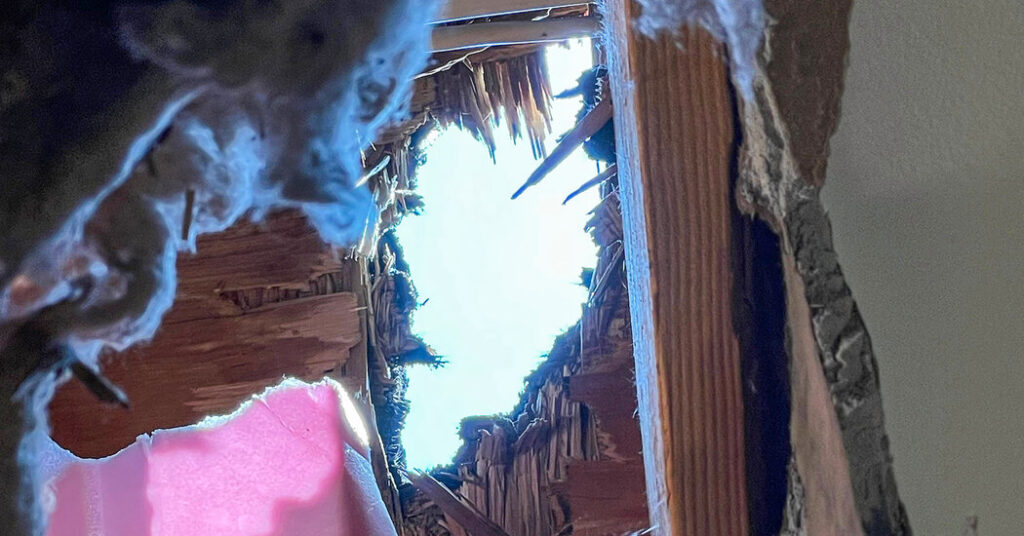
The owners of a house in Hillsborough, N.J., would have begged to differ. At 11:20 a.m. that same day, a man working in his home office was rudely interrupted. “I heard an immense crash and felt the house shake,” he said. It was as if all his kitchen cabinets had suddenly fallen off the walls.
After regaining his composure, he made his way to the main bedroom. “I open the door, and I see a hole in the ceiling above my bed,” he said.
The air smelled like rotten, sulfurous eggs, mingled with a fine dust. There appeared to be black soot on every horizontal and vertical surface. When the man glanced at his pillow, he saw several onyx-colored rocks.
“Good thing I didn’t sleep in,” he said. (The homeowners asked for anonymity to avoid revealing the precise location of their home.)
Before it reached Earth, the asteroid had a mass of 115 pounds (which was calculated based on the brightness of the fireball, the speed of the object and the sonic boom). Most of it was annihilated as it sped through the atmosphere at 32,000 miles per hour. But a sizable fragment completed its journey to New Jersey, and the homeowners spent weeks carefully gathering roughly three pounds of extraterrestrial material.
Though they shared their findings with scientists, the couple kept their discovery secret from the public for two long years.
Now, a new study published on Wednesday in the journal Science Advances reveals that the space rock is no ordinary specimen. It contains complex organic molecules and tantalizing evidence of salty water — ingredients that life, as we know it, thrives on. Asteroids much like the Hillsborough sample may have delivered the same crucial compounds to a newly-formed Earth billions of years ago.
“That makes this meteorite very special,” said Peter Jenniskens, a planetary astronomer and meteoriticist at the SETI Institute in California, and one of the authors of the new study.
This type of meteorite is also notoriously fragile and prone to environmental contamination. That so much of it was preserved in a near-pristine manner came down to the diligence and agility of the two homeowners. “They had secured the crime scene, if you like,” Dr. Jenniskens said.
Thanks to their efforts, the scientific community has a remarkable and unusual relic from the solar system’s past to marvel over. “It’s what we always dream about,” said Ashley King, a meteoriticist at London’s Natural History Museum who was not involved with the new study.
When the homeowner first came across the hole in his roof, he and his partner couldn’t fathom what had caused it. An animal? Something that fell from an aircraft? But after hearing news reports about the fireball and the sonic boom, they realized the mess in their bedroom could have originated in space.
First they called the police, then the fire department. Both politely declined to help.
While researching meteorite falls online, one of the homeowners came across Mike Hankey, an amateur astronomer at the American Meteor Society and co-author of the new study, who had caught sight of the 2024 meteor using his AllSky7 network of fireball-seeking camera stations. The couple contacted him via email, then had a phone call the next day.
Mr. Hankey was ecstatic, and offered the baffled couple his congratulations. From the homeowners’ brief description of the debris, he knew that a peculiar type of meteorite had crash-landed in their bedroom, one that was both scientifically and financially valuable. “At least $100,000 just came through your roof,” he recalled telling the homeowners. “You’ve got to take good care of that. Every piece of dust you find is worth something.”
Aside from immediate family members, the homeowners refrained from telling anyone about their celestial visitor. Relying on Mr. Hankey’s advice, the homeowners extracted every fleck of meteor dust they could find, sealing the samples in glass containers to keep them dry. They used tape to peel microscopic bits off the walls and bought a new vacuum cleaner just to suck up cosmic particles from the carpet. Every find was itemized, labeled and preserved.
“We were extremely meticulous,” one of the homeowners said. “The only thing we were missing were the hazmat suits.”
Scientists determined that the meteorite was a specific kind of space rock called a CM chondrite. “These are primitive meteorites,” said Peter Brown, a meteor physicist at Western University in Ontario who was not involved with the new study. “They resemble the chemistry that made the planets.”
Meteorite hunters had collected several hundred CM chondrites over the last century or so, but many were found long after they had reached the ground. That meant they had been exposed to Earth’s elements, leaving them in a somewhat degraded state. The few that had been captured immediately, like the Hillsborough meteorite, retained much of their ancient chemistry.
In addition to containing prebiotic chemical compounds, the meteorite shows intriguing signs of mineral alteration by salty water. Something similar was identified in rock samples taken directly from the asteroids Ryugu and Bennu — by robotic space missions operated by Japan’s space agency and NASA, respectively — in recent years.
That suggests that the Hillsborough meteorite came from a larger object that, at some stage, had water flowing within it. “It’s really cool; it’s really exciting,” Dr. King said.
Based on the meteorite’s composition, the trajectory of its fall and the length of its exposure to solar and cosmic radiation while venturing through space, the study’s authors believe it was first part of a huge asteroid named 163 Erigone, that formed in the cold shadows beyond Jupiter. Around 155 million years ago, another massive object collided with it, creating a new family of asteroids. This includes the peanut-shaped asteroid named Donaldjohanson, one that NASA’s Lucy spacecraft photographed in 2025.
Then, 6 million years ago, a member of this asteroid family collided with another asteroid, causing it to fracture into several smaller rocks. One escaped from the main belt of asteroids between Mars and Jupiter and started flying about near Earth. Then, around 200,000 years ago, a 115-pound piece broke away. Its odyssey ended when it tore through a roof in New Jersey.
That any of that piece made it to the planet’s surface was miraculous. This specific type of meteorite is “like a packed mud ball,” Mr. Hankey said. The weather radar data suggests that pebble-size pieces fell over a large area between Staten Island and Hillsborough, but none were found during several weeks of searching, in part because rain had most likely turned them into a muddy slush.
All things considered, it was serendipitous that a large fragment landed inside someone’s bedroom. “Had this landed in a wooded area, there’s a good chance it might never have been found,” Dr. Brown said.
Aside from the modest repair costs involved, the New Jersey residents still can’t believe their luck. In a cosmic twist of fate, they had purchased the home only a few months before their rocky visitor arrived.
“We closed on the house in January of 2024,” one of the homeowners said. “And we got a new resident in July.”
The post It’s a Treasure to Science. Too Bad It Came Through Their Roof. appeared first on New York Times.