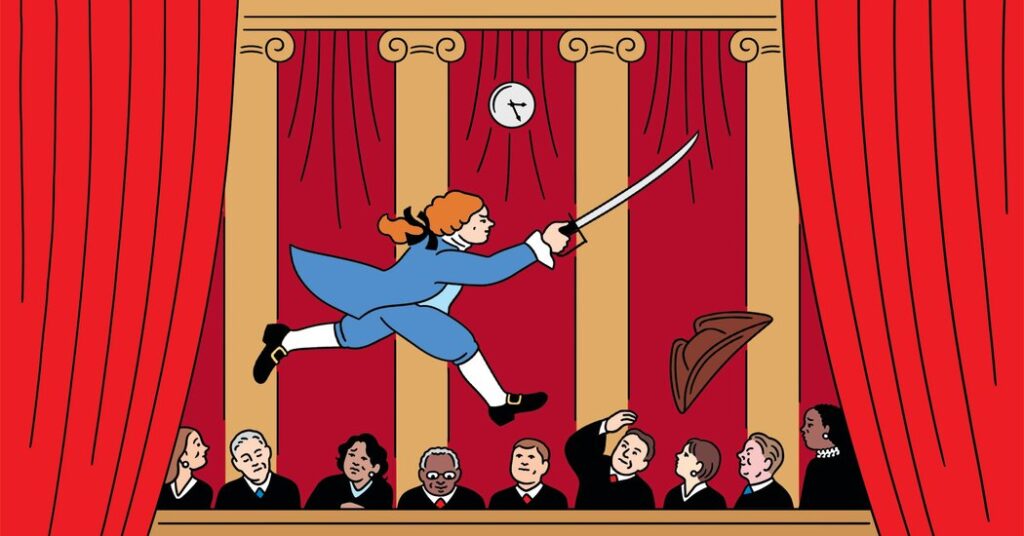
Among all the developments of a confounding Supreme Court term, there is one that hasn’t received the attention it deserves. This was the term when the court’s obsession with “originalism” descended into parody.
A vaunted method of constitutional interpretation that conservatives unleashed during the Reagan era, originalism is supposed to constrain judges by placing them firmly in history’s grip. Justice Brett Kavanaugh expressed the assumption behind the theory a few years ago: “History is far less subjective than policy.” He was seeking to explain, in a concurring opinion in a gun rights case, why only “history and tradition,” rather than modern circumstances or concerns, justified restricting the Second Amendment right to “keep and bear arms.”
How objective is history, really? Let’s examine “history and tradition” in action.
Imagine a young man, living with his parents in the Dallas area, who has a steady job and who, like many Texans, keeps a gun at home. He also, a few times a week, uses marijuana. It happens that a federal law known as Section 922(g)(3) makes it a crime for an “unlawful user” of a “controlled substance” to own a gun. The penalty for violating this little-known section of the federal criminal code is a prison term of up to 15 years.
The government decides to prosecute. Faced with coming up with the “history and tradition” demanded by Supreme Court precedent, the prosecutors scramble to respond to the young man’s invocation of the Second Amendment in his motion to dismiss the case.
The court’s leading precedent in this area, the Bruen decision from 2022, makes clear that “historical tradition” does not refer to what was going on when a challenged regulation was adopted. In the case of the law in question here, that was 1986. No, Bruen means that the government has to come up with an analogous regulation from the era of the country’s founding (or, according to some originalists, from the 1868 adoption of the 14th Amendment, through which the Bill of Rights applies to the states). Given that marijuana was not being consumed in meaningful quantities in America in 1791, when the Second Amendment and the rest of the Bill of Rights were added to the Constitution, nor in 1868, what is the government to do?
The creative government lawyers come up with “habitual drunkard” laws from the 18th and 19th centuries. These common state laws took obviously inebriated people off the streets and sent them to workhouses or jails, where they had no access to firearms. Is this the best analogue that the federal government, with all the resources at its command, can unearth to validate a modern gun law?
What I have just described is not a hypothetical case, but the actual facts of United States v. Hemani, decided by the Supreme Court on June 18. The government not only lost, but lost unanimously. Not a single justice bought the “habitual drunkard” analogy. While there were four separate opinions, all nine justices agreed that Section 922(g)(3) could not be constitutionally applied to the defendant, Ali Hemani. The “habitual drunkard” laws were not only a flawed stand-in for casual marijuana use, Justice Neil Gorsuch said in his majority opinion. Beyond that, he added, the modern law offered fewer procedural protections than the old ones for the people to whom it applied. While habitual drunks typically had to be adjudged incompetent before losing their liberty, Section 922(g)(3) contains no requirement of addiction or incapacity.
In retrospect, it is clear that Bruen’s “history and tradition” doomed the case from the start. When the case was argued, the justices obviously weren’t buying what Principal Deputy Solicitor General Sarah Harris was trying to sell.
Justice Samuel Alito noted that most of the drugs that are illegal today were unknown to the Constitution’s framers. Justice Sonia Sotomayor asked whether the federal statute would apply to someone who used marijuana at a party “even though the gun is somewhere else.”
“That is correct,” Ms. Harris replied.
Justice Gorsuch wanted to know how the founding era defined habitual drunkenness. “John Adams took a tankard of hard cider with his breakfast every day,” he said. “James Madison reportedly drank a pint of whiskey every day. Thomas Jefferson said he wasn’t much of a user of alcohol; he only had three or four glasses of wine a night, OK?” The justice observed that “the American Temperance Society back in the day said eight shots of whiskey a day only made you an occasional drunkard.”
The argument transcript at this point indicates “(Laughter.)” I wasn’t in the courtroom for the March 2 argument, but I’ve seen enough arguments to know that when the core of your position becomes the butt of a justice’s joke, it’s not a good sign.
Was this the moment when “history and tradition” became parody? Or was it the Hemani opinion itself, in which Justice Gorsuch stolidly marched through the government’s defense of the law before concluding that “the government’s analogy fails under every measure it asks us to consider.” It fell to Justice Ketanji Brown Jackson, who was not yet on the court when Bruen was decided, to speak the obvious truth in her concurring opinion: “Bruen is unworkable.”
Although I’ve had a bit of fun with the Hemani case, a serious question remains: Did it teach the court anything? Or will the justices continue stumbling through the history books under the fiction that at the end of the road lies objectivity? The answer matters greatly. During the new term that begins in October, the court will decide whether the Second Amendment protects a right to own an AR-15 rifle. Is this weapon of choice for many mass murders one of the “arms” the Second Amendment gives individuals the right to keep and bear?
Elected officials in Cook County, Ill., which includes Chicago, enacted one of the assault weapons bans at issue in the case decades ago. It argues that history and tradition fully support its position. Every federal appeals court to have reviewed such a law, including the Seventh Circuit in this case, agrees. The county’s brief also makes a strong policy argument for why the ban is necessary in a major city plagued by gun violence.
If the Supreme Court is moved by neither argument — a distinct possibility, given its recent record — the result will not be simply a failure of constitutional method. Cloaked in “objectivity,” it will be a failure of democracy.
Linda Greenhouse, the recipient of a 1998 Pulitzer Prize, reported on the Supreme Court for The Times from 1978 to 2008.
The Times is committed to publishing a diversity of letters to the editor. We’d like to hear what you think about this or any of our articles. Here are some tips. And here’s our email: [email protected].
Follow the New York Times Opinion section on Facebook, Instagram, TikTok, Bluesky, WhatsApp and Threads.
The post Are We Still Supposed to Take This Conservative Legal Theory Seriously? appeared first on New York Times.