It’s hard to think of a more thorough way to showcase a festival than the gala with which the Ravinia Festival opened its season on Saturday night.
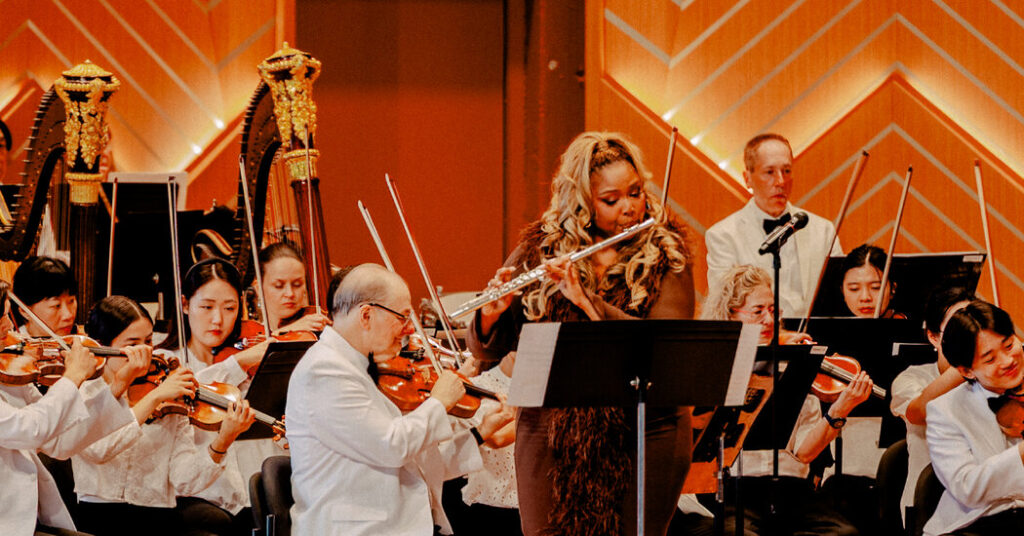
Marin Alsop was there, the latest in a line of Ravinia chief conductors that includes James Conlon, Christoph Eschenbach and Seiji Ozawa. Under her baton was the Chicago Symphony Orchestra, in residence at its suburban summer home as it has been since the festival debuted in 1936. Yunchan Lim, the superstar Korean pianist who recently received his college diploma, joined them for a typically astute reading of the Ravel Piano Concerto. Janai Brugger, the soprano and Chicago-area native who passed through Ravinia’s summer school for young artists on her way to a global career, sang “The Star-Spangled Banner.” And the 17-year-old flutist Kaylee Johnson, an alum of the Reach Teach Play education program, played a duet with Lizzo, of all people.
Still, the star of the show was Ravinia’s freshly and gorgeously renovated Hunter Pavilion. Renamed for the lead donors to a project that cost $70 million, the pavilion is the centerpiece of efforts by Jeffrey P. Haydon, Ravinia’s president and chief executive, to push it to the forefront of the American festival circuit.
“I want Ravinia to be known nationally as a premier summer outdoor music destination,” Haydon said in an interview in his office, while Billy Idol’s band rehearsed outside. “You can think of those iconic places, whether Red Rocks, the Hollywood Bowl, Tanglewood. Largely it’s there, but I think the facilities have not met that level yet.”
Ravinia’s renovations have been correspondingly extensive, beginning with infrastructure improvements last year, with more work still to do. Throughout, the festival has been conscious of the need to preserve the spirit and the heritage of grounds that have welcomed generations of Chicagoland families for picnics and music.
“This wasn’t just a matter of swapping out seats and putting on a fresh coat of paint,” said Haydon, who previously directed the Caramoor Center for Music and the Arts in New York and the Ojai Music Festival in California. “It’s kind of transformed from a venue to a piece of art.”
Designed by Michael C. Barnes of Lohan Architecture in Chicago, the refurbished pavilion has a calm flair, with luxurious detailing that reflects the Arts and Crafts style of the rest of the campus and elevates it beyond the functional outdoor-season norm. The pattern on the walls surrounding the stage nods to the stained-glass windows of the charming old Martin Theater, the last remnant of the amusement park that a railroad company initially laid out here in 1904.
Much of the renovation, though, was more of a practical necessity than an aesthetic choice, especially as complicated maintenance issues became difficult to put off for much longer. The stage has been extended outward by seven feet to give room for an orchestra and chorus to stretch. Ancient wooden seats have given way to rows of softer, wider replacements. Combined with the requirement to make the amphitheater compliant with disability laws, those changes have cut the capacity from 3,350 to 2,840. Haydon said that those seats were rarely full for orchestral concerts in previous years, and that tickets are being redistributed to the lawn to keep the total capacity at around 13,000.
Another need, Haydon said, was for the festival to express its respect for the Chicago Symphony. Ravinia’s arrangement with the ensemble is different from Tanglewood’s with the Boston Symphony or the Hollywood Bowl’s with the Los Angeles Philharmonic. Those orchestras own those venues, while Ravinia is independent, with a $51 million operating budget and a $166 million endowment as of its last financial report. It picks its own music director, selects the soloists, plans the repertoire and hires the Chicago Symphony to perform for six weeks each year, on a contract that was recently renewed through 2034. Although the Symphony plays less than a fifth of Ravinia’s 100 or so shows a year, Haydon said that “the residency anchors the whole season.”
Both Haydon and Jeff Alexander, the Chicago Symphony’s president, said that their partnership is mutually supportive. When Klaus Mäkelä was announced as the orchestra’s new music director in 2024, for example, Alexander notified Haydon months in advance, and Haydon quickly agreed to invite the Finnish wunderkind to conduct a couple of concerts this August so he could spend more of his scarce time with the ensemble before he takes charge next year.
“We’re so delighted to have this relationship,” Alexander said, “and particularly delighted that we were involved and consulted on the important steps of the renovation, and that it turned out as beautifully as it did.”
Ravinia’s consultations included meetings with Symphony musicians to give feedback on improvements that they would like to see to backstage areas, which eventually took up about $30 million of the refurbishment costs. Dug under the stage and seating area, the resulting amenities include new audiovisual circuitry, a library and a greatly expanded locker room for the many more women who now play in the orchestra compared with when the facilities were built decades ago.
Collaboration was also important for retuning the pavilion’s acoustics. “The biggest issue was the density of sound,” said Alsop, who is in her sixth and final year as chief conductor and is keen to note how eagerly the festival has supported her efforts to invite other women conductors to perform. “Onstage,” she added, “it was really loud.”
Musicians are no longer forced to wear earplugs, Alexander said, and although refinements are still needed to make sure that the musicians can hear one another properly, Alsop said that she likes the stronger bass, heightened clarity and better blend of the updated hall.
On Saturday night, all those attributes were in evidence, even with the gentle amplification that Ravinia provides for listeners seated in the hall. Background chatter from the lawn seeped into the pavilion more than it might, and there was the usual wildlife to contend with. Even if the Chicago players were still audibly getting used to their new surroundings, though, inner lines were amply apparent in the thick textures of Artur Rodzinski’s suite from Strauss’s “Der Rosenkavalier,” which closed the concert, and the sound had about as much bloom as one can expect from a venue that is open to the air on three sides.
Ravinia came off as simply a lovely place to hear good music. More than a fresh coat of paint, indeed.
The post With Lizzo and Calm Flair, a Storied Venue Reopens for Summer appeared first on New York Times.