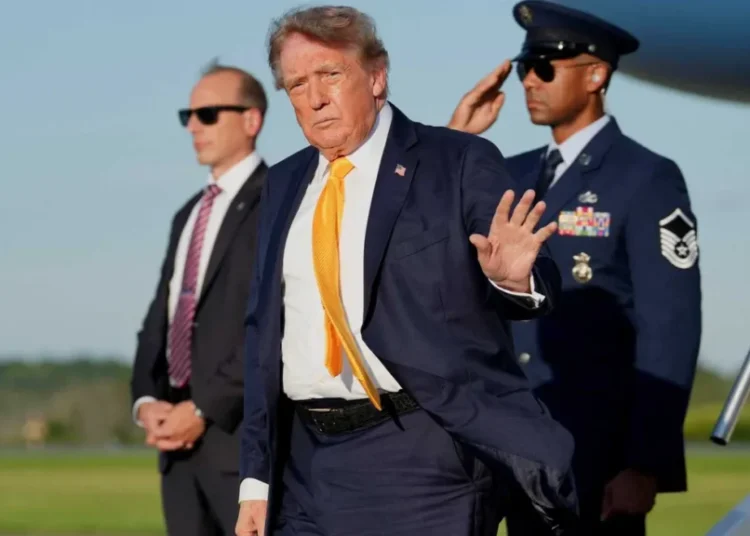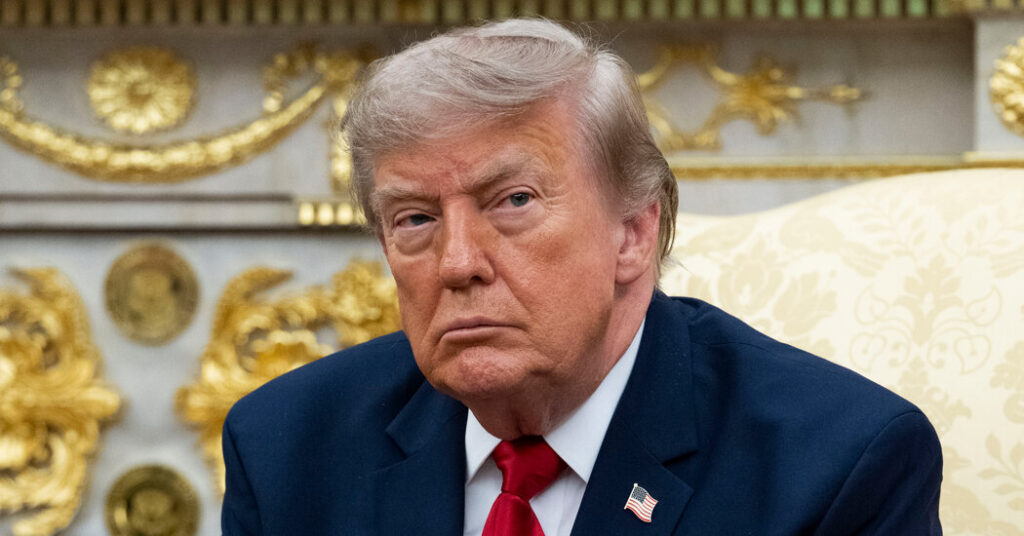
The U.S. military bombed more Iranian targets on Tuesday, returning to the kind of intensive attacks that marked the start of the war, as President Trump abruptly dropped a plan he had announced a day earlier to charge shipping companies fees for providing security in the Strait of Hormuz.
As the two countries have sharply increased their attacks over the past week, the truce they signed last month has been left in tatters, and Mr. Trump’s path out of the conflict remained unclear. Both sides are seeking to control the Strait of Hormuz, a crucial transit route for oil and gas shipments. The renewed hostilities have severely curtailed sea and air traffic to the region with consequences for the global economy.
On Monday, Mr. Trump said he had decided to impose a 20 percent fee on cargo passing through the strait to reimburse the U.S. military for providing security. Analysts said the plan could have more than doubled the cost of shipping oil through the strait, driving up global energy prices. Vice President JD Vance and Secretary of State Marco Rubio had also spent months declaring the administration was opposed to fees or tolls in international waterways.
On Tuesday, Mr. Trump reversed course, scrapping the fee plan, in the latest dizzying shift in his Iran policy.
He said he had decided not to impose fees after the leaders of Persian Gulf nations — “kings and emirs, and all of the people that we all know and we all love” — called him and said “we’d love to do it a different way. We’d love to invest in the United States with billions and billions of dollars.”
Mr. Trump did not describe what those potential investments might entail, and the Persian Gulf states had no immediate announcements of new deals with the United States.
The shift came as the Trump administration has been vigorously opposing an effort by Iran to charge fees in the strait. Mr. Trump said he was pleased with the outcome.
“I like that, actually, because I don’t think anybody should be able to charge a fee for the strait,” he told reporters at the White House during a visit by the prime minister of Iraq, whom he welcomed as a supporter of American oil companies.
Mr. Trump’s change in plans underscored the level of unpredictability that businesses working in the region are facing as the conflict between the United States and Iran lurches back toward war.
“The fact that things are changing all the time, itself, means that it’s hard to make a decision to normalize trade,” said Lasse Kristoffersen, the chief executive of Wallenius Wilhelmsen, a car shipping and logistics company based in Norway.
Oil prices had climbed to their highest level in a month, $87 a barrel, before falling on Tuesday to $81 after Mr. Trump dropped his fee plan. It was about $72 a barrel before U.S. and Israeli forces started attacking Iran in late February.
Oil shipping routes have been a central focus of the fighting between Iran and the United States.
U.S. Central Command, which oversees American forces in the Middle East, said on Tuesday that it was restarting a naval blockade of Iranian ports, which had been in effect from April 13 to June 18, in an effort to thwart Iran’s oil exports and weaken its economy.
The U.S. military added that its strikes on Iran in recent days were intended to degrade the Iranian military’s ability to target commercial ships in the strait. But Iran’s attacks have not stopped.
The Islamic Revolutionary Guards Corps of Iran said overnight that it had fired on two tankers registered to the United Arab Emirates after they attempted to transit the strait near the coast of Oman rather than through Iranian-controlled waters. Iran has warned commercial vessels to only use routes it has approved.
The Indian foreign ministry said in a statement that 30 of the 46 crew members on the two targeted tankers were Indian citizens. One Indian seafarer was killed, and 10 others were injured, two seriously, the ministry said.
“We strongly condemn these attacks and acts of violence targeting seafarers and disrupting free and safe navigation through international waterways like the Strait of Hormuz,” the Indian foreign ministry said, adding that it had a lodged a “strong protest” with an Iranian diplomat in New Delhi.
It was not the first time that Indian sailors have suffered in the violence between the United States and Iran. An Indian crew member of a Cyprus-flagged ship has been missing since it was hit by an Iranian strike over the weekend. Last month, the Indian government said that a U.S. strike on a commercial tanker in the Gulf of Oman killed three Indian sailors and it lodged an official protest with the United States.
Only 10 ships passed through the strait on Monday — the smallest daily total in more than a month and far fewer than the roughly 130 vessels that transited daily before the war, according to Kpler, a maritime tracking company.
Air travel has also been affected by the increased fighting between Iran and the United States. The European Union’s aviation safety regulator on Tuesday warned airlines to avoid the airspace of Bahrain, Kuwait, Qatar, the United Arab Emirates and part of the Gulf of Oman. Attacks in those areas, it said, posed a “high risk to civil flights.”
As the United States stepped up its strikes, Iranian state media reported several explosions in southwest Iran on Tuesday. The deputy governor of Bushehr province, Ehsan Jahanian, said four locations in the port city of Bushehr, home to Iran’s only civilian nuclear power plant, had been struck, according to the state news agency, IRNA.
Later on Tuesday, the Central Command said that American forces had conducted additional strikes on Iranian targets but did not specify the location of the attacks. Iran’s state news agency reported that American forces had fired projectiles on Tuesday evening at Qeshm Island near the entrance to the Strait of Hormuz.
The Iranian military said it had launched another round of strikes at U.S. military facilities in Bahrain and Jordan. Kuwait’s army also reported hostile missile and drone attacks. It said a Kuwaiti naval vessel had been targeted, and that four members of the Kuwaiti military had been injured and were in stable condition.
Reporting was contributed by Ravi Mattu, Eric Schmitt, Shirin Hakim, Mujib Mashal, Pranav Baskar, Maggie Haberman, Erika Solomon, Niraj Chokshi and Sanam Mahoozi.
The post Trump Drops Plan to Tax Ships as Fighting With Iran Escalates appeared first on New York Times.