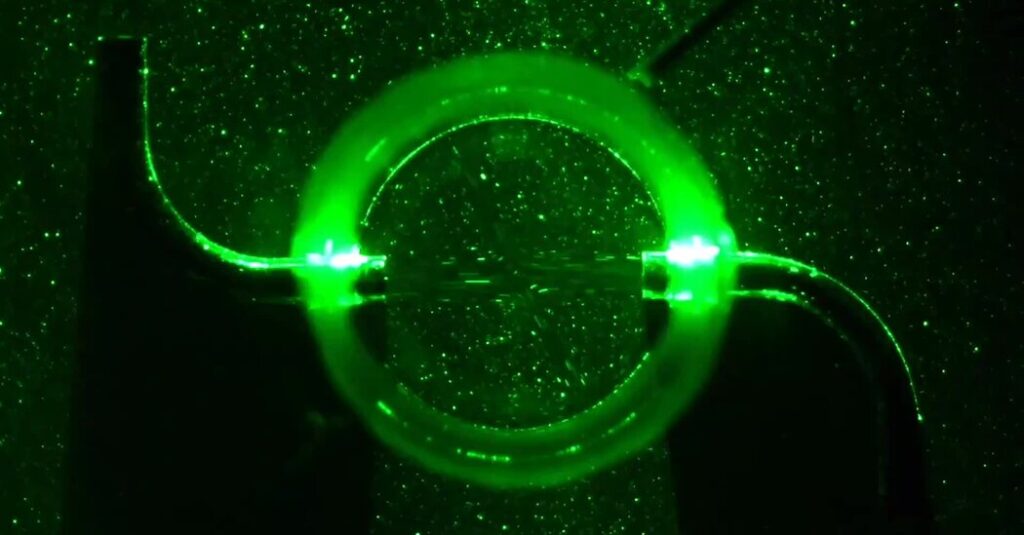
Scientists say they have solved in detail what may be the most famous lawn-care-related problem in all of physics.
The so-called Feynman sprinkler problem is named after one of the best-known physicists of the 20th century, Richard Feynman, even though he was not the first to pose it, and he was unable to solve it.
The problem is this: Imagine a lawn sprinkler submerged underwater, with water being sucked into its arms instead of sprayed out. Does the sprinkler rotate in the same direction as before, spin in the opposite direction or not rotate at all?
Scientists led by Leif Ristroph, an experimental physicist and applied mathematician at New York University, say they have cracked this question. “I am confident we’ve provided the experimental answer to the Feynman sprinkler problem,” Dr. Ristroph said.
The researchers report their latest findings in a paper published on Monday in the Proceedings of the National Academy of Sciences.
“This Feynman problem, as put by Feynman — this is solved,” said Detlef Lohse, a professor at the University of Twente in the Netherlands who was not involved with the research.
To understand the problem of the reverse, submerged sprinkler, first consider a normal S-shaped garden sprinkler that rotates around a central pivot and sprays water out. Water flows up through the center and flows out of nozzles at the ends of its two curved arms, producing thrust that spins the sprinkler. The physics to explain that motion — essentially like a water-powered rocket — is simple and uncontroversial.
But reverse the flow, and the problem becomes complex.
Even though the equations describing the motion of the water and the sprinkler are the same, there is no simple answer. Physicists have been arguing over it since Ernst Mach, an Austrian physicist, first described the problem in 1883.
In his book, “Surely, You’re Joking, Mr. Feynman,” Feynman said it was a topic of argument among graduate students when he was at Princeton University in the 1940s.
He offered an argument for how the reverse sprinkler could be spinning in one direction, and then made a conflicting argument for how it could be moving the other way.
He did not reveal what he thought the answer to be, but he described how he had set up an experiment to settle the question. The apparatus exploded. “Suddenly the whole thing just blew glass and water in all directions throughout the laboratory,” Feynman wrote.
Dr. Ristroph decided to tackle the quandary about five years ago. “I was searching around for some good unsolved hard problems, and this one really caught my eye, just because it has such an infamous history,” he said.
One of the collaborators Dr. Ristroph recruited was Brennan Sprinkle, then a postdoctoral researcher just starting at N.Y.U. “Leif said something very polite,” Dr. Sprinkle said. “A polite version of ‘Hey, you’ve got a kind of funny name — check out this experiment I got running.’”
Dr. Sprinkle visited the laboratory and was intrigued, both because of his name and because of the science. “My first reaction was, yeah, this would be funny,” he said. “And then my second reaction was, ‘Oh, actually, this is a deeply nonintuitive problem that is very cool.’”
Theorists had made conflicting predictions about which direction the reverse sprinkler should be spinning. Experiments — even those that did not explode like Feynman’s — were inconclusive.
After conducting precise experiments, Dr. Ristroph and his colleagues at N.Y.U. reported two years ago that they had the answer: the submerged sprinkler sucking in water spun in the opposite direction to a typical sprinkler expelling water.
The spin was considerably slower, at about one-fortieth the usual speed.
The researchers also had an explanation for why it spun in the opposite direction. The bends in the sprinkler arms created a force that shifted the two jets of incoming water.
“If you’re a car and you’re turning right, you will feel a force, an inertial force, going in the opposite direction,” Dr. Sprinkle said.
In the fluid, the force shifted the jets so that they did not collide head on, creating a twisting force that rotated the sprinkler.
Not everyone was convinced.
“I have never received so much hate mail,” Dr. Ristroph said.
Because the dynamics of flowing fluids are complex, the critics wondered, how could the researchers be sure that their experiment, which described one particular configuration, was true in general?
A new series of experiments described in Monday’s paper looked at what happened with “silly sprinkler” shapes, testing whether other factors might change the direction of the spin.
For example, Feynman’s argument for why the reverse sprinkler would move in the opposite direction, as Dr. Ristroph’s experiments observed, was that suction at the ends of the arms would pull the sprinkler in that direction.
If that were true, then adding a second bend to each arm so that the opening faced the other direction would conceivably change the direction of the spin.
“It does nothing like it, just didn’t matter,” Dr. Ristroph said. The sprinkler with the extra bends rotated in the same direction as the simpler S-shape. So did other sprinkler variations. The most important factor was the amount of bending near the pivot, because that determined the offset of the two incoming jets.
The alternative ideas are “pretty definitively wrong from what we found,” Dr. Ristroph said. That makes him more confident that the explanation they had offered in the 2024 paper was correct.
Submerged sprinklers moving in the reverse direction do not have much obvious use in the real world, but the research could help with a general understanding of the complex and intertwined motions of a solid object immersed within the flows of a fluid.
That knowledge could then be applied to design systems like those that harvest energy from ocean waves or winds.
Dr. Ristroph said the Feynman sprinkler problem is not completely solved yet, because no one has yet succeeded in generating a computer simulation showing exactly how the water exerts pressure on the sprinkler. The problem is complex because of the high pressures within the sprinkler tubes and because everything is in continual motion.
That is what Dr. Sprinkle, now a professor of applied mathematics and statistics at the Colorado School of Mines, is still working on.
“It just winds up being a pretty numerically challenging setup,” Dr. Sprinkle said.
The post Researchers Claim to Have Solved the Perplexing ‘Reverse Sprinkler’ Problem appeared first on New York Times.