Pat Oliphant, the dean of political cartoonists, who drew and sometimes eviscerated a rogues’ gallery of presidents, pedophile priests, warmongers and other editorial-page villains for American newspaper and online readers for half a century, died on Monday in Santa Fe, N.M. He was 90.
His son, Grant Oliphant, said he had died at home of age-related health issues.
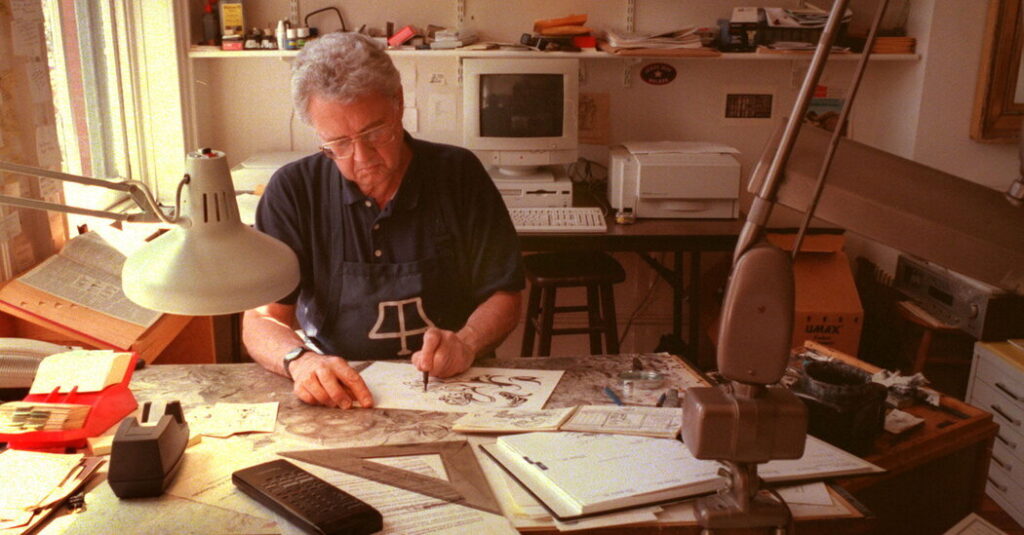
With an impious eye for wickedness in high places and a deft left hand for pen-and-ink drawings, the Australian-born Mr. Oliphant moved to the United States as a young man, quickly won a Pulitzer Prize (which he disdained), and became one of the nation’s best-known political cartoonists, syndicated in as many as 500 American and foreign newspapers. He was showered with awards, and his work was featured in magazines and galleries and collected in books and museums.
A largely self-taught artist who also created bronze sculptures and painted in oils, Mr. Oliphant skewered powerful public officials and religious institutions with such boldness and acid wit that a Washington Post critic once said, “If Pat Oliphant couldn’t draw, he’d be an assassin.” In 1990, a profile in The New York Times Magazine called him “the most influential editorial cartoonist now working.”
His irreverence and his blunt, spare style, sometimes likened to that of Honoré Daumier, the 19th-century French caricaturist, was often imitated by other cartoonists. But he was also vilified by religious and civil rights groups for cartoons that his critics said not only crossed the lines of good taste but unfairly damaged the reputations of people and institutions — and that, at their worst, were racist.
Before Mr. Oliphant established himself as the nation’s most dominant political cartoonist, his predecessors largely resorted to labels, and their tone was one of righteous indignation. What Mr. Oliphant did was to unsheathe the most powerful weapon in the cartoonist’s arsenal — ridicule — and slip it into his victims like silent knife thrusts.
He drew the F.B.I. chief J. Edgar Hoover in fishnet stockings and Vice President Dan Quayle in a baby carriage. During peacetime military buildups, he cast piggy generals gorging at a public trough. During the Vietnam War, his Statue of Liberty looked heavenward, ignoring a crowd of Asian faces, and said, “Send me your tired and huddled masses, your generals, your wealthy classes, your crooks and pimps and bar girls, yearning to breathe free.”
His gallows humor hung 10 presidents. A sampler: Nixon as a thug with a smoking gun. Gerald Ford with a bandage on his head. A prissy George H.W. Bush with a woman’s purse. Jimmy Carter’s White House lawn strewn with truck tires, an old car and an outhouse. Ronald Reagan with a cork in his ear, deaf to the suffering masses. Barack Obama as a stone Easter Island monolith, surrounded and worshiped by tiny voters.
When Mr. Carter hit town in 1977, the new Oliphant menu at a fancy French restaurant boasted “Grits du Jour en Fatback” and “Les Chitlins Bornagin Saute.”
In 1998, after the Oval Office sex scandal broke, Mr. Oliphant said he tried to go a whole week without making any reference to Bill Clinton and Monica Lewinsky — and almost made it. He broke down with a pictorial gathering of panicky charwomen at a White House phone.
“Call Mr. Starr,” one says. “Myrtle’s been groped!”
During the 1980 Democratic primaries, Mr. Oliphant drew Senator Edward M. Kennedy at the wheel of a speeding car, while a frightened Jimmy Carter cowers in the back seat, wearing goggles and scuba diving gear — a dig at the senator, who drove off a bridge after an all-night party on Chappaquiddick Island in Massachusetts in 1969. A young campaign aide, Mary Jo Kopechne, was in the car and drowned.
A 2002 Oliphant classic depicted a mob of lecherous priests pouring out of “St. Paedophilia’s Catholic Church” in pursuit of terrified, fleeing children. The caption says, “Celebration of Spring at St. Paedophilia’s — the Annual Running of the Altar Boys.” An older couple looks on. The husband says, “If I was the pope, I’d marry a few of them off.”
Two tiny penguins, a device regularly deployed by Mr. Oliphant, also observe the chase.
“I’ll go tell the bishop,” one says.
“The bishop has first dibs,” the second explains.
The Catholic League called Mr. Oliphant “one of the most viciously anti-Catholic editorial cartoonists ever to have disgraced the pages of American newspapers.” The New York Times, The Washington Post and other papers declined to run the priest-pedophilia cartoon on the web or in print. The Troy (N.Y.) Record apologized for publishing the drawing on its editorial page.
After Israel’s 2008 offensive against Hamas, Mr. Oliphant drew a headless, jackbooted figure goose-stepping over a small woman holding a baby named “Gaza.”
The Simon Wiesenthal Center said Mr. Oliphant had mimicked Nazi propaganda techniques to demonize Israel. Earlier complaints by the Asian American Journalists Association and the American-Arab Anti-Discriminiation Committee had characterized his ethnic caricatures as racist.
Mr. Oliphant, who called himself a “grudging liberal,” insisted that his cartoons did not favor liberals or conservatives and that he harbored no particular political, ethnic, racial or gender biases. But he was rebuked often, by Democrats as well as Republicans, by gay and lesbian groups and by others offended by political slants that appeared to have actively courted controversy.
Two legal principles made libel suits against him impractical. As expressions of opinion, his cartoons were protected by constitutional free-speech guarantees. And his targets, as public figures and not private citizens, were held to far higher standards of proof. Indeed, Mr. Oliphant’s sharpest blades were always reserved for politicians.
“I start with the premise that there’s not a good one in the bunch,” he told The Times in 1975. “They’re all guilty until proven innocent.”
Patrick Bruce Oliphant was born on July 24, 1935, in Adelaide, Australia, to Donald and Grace (Price) Oliphant, who lived in hill country an hour north of the city. His brother, John, was 12 years younger. His father was a draftsman for Australia’s Ministry of Lands.
Patrick grew up in a three-room cabin with no electricity or running water in a desert of snakes and scorpions. He attended a one-room schoolhouse and hated formal education. But he liked to draw, and his father took him to art galleries in Adelaide. He attended Unley High School there, graduating in 1952.
Hired as a copy boy by The Adelaide News, the tabloid that was the foundation of Rupert Murdoch’s global media empire, he admired the work of an editorial cartoonist whose flowing wit seemed to jump out of the ink bottle. “I decided it was the thing I wanted to do more than anything else,” he told The New Yorker years later. “It combined writing and drawing, and that gave me all the outlets I could imagine.”
He soon joined The Adelaide Advertiser, where, after replacing a retiring editorial cartoonist in 1955, he drew five cartoons weekly on local, national and international news subjects. Editors and readers liked his work, but the paper’s conservative policies blocked his desire to focus on politics.
In 1964, he learned that the veteran editorial cartoonist Paul Conrad had left The Denver Post. He applied for the job, sending samples of his work, and was hired in 1965. He was an overnight success.
Besides his vertical cartoon signature, with the “i” dotted by an inkblot, his trademark device was a tiny stylized penguin (or piggy), an alter ego called “Punk,” whose astringent last words from the edge sometimes contradicted the thrust of Mr. Oliphant’s opinion, softening the blow of his attack.
By 1966, his cartoons were being circulated internationally by The Los Angeles Times Syndicate. His reputation grew rapidly, and in 1967 he won his Pulitzer for a cartoon portraying North Vietnam’s revolutionary leader, Ho Chi Minh, carrying a dead soldier. The caption read, “They won’t get us to the conference table … will they?”
As Mr. Oliphant later told it, the cartoon he submitted for the prize was, intentionally, one of the weakest he had published in 1966. It was a kind of test. When it won, he criticized the Pulitzer Board for choosing it on the basis of its America-boosting point of view rather than the quality of his work. Thereafter, he scorned the Pulitzers and became a regular critic of the board’s selection processes.
Mr. Oliphant moved to The Washington Star in 1975 and thrived in the political circus of the nation’s capital. His work was often displayed on The Star’s front page. He became a naturalized American citizen in 1979, and in 1980 he switched to Universal Press Syndicate, which reached millions of readers in the United States and beyond.
When The Star closed in 1981, Mr. Oliphant was so well established with syndication sales that he had no need of a newspaper base. He rejected offers from other papers and became the first major independent cartoonist without a home newspaper. He now had total editorial control, the freedom to draw what he wanted and work where he chose.
By 1983, he was the most widely syndicated political cartoonist in America. He later cut back from five to four cartoons a week, and in 1997 he began shifting his home and studio from Washington to Santa Fe, N.M., a move completed in 2004.
While he had long painted oil portraits, Mr. Oliphant in the 1980s branched out into other fine arts, creating lithographs, etchings and bronze sculptures of presidents and other national leaders, which were sometimes sold to their subjects.
The Smithsonian National Portrait Gallery in Washington mounted a show in 1990, “Oliphant’s Presidents: 25 years of Caricature.” In the 1990 Times Magazine profile, Alan Fern, the gallery’s director, gave this assessment: “I think he’s a genius. His drawing is the most eloquent and least labored of any I’ve ever seen.”
Mr. Oliphant’s papers, including 7,000 cartoon drawings, were donated to the University of Virginia. His work was also collected in 25 books and in the Library of Congress, various presidential libraries, the Smithsonian Institution, the Metropolitan Museum of Art in New York and other museums.
In 1958, he married Hendrika de Vries, a Dutch-born swimming champion. They had a son, Grant, and two daughters, Laura and Susanne, before divorcing. His marriage to Mary Ann Kuhn in 1983 also ended in divorce. In 1996, he married Susan C. Conway, a Washington gallery owner who was his business manager. She had two children, Pauline and Daniel Conway, by a previous marriage. (She died in December 2025.)
Survivors include three children, Grant, Laura and Susanne Oliphant and two stepchildren, Pauline and Daniel Conway.
Mr. Oliphant, who owned and flew a small plane and cultivated a garden in Santa Fe for his vegetarian tastes, retired from cartooning in 2015. But a year later, Donald J. Trump, who had made disparaging remarks about Muslims and Mexicans and boasted of sexual conquests, was elected president.
Mr. Oliphant came out of retirement to express his visceral feelings about Mr. Trump for The Nib, a cartoon website. In one cartoon, he portrayed the president as a member of the Hitler Youth, with jackboots and a swastika armband, admiring himself in a pier glass as a ghoulish Steve Bannon salutes his führer.
“How do I look, Herr Bannon?”
“Exquisite as usual, Herr Trump,” the toady says.
“Heil Trump!” says a little piggy.
Yan Zhuang contributed reporting.
The post Pat Oliphant, Cartoonist Who Skewered the Powerful, Dies at 90 appeared first on New York Times.