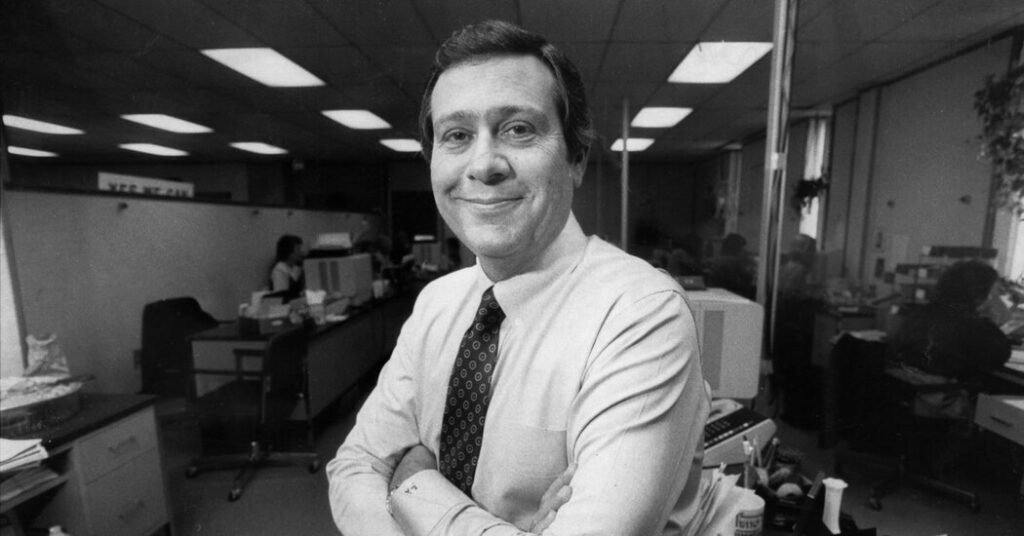
Leonard Abramson, a former pharmacist who built U.S. Healthcare, one of the first health maintenance organizations, and who used some of the nearly $1 billion he received from selling it to give generously to cancer research and other medical causes, died on July 4 at his home in Blue Bell, Pa. He was 93.
His daughter Judith Abramson Felgoise confirmed the death.
Mr. Abramson started U.S. Healthcare at the right time: two years after the passage of the Health Maintenance Organization Act of 1973, which encouraged the growth of H.M.O.s to fight spiraling medical costs.
“Until then, H.M.O.s were very closed systems and U.S. Healthcare was one of the first companies to pioneer a much more open-ended H.MO. that could be expanded rapidly,” said Larry Levitt, executive vice president of health policy for KFF, formerly known as the Kaiser Family Foundation. “It was also one of the first H.M.O.s to convert from nonprofit to for profit, and many others followed in its footsteps.”
H.M.O.s like U.S. Healthcare were designed to increase cost efficiency by providing doctors and hospitals with a network of set fees for their services, instead of à la carte payments each time a patient is treated; they also controlled patient access to specialists within their networks.
Mr. Abramson said that U.S. Healthcare produced savings by, among other measures, avoiding excessive hospital admissions and by emphasizing preventive care and wellness programs.
“When we started, the average maternity stay in a hospital was four days,” he told The New York Times in 1995. “Now it is 24 hours and studies show that babies are healthier, moms are healthier. The longer length of stay did not give better quality care.”
In 1995, U.S. Healthcare covered some 2.2 million people and spent about 73 cents of each premium dollar for medical costs, the lowest in the industry. The company’s profits were celebrated by Wall Street, but some doctors and consumer advocates said that the company sometimes shortchanged services provided to patients, including time they needed to recover in hospitals.
David Ansel, a pediatrician in North Andover, Mass., told The Baltimore Sun in 1994 that the insurer, by paying him a fixed fee for all patients, was not acknowledging how much more time he spent with sicker patients. The company, he also said, “pressured him to refer patients to inappropriate specialists and hospitals.” The company did not offer a comment at the time.
In 1996, during a wave of consolidations in the health care industry, Mr. Abramson sold the company to Aetna Life & Casualty for more than $8 billion. He told The Times that the deal was necessary “to get the mass we needed, the power to negotiate with the physicians, the hospitals, the drug companies” and force down their charges.
The sale brought him a windfall of $967 million in cash and stock, a $25 million corporate jet and $10 million in consulting fees.
“By applying American capitalism to health care,” he wrote in his 1990 book, “Healing Our Health Care System,” “I have realized the American dream.”
Leonard Abramson was born on Nov. 12, 1932, in Philadelphia. He was the only child of Joseph, a Jewish immigrant from Lithuania, who was a butcher and a cantor, and Zipporah (Sebotnick) Abramson, who ran the home.
In a 1991 interview with Forbes magazine, Mr. Abramson said he was driven to be a better businessman than his father. “I felt I had to be successful,” he said.
After graduating in 1954 from Penn State University with a bachelor’s degree in arts and letters, he earned a degree from the Philadelphia College of Pharmacy and Science in 1960. To support himself during his studies, he drove a cab.
He became a drug salesman in Philadelphia for Parke-Davis but left after not getting the promotion he wanted. He then bought two Philadelphia-area pharmacies. After selling them, he started a medical equipment business, which he also sold.
At RH Medical, a hospital management company in Cheltenham, Pa., he created Family Medical Care, a prepaid medical plan. But it was too costly for RH Medical to continue with, so Mr. Abramson bought it from RH Medical for $500,000. It would be known by different names; in 1986, it became U.S. Healthcare.
In 1978, with his company a few years old, he wrote an advertorial that ran in newspapers across the country, arguing that H.M.O.s were a remedy for “staggering health care costs.”
“H.M.O. programs,” he wrote, “have already proven themselves to be the first effective health care delivery system capable of leveling health care costs and eventually reducing them.”
During the 30 years following his sale of U.S. Healthcare, Mr. Abramson used his wealth for philanthropic causes.
In 1997, he and his wife, Madlyn (Kornberg) Abramson, made their single biggest philanthropic splash: They pledged $100 million to establish the Leonard and Madlyn Abramson Family Cancer Research Institute at the University of Pennsylvania’s cancer center.
The gift exceeded the $70 million in research grants then held by the center and was believed at the time to be the single largest donation to a cancer research center.
“I want this gift to give everybody the cure I got,” Ms. Abramson, who had been treated successfully at the University of Pennsylvania for breast cancer, said at a news conference.
In 2002, as the Abramsons’ giving increased, the cancer center was renamed for the couple. Their total donations to cancer research at the university exceeded $140 million.
One of the center’s most significant achievements was developing the first gene-altering drug for cancer, Kymriah, which was approved by the Food and Drug Administration first to treat pediatric and young adult B-cell acute lymphoblastic leukemia, and then for two types of lymphoma.
Dr. Robert H. Vonderheide, director of the cancer center — which combines research, care and education — said in an interview that Kymriah might not have been developed without the Abramsons’ generosity.
“That $100 million created the environment,” Dr. Vonderheide said, that led to the hiring of new investigators, including Dr. Carl June, the gene therapy pioneer who led the team that developed Kymriah.
Dr. Vonderheide added that Mr. Abramson “had great confidence in us to make good use of his support. His standards were high — he wanted cancer eliminated.”
Drew Weissman and Katalin Kariko, researchers at the cancer center, won the 2023 Nobel Prize in Physiology or Medicine for their work in developing mRNA vaccines to fight Covid.
In addition to Ms. Felgoise, Mr. Abramson is survived by two other daughters, Nancy Abramson Wolfson and Marcy Abramson Shoemaker; nine grandchildren; two great-grandchildren; and a companion, Ellen Goldberg. His wife died in 2020.
The Abramsons’ other philanthropic efforts included $15 million to help start the Children’s Hospital of Philadelphia’s pediatric research center and $10 million to Temple University’s dental school, which was renamed for Maurice Kornberg, Ms. Abramson’s father, a dentist.
After his wife’s death, Mr. Abramson gave $2.5 million to the pediatric emergency department at a second location of the Children’s Hospital, in King of Prussia, Pa., and $10 million to the Jupiter Medical Center in Florida, where they had their primary residence, to create an endowed chair of cardiac surgery in his wife’s name.
“They were so blessed to be successful and felt it was their responsibility to give back,” Nancy Abramson Wolfson said in an interview. “Health care become their focal point, because that’s where my father became successful.”
The post Leonard Abramson, Health Care Innovator and Philanthropist, Dies at 93 appeared first on New York Times.