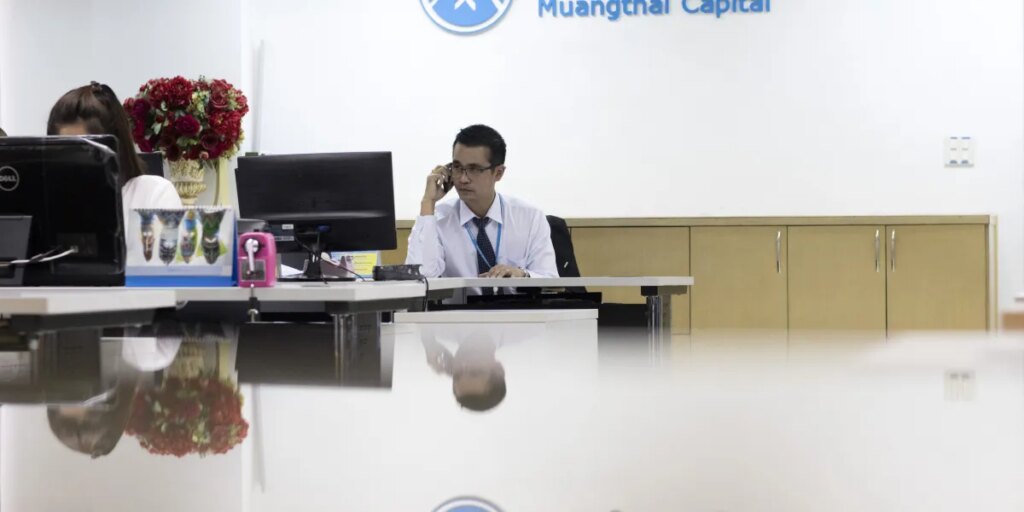
Parithad Petampai wasn’t sure he’d be ready to take over the CEO role at Muangthai Capital, Thailand’s largest microlender. Parithad’s parents—his father Chuchat Patcharachai and his mother Daonapa Petampai—had founded the company over three decades prior.
Last August, Parithad was catapulted into the position of CEO, after a court deemed Chuchat legally incapacitated.
“I’ve been sitting next to my dad for almost twelve years, yet he didn’t let me touch the wheel. I was always worried about how I’d be able to drive the car,” Parithad told Fortune on the sidelines of Maybank’s Invest ASEAN Summit in Singapore. “But when the day came, it felt automatic.”
Chuchat passed away in April, just months after his son took over as CEO last August. Daonapa continues to serve as managing director, while Parithad’s brother Suksit sits on Muangthai’s board of directors.
“It’s not easy,” Parithad admitted, pointing to generational differences between him and his parents. “My mom is very traditional. It took me two years to convince her to allow workers to input information digitally, rather than writing everything on paper first!”
How Thailand’s largest microlender got started
Chuchat and Daonapa founded the business in 1992 as Muangthai Leasing, a motorcycle financing operation. “We came from a poor family,” Parithad explained. “My grandparents were Chinese immigrants who moved to Thailand.”
The couple listed Muangthai on Thailand’s stock exchange in 2014, raising 3 billion Thai baht ($89.9 million) during its IPO. “Before we IPO-ed, Muangthai only focused on Thailand’s central and northern areas,” Parithad said. “But as the company matured and grew, we also moved into the eastern part of the country.”
Parithad joined his parents’ company in 2015, following brief stints as an analyst at Goldman Sachs in London and Kasikornbank in Thailand.
The firm, renamed Muangthai Capital in 2018, now operates over 9,000 physical branches across Thailand. Muangthai ranks No. 295 on Fortune’s Southeast Asia 500 list, with 2025 revenue of 30.74 billion Thai baht ($936 million).
‘Without our money, the people will struggle’
When asked how he balances profitability and social aims at Muangthai, he answered, with some exasperation that he wasn’t “the kind of person who works for money.”
“I’m more of a person who enjoys the impact a role helps me to create. People don’t really understand me sometimes,” he added.
Muangthai operates in Thailand’s booming microlending space, where financial firms provide small, short-term loans to people and businesses with limited access to capital. The country’s microfinance market is expected to reach 273 billion baht ($8.2 billion) by 2027, according to the Asian Development Bank in 2023. Other notable Thai microlenders include the Srisawad Corporation and Thai Credit Bank.
Parithad said his company targets Thailand’s bottom 10%. “Without our money, the people will struggle,” he explained. “Farmers will not be able to buy fertilizers, parents can’t foot their children’s school fees, and those who run into accidents won’t be able to afford medical treatment for their wounds.”
Microlending challenges
Yet the microlending industry can be a problematic one. Microlenders offer loans at high-interest rates, averaging between 28% and 33% annually. Critics say the industry can send vulnerable borrowers into cycles of debt, and cause them to fall victim to further predatory lending, asset seizures, and forced labor.
The risk is especially clear in Thailand’s neighbor, Cambodia, where a booming microfinance industry has led to worrying levels of debt among borrowers. According to the Wall Street Journal, microfinance borrowers in Cambodia now owe over $3,900 on average, more than three times the median income. One in ten loans are more than 30 days overdue. A watchdog inside the World Bank, in a late June report, accused the industry of engaging in pressure tactics and paying insufficient attention to a borrower’s ability to pay.
Parithad carefully pushed back against some of these criticisms about microfinance. “If you want to create a large social impact, your business has to be profitable, but the profits must be capped at a moderate level,” he said.
“In the long run, if our customers’ lives get better, instead of coming to Muangthai with a motorbike, they might come to us with pick-up trucks and bigger ticket items—so we’ll grow together with them.”
Still, Parithad says some traditional sources of capital, like the Thai government and local banks, are wary of Muangthai and other microfinance providers. In March, the Bank of Thailand warned of rising financial costs for local micro-SMEs, which “increasingly rely on nano-finance loans” despite their high interest rates and credit risks.
“We should be supported more by the Thai government,” Parithad said. “All the support that we receive is from international organizations like the Asian Development Bank, International Finance Corporation, the German Investment Corporation and the Japan International Cooperation Agency.”
In September 2024, Muangthai issued a landmark $335 million social bond on the Singapore Exchange, where JPMorgan served as the sole global coordinator. “When we faced challenges in the Thai bond market, the help we received was from JPMorgan,” Parithad said. “We also received lots of loans from foreign Japanese, Taiwanese and Chinese banks, but where were the Thai entities?”
“Those in my country see us as a threat.”
Thailand and the world
After years of political instability, analysts are more optimistic that a new government, led by Prime Minister Anutin Charnvirakul, might be able to pass new economic policies and revive the country’s economy. Thailand’s benchmark SET Index is up by 28% year-to-date, ahead of markets in Malaysia, Vietnam and Singapore.
“With a new prime minister, the stock market has shown confidence,” Parithad said. He also points to credit rating agency Moody’s recent decision to upgrade Thailand’s credit outlook from negative to stable.
He’s also optimistic that Thailand can benefit from the U.S.-China trade war, as trade gets diverted to new countries.
And Thailand could stand to gain as Beijing and Washington compete for friends. “As the Chinese and Americans have conflict, Thailand can become the back door,” he said. “Hopefully, the two superpowers will deploy more technology to my people, and we can earn more income.”
“Southeast Asia will become one of the highlights of the world. I’m excited to see how money will be deployed to this region, and how Chinese technology like EVs will impact people in my country.”
The post ‘Without our money, people will struggle’: Muangthai Capital’s new CEO Parithad Petampai defends the role of microfinance in Thailand appeared first on Fortune.