President Trump on Monday reduced the size of two national monuments in Utah by nearly 3 million acres, teeing up a legal battle over whether presidents have the power to shrink such sites in the first place.
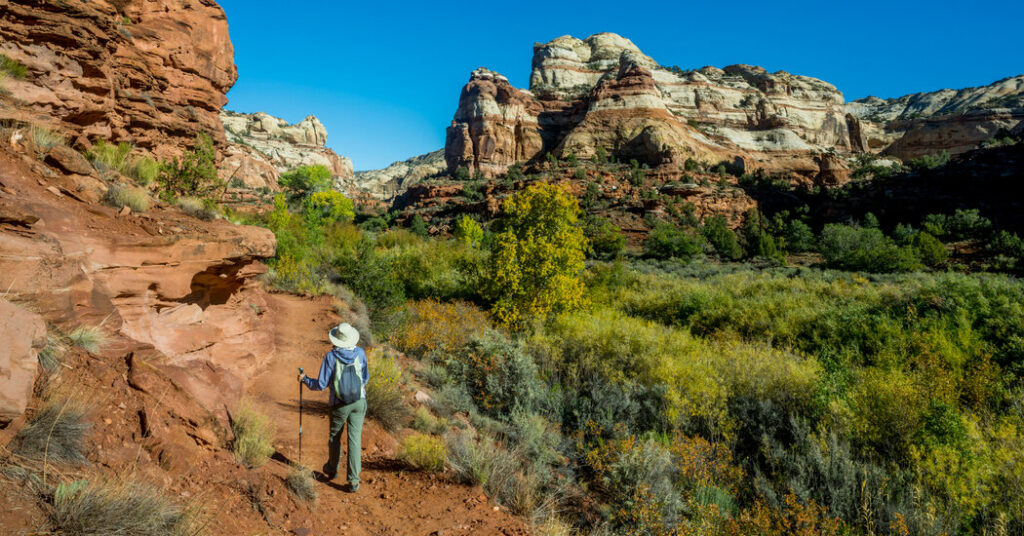
Mr. Trump signed two executive orders to sharply cut the Bears Ears and Grand Staircase-Escalante National Monuments. Both sites are known for their sandstone canyons and vast mesas, which are rich in wildlife habitat as well as archaeological sites of importance to Native American tribes.
During his first term, Mr. Trump similarly shrank both monuments at the urging of top Republicans from Utah, opening about 2 million acres to oil drilling, uranium mining and other development. But tribes and environmentalists sued over Mr. Trump’s move, and President Joseph R. Biden Jr. subsequently restored sweeping protections to both sites before a court could issue a final decision.
Tribes and environmentalists are expected to lead another lawsuit over Mr. Trump’s latest effort to shrink the monuments. The legal fight could have far-reaching implications for the future of land conservation, potentially putting dozens of other monuments at risk and opening millions of additional acres to commercial activities.
The Trump administration has already taken a flurry of other steps to encourage development and recreation on federal lands across the country. In May, for instance, Mr. Trump moved to lift restrictions on off-road vehicles in most national parks.
Before signing the executive orders in the Oval Office, Mr. Trump said that previous presidents had blocked fishing and other activities within national monuments.
“You can’t go fishing, you can’t do anything,” he said. “You can virtually not even walk on it.”
The six members of Utah’s congressional delegation attended the event in the Oval Office, as did Utah’s governor, Spencer Cox. All are Republicans.
“It’s very clear that these monument designations are supposed to be the smallest area possible to protect the antiquities, and these multi-million-acre monuments that are bigger than the state of Delaware certainly do not fit that designation,” Gov. Cox said.
National monuments are lands that are legally protected from development. They are similar to national parks, but while national parks are created by Congress, national monuments are created by presidents through the Antiquities Act of 1906.
Many tribal leaders and environmental lawyers say the Antiquities Act does not authorize Mr. Trump to reduce the size of Bears Ears and Grand Staircase. The century-old law, they say, grants presidents the authority to designate monuments but not to abolish or shrink them.
But many Republicans, ranchers and oil drillers say previous presidents abused the Antiquities Act by putting vast stretches of land off-limits to development. They note that the law says presidents should limit monuments to the “smallest area compatible with proper care and management of the objects to be protected.”
President Barack Obama designated Bears Ears during his final weeks in office in 2016. President Bill Clinton classified Grand Staircase in 1996, halting plans for a coal mining project there.
After Mr. Trump shrank both monuments in his first term, his administration sold oil and gas leases on more than 76,000 acres of land adjacent to Bears Ears. But the Biden administration subsequently canceled most of those leases, and the oil industry has little interest in drilling within the monument itself, according to Melissa Simpson, the president of the Western Energy Alliance, an industry trade group.
“Despite years of rhetoric from environmental advocacy groups, Bears Ears has never been a significant oil and natural gas prospect,” Ms. Simpson said in a statement.
Bears Ears is named for a pair of buttes, or flat-topped hills, that rise thousands of feet above the surrounding canyons. The two symmetrical structures dominate much of the nearby landscape in southeast Utah.
Grand Staircase is named for a sequence of sedimentary rock layers that stretches from Bryce Canyon National Park to the Grand Canyon. Paleontologists have made extraordinary discoveries there, excavating the fossils of tyrannosaurs and other dinosaurs that roamed the region more than 74 million years ago.
Today, both monuments provide crucial habitat for hundreds of species, including bighorn sheep, elk and mule deer. They also contain thousands of archaeological sites that Native American tribes consider culturally significant, including the remains of burial grounds, cliff dwellings and rock art panels.
Bears Ears is the ancestral homeland of five tribes in the region: the Navajo Nation, Hopi Tribe, Ute Indian Tribe, Ute Mountain Ute Tribe and Pueblo of Zuni. The Biden administration reached a unique agreement with a coalition of the tribes, authorizing them to jointly manage the monument with the federal government.
Anthony Sanchez Jr., the head councilman for the Pueblo of Zuni and the co-chair of the Bears Ears Inter-Tribal Coalition, described a feeling of whiplash.
“You have an administration that backs you up, and then you’re back to square one again,” he said in an interview Monday.
Mr. Sanchez said he worried about the potential for vandals to damage or destroy the rock art at Bears Ears.
“Even now, with the boundaries not reduced, we still run into that trouble,” he said.
Scott Braden, the executive director of the Southern Utah Wilderness Alliance, suggested that the nonprofit environmental group would sue over Mr. Trump’s effort to shrink the monuments.
“The Southern Utah Wilderness Alliance is committed to defending the monuments — whether that’s in a court of law or the halls of Congress,” Mr. Braden said in a statement. “We are confident that President Trump’s reckless and unlawful acts will be rejected and the monuments restored.”
But Ben Burr, the executive director of the BlueRibbon Coalition, a group that supports opening public lands to off-road vehicles, vowed to defend Mr. Trump’s move in court.
“Right-sizing these monuments to what the statute actually allows isn’t an attack on public lands; it’s how we keep them open for all Americans to enjoy,” Mr. Burr said in an email. “We plan to continue fighting in the courts and in the Congress to ensure that abuse of the Antiquities Act becomes a thing of the past.”
The litigation over Bears Ears and Grand Staircase could eventually reach the Supreme Court, where Chief Justice John G. Roberts Jr. has suggested that the Antiquities Act is ripe for review.
“Any land reserved under the act must be limited to the smallest area compatible” with proper management, Chief Justice Roberts wrote in 2021. “Somewhere along the line, however, this restriction has ceased to pose any meaningful restraint.”
The post Trump Sharply Cuts the Size of Two National Monuments in Utah appeared first on New York Times.