Sam Neill, the New Zealand actor who died at age 78 in Sydney, Australia on Monday, had a long and varied résumé. He played everyone from an international spy (Possession) and a detective chief inspector (Peaky Blinders) to a legendary wizard (Merlin). He even played the literal spawn of the devil (Omen III: The Final Conflict).
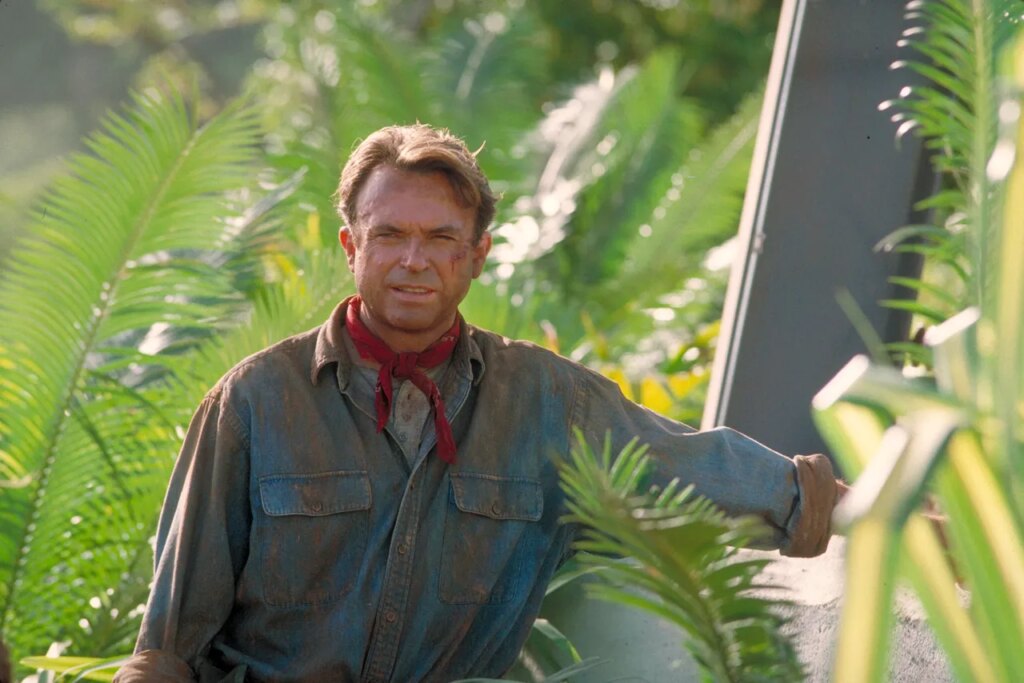
But throughout his career, Neill was also known for scientist roles in films like The Dish and Event Horizon, with none more celebrated than Dr. Alan Grant, the rugged paleontologist and undisputed hero of Jurassic Park.
As fans paid tribute to Neill, remembering both his wonderful performances and the charming updates about the farm animals on his idyllic New Zealand vineyard, one clear theme emerged with respect to the iconic Dr. Grant.
“How many of us were inspired to become scientists after watching Dr. Alan Grant and Dr. Ellie Sattler?” wrote Lucky Tran, the director of science communication at Columbia University Irving Medical Center, in a post on X that included an image of Neill and costar Laura Dern examining a sick triceratops in a scene from Jurassic Park. Thomas Ronge, a marine geologist working for the Scientific Ocean Drilling Coordination Office (SODCO) at Texas A&M University, shared on Bluesky that the sci-fi blockbuster had led him to pursue studies in paleontology, and that while he had ultimately gone into a different field, “I’m always Dr. Grant at heart.”
Speaking for myself, I can say that after seeing Jurassic Park at age 9, I entertained great dreams of being a paleontologist like Alan Grant (or perhaps an actor, like Sam Neill). Just what was it about this character that had kids clamoring to apply to STEM programs?
“The heroes of my favorite movie were level headed scientists who used their wits, not guns or physical strength, to overcome obstacles,” Kevin Holloway, who worked as a neuroscience researcher at the University of Oregon in the late aughts and early ‘10s, tells WIRED. “They also had a clarity of purpose and absolute conviction in their beliefs.”
As Grant, he says, Neill was “the ‘quintessential ‘man of science’ role model [by] which all others are measured.” Ultimately, Holloway didn’t pursue a PhD, and he now works as a nurse “doing diabetic foot care, advanced wound care, and street outreach”—but he still “absolutely” credits Neill’s turn as Grant for steering him into science.
Jurassic Park hit theaters when Jim Porter was 23 and completing his undergraduate studies with a geology field camp in the western US, he recalls. “I read the [Michael] Crichton novel on the way there, then saw the movie in a small town theater,” he says, noting that the field work was “certainly different after that.” He loved Neill’s “convincing and endearing portrayal of a scientist whose priority was understanding and revering Earth’s history rather than opportunistically monetizing it,” saying this “reinforced my career choice as an environmental scientist.”
It wasn’t merely Grant’s distinction and principles as a researcher that made him such an aspirational figure for so many. He was also a potent counterexample to the violent, macho action stars of the 1980s and 1990s.
“He’s believable as a field scientist and also has such a gruff kindness about him,” says Jamie Anderson, who earned a DPhil in archaeological sciences from the University of Oxford in 2018 and calls Jurassic Park her favorite film. She cites “the way he takes on looking after the kids even though they’ve been driving him nuts” and his treatment of Dr. Sattler “as his equal and someone he’s proud of” as reasons that Grant made “a great antidote to more toxic masculine figures in many other action movies, especially from that era.”
James, who works as a civil engineer in Orlando, Florida, and requested to withhold his last name out of professional concerns, offers a similar assessment of Grant as a direct, accomplished, and brilliant man without the off-putting arrogance. “Sam Neill’s character and how he responded to everyone with confidence but also kindness really stuck with me,” he says. “It’s clear he knows his shit, but he’s not an asshole about it. Simple enough but shocking how uncommon that is.” While James may not have pursued his childhood ambitions of becoming “a paleontologist, or an archaeologist, or volcanologist, or some sort of ‘-ist,’” he aims to bring Grant’s values to his engineering work. “I get to use my brain and also try to be decent to people,” he says.
Like just about everyone who grew up obsessed with Jurassic Park, Richard Ferro, a family medicine physician in California, has memories of wearing out an old VHS copy. When he was 5 years old and sick with chickenpox on a visit to family in Costa Rica, it was all he had to entertain himself, and he rewatched it continuously.
“To me, Dr. Alan Grant was the epitome of what it means to be a scientist,” Ferro tells WIRED. “He was thoughtful and analytical. He could be lighthearted in one moment and muse about the philosophy of scientific theory in another. But when he saw a triceratops for the first time, he was a kid again, grinning from ear to ear while lying on its chest, feeling his body rise and fall with each breath. His character taught me at an early age that intelligence and wonder can and should coexist.” Ferro says he wouldn’t be where he is today without Neill’s “monumental performance.”
With Neill gone, that guiding light will nonetheless endure—if on streaming platforms instead of videocassettes and DVDs—and another generation is bound to be swept away not only by Steven Spielberg’s thrill-ride adventure but the people who made it seem real.
James says he can’t wait to introduce his young son to Jurassic Park and its beloved star to his “little guy,” and though he notes that his wife thinks it “may be a bit scary,” he has no such reservations.
“I think he can handle it,” he says.
The post Sam Neill Inspired a Generation of Scientists appeared first on Wired.