Television creatives and executives have pledged to increase racial diversity on and off screen for years. But whether it makes a difference in viewers’ actual feelings and reactions toward race and class has long been a question.
A new report, published Monday in the journal American Psychologist by the American Psychological Assn., indicates that it does. Titled “The Role of Children’s Media in White, U.S. Children’s Developing Racial Bias,” the yearlong longitudinal study that looked at white children between the ages of 4 and 8 found that those whose favorite TV shows and movies portrayed fewer Black characters were less likely to choose to play with a Black child, held less positive attitudes toward Black children and were less likely to choose to attribute Black-white racial inequalities to intrinsic racial differences. These results were more overt when the analysts factored in class and status dynamics.
Michael T. Rizzo, an assistant professor of psychology at University of Illinois, Urbana-Champaign, and the corresponding author of this study, says that his work looked at white children’s reactions because “they are the dominant and majority group in the United States” and research has shown that “they’re the most likely to develop biases.” Similarly, he says that while “anti-Black racism is not the only form of racism in our country,” historically speaking, “this is where the literature really focuses on.” The age range was chosen because accurate readings on these topics are harder with older kids. As kids age, he says, they usually “pick up the idea that they shouldn’t be responding with prejudice.”
Depictions of classism in these programs — from when it was obvious, with the lead characters shown as royalty, doctors or politicians, to less overt examples like a secondary character who’s just there for comic relief or may not be as wealthy or smart as the leads — were equally important, Rizzo says, although he acknowledges it’s hard to say how aware young kids are of this type of divide.
“Even if they have some of these biases, they recognize that they shouldn’t be telling the experimenter about those biases,” he explains.
A new parent himself, Rizzo also comes to these findings with a personal stake.
“I have an 18-month-old son,” he says. And while he says that “the main motivations are scientific and understanding what’s going on, as a father of a white son, I want to know what world he’s going to be experiencing, and how he’s going to be making sense of it.”
Rizzo and his team examined the media consumption of 593 white children from across America. The aim was to assess how their biases were affected by scene-by-scene content analysis of the racial representation of 29 popular kids shows and movies. All of these titles were chosen based on parental and guardians’ reports of the subjects’ favorite programs. They include familiar titles like the Disney movies “Frozen 2” and “The Princess and the Frog,” and TV shows that have long been staples of childhood like “Sesame Street,” “Dora the Explorer” and “Sofia the First.”
The study avoided programming with predominantly non-human characters, even if the voice casting and dialogues may have helped them be racially, gender or ethnically coded.
That the paper’s release coincides with summer vacation and, thus, a likely rise in screen time, is also significant. In May, the U.S. Department of Health and Human Services released a study that claimed “early exposure to screens carries developmental and cognitive risks,” and a May report from children’s educational gaming company LingoKids found that “98% of U.S. parents allow some daily screen time,” usually as a childcare necessity when adults have to work or complete household tasks like cooking dinner.
As Rizzo’s study notes, this also means that the interactions with different people and cultures that used to happen organically in neighborhoods and in social spaces are increasingly being replaced by digital simulation.
“This is more speculation, but the more time children spend watching shows that are representing biased race and status disparities, the more time they’re absorbing and trying to make sense of those, and thinking about those,” Rizzo says. “If children are less exposed to the inequality in media, then the inequality in media might have less of an impact. But that doesn’t mean that they wouldn’t be developing the biases [in other places].”
As the chief creative officer for Fred Rogers Productions, Ellen Doherty oversees content focused on younger viewers that she says tell “stories that are about the human experience. And the human experience of being a 3-year-old or a 63-year-old, or wherever you are in between or beyond, is actually pretty universal.”
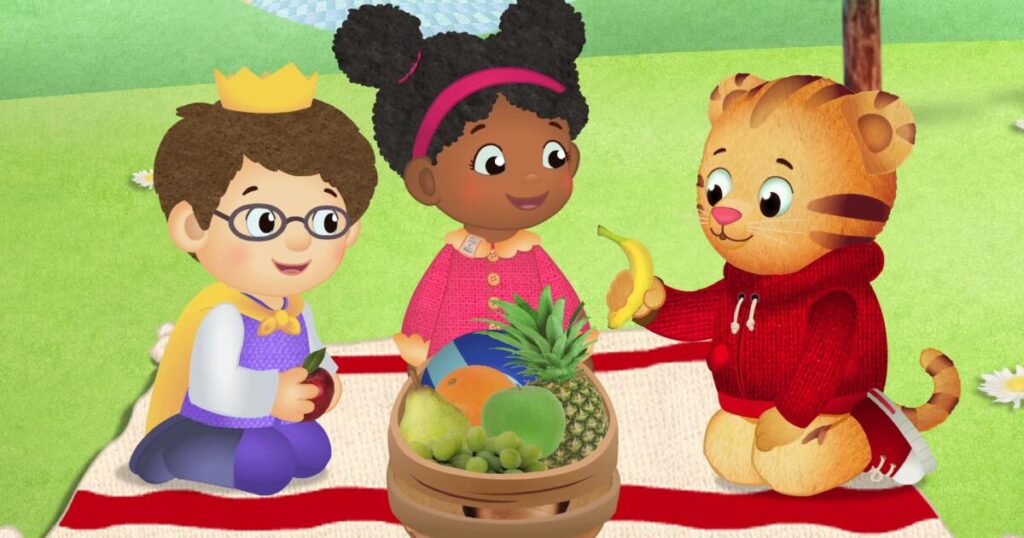
When producing shows like “Daniel Tiger’s Neighborhood” and “Odd Squad,” both programs studied by Rizzo and his team, Doherty says that the “number one thing is embracing simplicity and knowing that, sometimes, fewer words can be better when they’re the right words.” A “Daniel Tiger” episode about a rainstorm could just have a tree break a window instead of more catastrophic damage. Meanwhile, it’s important to embrace realism. The PBS Kids show “Alma’s Way,” a Fred Rogers production, is set in the Bronx. Doherty says it would be inauthentic for that show not to have characters of racial minorities, even if this isn’t something that’s always addressed in the episodes’ plots.
Rizzo notes that his findings do not have to have permanent implications.
“Children are still just starting to understand the world, and if you are able to intervene early, you can shape how children think for the rest of their lives,” he says.
He recommends watching these shows with kids and asking them how they feel or what they think it means when they see certain characters who have more authority than others or get to do cooler things. That way, he says, “you can start to get a sense of how they’re understanding the world. Then, as a parent, you have the opportunity to shape those beliefs early on before they become really deeply entrenched.”
The post Racial and class diversity in TV and films can help children challenge biases, study finds appeared first on Los Angeles Times.