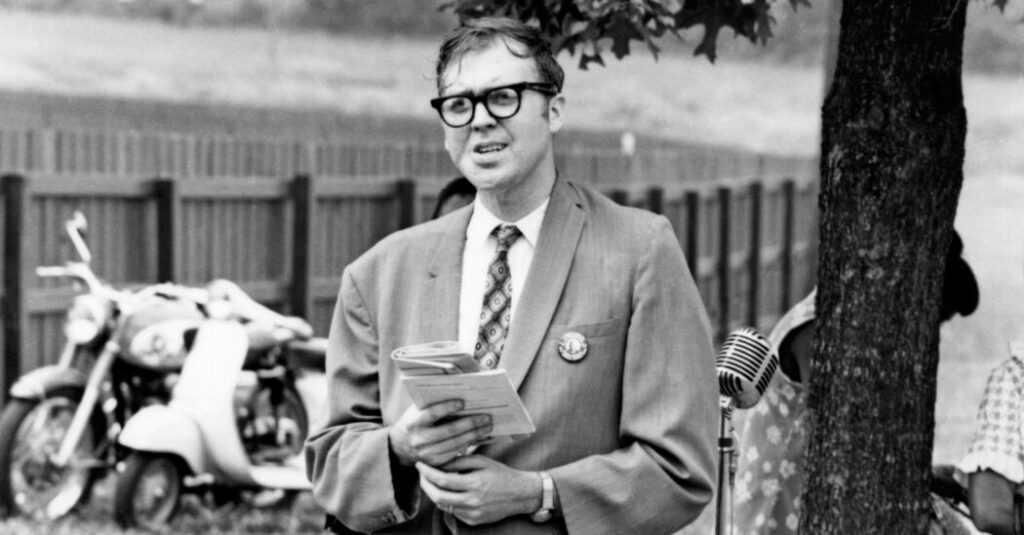
The Rev. Ed King, a minister from Mississippi who was one of the few white people to play a leading role standing with Black leaders during the bloody civil rights struggle in his native state, died on July 4 in Ridgeland, Miss. He was 89.
His death, in an assisted-living facility, was confirmed by his daughter Margaret King.
The outspoken chaplain of Tougaloo College, a historically Black institution in Jackson, the state capital, Mr. King endured imprisonment, an attempt on his life that left him disfigured and rejection by other white people, all in service to a goal — integration — to which most Southerners of his middle-class background were hardly sympathetic.
In a state perhaps more determined than any other to preserve inequality, Mr. King took part in a daring sit-in at the whites-only Woolworth lunch counter in May 1963. A violent mob attacked the protesters, and did not spare white allies. His sunken cheek and jaw, bashed in a car crash engineered by segregationists that same year, served as a chilling warning to civil-rights workers pouring into Mississippi.
“He became the most visible white activist in the Mississippi movement, and he paid a heavy price for honoring his convictions,” the historian John Dittmer wrote in “Local People: The Struggle for Civil Rights in Mississippi” (1994).
Mr. King was a founder of the Mississippi Freedom Democratic Party, set up to challenge the state’s segregationist regular Democrats. In 1963, he ran for lieutenant governor on a symbolic ticket with a Black man, Aaron Henry, spurring thousands of Black people to cast ballots. At the 1964 Democratic National Convention in Atlantic City, N.J., the Freedom Democrats tried to replace Mississippi’s regular Democratic delegates. The effort was unsuccessful, but it focused a harsh national spotlight on the wrongs in their home state.
“King was ostracized by his family,” Mr. Dittmer wrote, and “scorned by his colleagues in the clergy.”
Three days after he was arrested, along with hundreds of others, during the 1963 Jackson street marches that followed the Woolworth sit-in, Mr. King was barred by the state’s Methodist Conference from any church posts in Mississippi.
“He was a white Mississippian, and he was involved. That made him one of a kind,” Joan Trumpauer Mulholland, another white civil rights activist who also took part in the Woolworth’s sit-in, said in an interview.
“There were some who supported us in the background,” Ms. Mulholland, the first full-time white student at Tougaloo College, added. “He supported us out front.”
On June 18, 1963, less than a month after his fellow Methodists banned him — and less than a week after the N.A.A.C.P. leader Medgar Evers, his associate and friend, was assassinated in Jackson — a car driven by a white man shot out of a side street on a rainy night in the state capital, and hurtled toward Mr. King’s vehicle.
It forced another car to crash into the one in which Mr. King and another activist, John Salter, were riding. Months of surgeries followed; Mr. King remained scarred for life.
“The early ’60s were times of madness in Mississippi and many other places,” Mr. King wrote in the preface to Mr. Salter’s book “Jackson, Mississippi: An American Chronicle of Struggle and Schism.”
“White Mississippians easily remained good Mississippians,” Mr. King added, “by denying that concentration camps had been set up in their own communities, that a police state existed.”
Ralph Edwin King Jr. was born on Sept. 20, 1936, in Vicksburg, Miss., the son of Ralph King Sr., an engineer with the U.S. Army Corps of Engineers, and Julia Wilmer (Tucker) King, whose father had been the local sheriff.
He attended Carr Central High School in Vicksburg and “grew up in a family where you were taught to be kind to ‘coloreds’ as opposed to other kinds of whites that you knew about that weren’t kind,” Mr. King told an interviewer for the Mississippi Department of Archives and History in 1980.
From 1954 to 1958, he attended Millsaps College in Jackson, graduating with a bachelor’s degree in sociology. By the end of the ’50s, Mississippi was radicalizing in the defense of Jim Crow, with groups like the White Citizens’ Council and the Ku Klux Klan on the front lines. But Millsaps was an oasis of tolerance; the college, for a period, accepted interracial student gatherings.
“I got there right at the end of that time and I saw the ax come down,” Mr. King said in the 1980 interview. “Which made any feelings I had about the race thing easier to have, because I could see the censorship and oppression moving in, and I was at the right age to think, if they don’t want me to hear this I’m certainly going to hear it all I can.”
In 1958, he entered the Boston University School of Theology, receiving a Master of Divinity degree in 1961 and a master’s in sacred theology in 1963.
In 1960, he took part in interracial gatherings in Montgomery, Ala., met the Rev. Dr. Martin Luther King Jr. and was arrested for the first time. After graduate school, early in 1963, he returned to Mississippi with his wife, Jeannette, and, at the urging of Mr. Evers, took the post of chaplain at Tougaloo, an embattled safe haven for the growing civil rights resistance. He also became dean of students there.
During Mississippi’s Freedom Summer of 1964, when hundreds of volunteers descended on the state to push desegregation forward, Mr. King and his wife helped organize Freedom Schools — alternative schools for Black people — and voter registration drives.
He left Tougaloo in 1968, later taught sociology and religion at Millsaps and the University of Mississippi, and served as president of the American Civil Liberties Union of Mississippi from 1973 to 1977. He also lectured widely on his experiences in the civil rights movement, and was frequently consulted by historians.
He and his wife divorced in 1983; she died in 2019. Besides his daughter Margaret, Mr. King is survived by another daughter, Lillian Nobles.
“He pulled me into the civil rights movement,” Representative Bennie Thompson, Democrat of Mississippi, said in a statement after Mr. King’s death.
“He did it as a white man who was completely at ease in a sea of Black folks — something so rare during that time,” Mr. Thompson added. “A lot of lives changed because he chose to stand with Blacks when so many were against us.”
The post Ed King, 89, Scarred Veteran of Mississippi’s Civil Rights Struggle, Dies appeared first on New York Times.