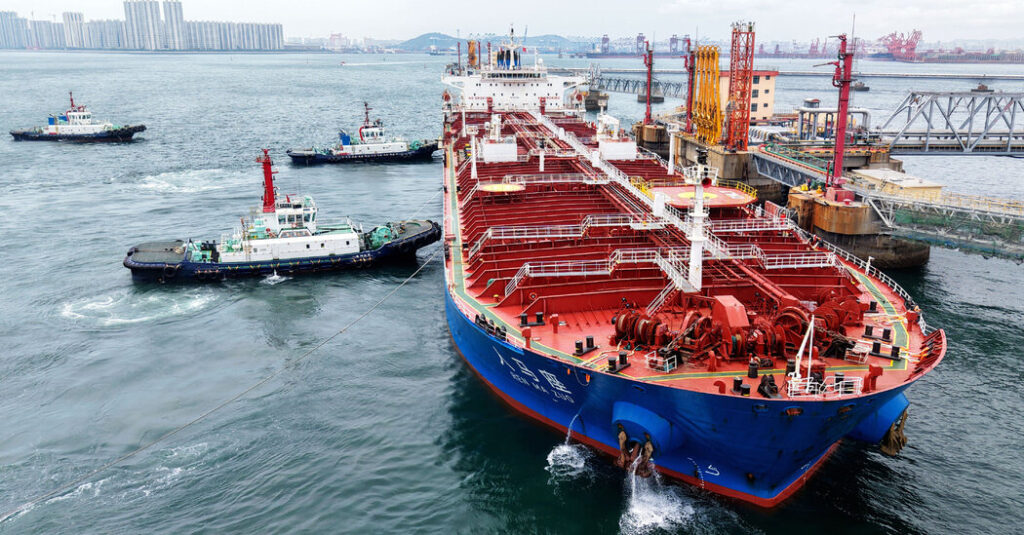
The passage of oil tankers through the Strait of Hormuz has been slowed significantly by the persistent cycle of hostility between the United States and Iran. But whether prices at the pump rise or fall will depend not only on how much oil flows out of the Persian Gulf but also on decisions made by China.
Typically the world’s largest oil importer, China slashed purchases this spring, reducing demand by so much that it prevented oil prices from soaring even higher earlier in the war.
Now, one of the biggest questions facing the market is: When will China start buying more oil again? The longer the country holds back, the lower oil prices are likely to go. The reverse is also true. A pickup in demand from China would raise prices, all else being equal.
“Where Chinese demand goes is really the most important piece of the puzzle,” said Karen Young, a senior research scholar at the Columbia University Center on Global Energy Policy.
Another significant factor is the Russia-Ukraine war. Wholesale diesel prices soared last week after Russia, one of the world’s biggest exporters, banned overseas diesel sales to preserve supplies at home. Ukrainian drone attacks have severely damaged Russian oil refineries, limiting the country’s ability to turn oil into transportation fuel.
Wholesale fuel prices generally foreshadow changes in consumer prices at gas stations, where diesel averaged $4.88 a gallon on Monday, up 2.5 percent from a week earlier, according to the AAA motor club.
There have been signs that China’s oil imports might soon pick up. The International Energy Agency recently cited procurement efforts and one-off tanker deliveries as hints of “renewed Chinese buying interest.”
It remains a mystery to most of the market how China has managed to slash imports by almost a third compared with a year earlier, according to May customs data released by Beijing. China is widely thought to have the world’s largest stockpile of oil, but it does not appear to have pulled much from the aboveground stores that analysts can monitor via satellite. And while its refineries have been processing less oil than usual during the war — and the country banned oil-product exports early on — that doesn’t fully explain the huge drop in imports, either.
The country has other levers to pull, including vast coal resources that it can use instead of oil products to make chemicals. At the same time, China gets a large share of its electricity from renewable energy and is the world’s largest electric vehicle market. Its extensive high-speed rail network, the biggest in the world, also dampens demand for oil.
This year is likely to be the first time China’s oil consumption will drop significantly since the oil crises of the 1970s and early 1980s, the I.E.A. said.
Regardless of how quickly demand recovers in China, the country’s vast stockpile of oil gives it a significant cushion. Many believe China can continue to hold off on increasing imports for some time.
“They’re not under any immediate pressure at all,” said Ben Cahill, a senior fellow at the Atlantic Council, a Washington-based think tank.
China’s ability to manage the market by ramping oil purchases up or down has been one of the biggest surprises of the war, analysts said.
That power over the global market is particularly notable since the country imports most of its oil. For decades, producers traditionally held the cards on oil prices. Time and again, members of the Organization of the Petroleum Exporting Countries, the oil cartel, have leveraged their significant market share to send prices soaring, as happened in the 1970s, or to allow them to plunge, as they did in 2014.
But OPEC’s influence has been eroded in recent years, first by the rapid growth of U.S. oil production and this spring by the departure of one of the cartel’s biggest members, the United Arab Emirates.
“China effectively operates more market power than any nation on earth, including Saudi Arabia and the United States,” said Gregory Brew, an analyst at the Eurasia Group, a research firm.
Of course, the intensity of the conflict in the Persian Gulf — and the extent to which it scares off shipowners — remains critically important for energy markets.
On Monday, President Trump said he was reimposing a naval blockade on Iran’s ports, a move designed to stop much of the country’s oil from flowing into the global market.
He also made clear that the United States does not plan to cede control over the strait to Iran.
“The U.S.A. will be, from this point forward, known as ‘THE GUARDIAN OF THE HORMUZ STRAIT,’” he posted on social media, adding that the United States would seek reimbursement for its services at a rate of 20 percent of “all cargo shipped.”
The ability to charge shipowners for safe passage through the strait has been a major issue of contention throughout the war, and it was not clear what authority the United States would have to assess such charges.
Since early May, the U.S. military has helped ships sail through the strait on routes close to Oman. Hundreds of millions of barrels of crude have been moved under that effort as of late June, according to U.S. Central Command.
“That has been effective until now, and it may remain effective,” said Richard Goldberg, the former senior counselor for Mr. Trump’s National Energy Dominance Council. “We’re at a moment of truth in how this will play out.”
For now, between the energy still flowing from the Persian Gulf, rising production in other countries and lower demand from countries like China, the world generally has the oil it needs. That is reflected in prices, which are hovering about 7 percent above prewar levels.
But cars and trucks run on gasoline and diesel, not crude oil. And between damaged infrastructure in the Gulf and in Russia, refineries are processing much less oil than usual. That partly explains why filling up remains more expensive than it was before the war.
Ivan Nechepurenko and Murphy Zhao contributed reporting.
The post China’s Next Move May Decide Whether Oil Prices Soar appeared first on New York Times.