The level of U.S. involvement in Venezuela since American forces captured its former president this year is remarkable. Secretary of State Marco Rubio has become a “de facto viceroy,” my colleagues report in a revealing story published this weekend. Through a steady stream of WhatsApp messages with its new president, Rubio controls Venezuela’s export revenues and decides how that money should be spent, who should be allowed to do business in the country and who should hold important offices.
That kind of authority over a foreign government is, let’s say, unusual. But it also comes with big risks for the United States — risks that have only grown after a pair of devastating earthquakes last month. That’s because the U.S. is entangling itself with a deeply unloved, unelected government that is rapidly losing its already limited credibility over a disaster response widely criticized as incompetent. Today I write about the explosive post-quake politics in Venezuela.
Rage vs. repression
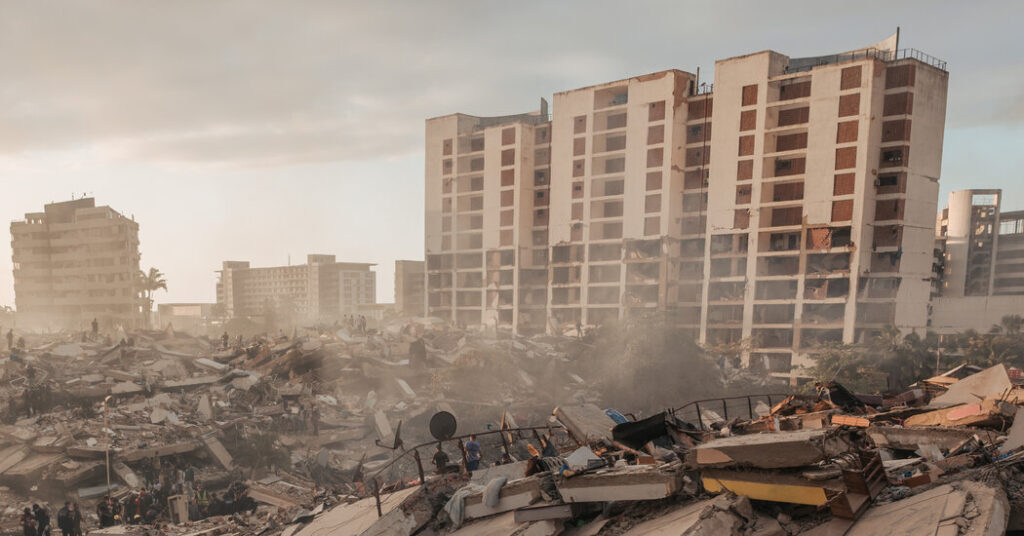
When the earthquakes came, much of the social housing project known as OPPE 26 — a densely populated set of concrete high-rises in the Venezuelan state of La Guaira — collapsed completely.
Drone videos reveal the scale of the destruction. The piles of dust and rubble the quakes left behind no longer resemble buildings at all.
The towers of OPPE 26 are far from the only buildings to have collapsed during Venezuela’s massive back-to-back earthquakes last month. But their utter destruction has taken on an outsize symbolic value.
These concrete blocks, home to thousands of people, were part of a showcase project of the Hugo Chávez government, built under a state program called Gran Misión Vivienda. They were a promise, as my colleague Julie Turkewitz writes, “to house the poor in dignity” as well as, in chavismo-speak, to “break the capitalist logic that commodified the home.” One Misión Vivienda project in La Guaira was named after the former president himself; the town homes in the Hugo Chávez complex “crumbled like toy houses,” Julie writes, amid questions about the quality of their construction.
The collapse of this state-built housing has fueled the post-earthquake rage at a repressive government that forfeited much of its legitimacy, even among many Chávez supporters, long ago. Now people are openly and forcefully voicing their anger at the government for the first time in years. Will anything change as a result?
‘Pockets of death’
Buildings like OPPE 26 weren’t just social housing. They were, as my colleague Anatoly Kurmanaev puts is, “the apex of a sprawling patronage system that helped keep the Socialist Party of Venezuela in power for nearly three decades.”
Plans for the buildings began in 2011, just ahead of an election, at a time when the Venezuelan state still had oil money to spend. Construction proceeded hastily; design details and information about soil tests were largely withheld from the public. Many were built by foreign companies with opaque contracts.
When they were completed, the government gave these apartments away and did not charge rent, Anatoly writes. In return, recipients were expected to attend government rallies, vote for its candidates and pressure their neighbors into doing the same. Those who supported the opposition risked losing their benefits, including the apartments.
It was a deeply transactional system; it also built a community.
But residents, seismologists and watchdog groups had long warned about the conditions in the OPPE complexes, including cracks in the walls and gas safety issues. (Complexes OPPE 25, OPPE 27 and OPPE 33 were also badly damaged.) In 2017, the president of the Venezuela College of Engineers called the questionable structural integrity of the units “a state secret.”
On June 24, the buildings became, as Julie memorably put it, some of Venezuela’s “densest pockets of death.”
“These people weren’t killed by the disaster,” said one man, who was searching for his son’s wife and their two children among the rubble. “They were killed by the government because they built these buildings like garbage.”
The return of repression?
His comment reflects something Julie noticed in her reporting on the earthquakes’ aftermath. People are suddenly talking to her in ways “that would have been unthinkable just a year ago,” she writes.
They’re angry that civilians are doing the vast amount of the rescue and recovery work, without training or equipment. They’re furious that Venezuela’s leader, Delcy Rodríguez, wore a luxury Italian ski jacket while visiting quake victims. And they’re openly saying so, in a state that still retains its vast repressive apparatus.
Many are also angry at their new American overlords who, after seizing President Nicolás Maduro and promising a phased transition to democracy, have nothing to show for it.
What happens next? In the months before the earthquake, Venezuela showed signs of tentatively creeping toward more political openness: Some political prisoners were released, and small protests were tolerated. But in the aftermath of a disaster that has killed 3,500 (a number that is still likely to rise) and has left thousands more homeless, openness might be harder to sustain.
The response might be a return to repression.
One test will come on July 28 — the second anniversary of the last presidential elections, which independent analysts say the opposition decisively won, only to have it stolen by Maduro. Labor unions and others are calling for countrywide protests.
The last time major social unrest broke out, after that election, Venezuelan officials responded by sending the military into the streets, killing protesters and locking people up. If something similar were to happen now, what would the U.S. do?
MORE TOP NEWS
The Iran cease-fire is unraveling
The U.S. conducted a fresh round of strikes on Iranian targets yesterday, a U.S. official said. Iranian state media reported explosions on an island in the Strait of Hormuz.
President Trump insisted that the strait was open to shipping traffic, adding that the U.S. had “bombed the hell” out of Iran on Saturday. Iran had declared the waterway, through which roughly 20 percent of the world’s oil supply passed before the war, closed. An Iranian attack on a container ship on Saturday set off the latest exchanges of fire. Follow our live updates.
OTHER NEWS
-
Lindsey Graham, a Republican senator and close Trump ally, died at 71. He was celebrated in Israel as a steadfast supporter of U.S. strikes on Iran.
-
One of Spain’s deadliest wildfires on record has killed at least 12 people. Another 23 people, mainly British and Belgian retirees, are unaccounted for.
-
Two people were killed and at least four others injured in a shooting at a street festival in Toronto.
-
The Trump administration issued subpoenas to several New York Times journalists after they reported on security concerns involving the new, Qatari-donated Air Force One.
-
Ukraine’s president announced a leadership shake-up, including the dismissal of the prime minister.
-
China evacuated nearly two million people before Typhoon Bavi made landfall.
-
Sheikh Hamad bin Khalifa Al Thani, who oversaw Qatar’s transformation from a little-known desert peninsula into a country with vast wealth, died at 74.
-
A speedboat carrying tourists capsized in southern Vietnam, killing 15 people.
-
My colleague Christina Goldbaum met families displaced by the war sheltering at the Lebanese National Theater in Beirut. Watch the video.
WHAT ELSE IS HAPPENING
-
Lionsgate’s contentious Michael Jackson biopic, “Michael,” became the studio’s first movie to earn $1 billion at the global box office.
-
An Australian judge ruled that the Melbourne Symphony Orchestra had not discriminated against a pianist whose performance was canceled after speaking out against Israel’s war in Gaza.
-
Jannik Sinner beat Alexander Zverev to win his second straight Wimbledon singles title.
TOP OF THE WORLD
The most clicked link in your newsletter Friday was a recipe for monkey bread.
WORLD CUP
The final four
After 100 matches, only France, Spain, England and Argentina are left standing. The semifinals will take place on Tuesday and Wednesday. Who is predicted to make the final?
Even bigger? Gianni Infantino said FIFA will examine expanding the next World Cup by another 16 nations to a 64-team tournament.
INTERVIEW OF THE DAY
Mick Jagger
The frontman of the Rolling Stones sat down for an interview before the release last week of “Foreign Tongues,” the band’s 25th studio album. At 82, Jagger spoke about how fame could make you “disassociated from what people might call ‘real life’” and how he has learned, with age, to switch off his stage persona. David Marchese, co-host of The Interview, described him as “chattier and warmer — and more playful — than I expected.” You can watch their conversation here.
MORNING READ
The film “Satluj” took only about a year to make, but filmmakers spent almost four more trying to get it past India’s censors. It explores the life of a human-rights activist who documented police abuses during the separatist insurgency that engulfed Punjab State in the 1980s and ’90s, one of the most violent periods in independent India’s history.
Censors demanded 127 cuts. The filmmakers eventually gave up on a theatrical release and posted the movie online instead, but the streaming platform removed it within 48 hours. Read more about the state of censorship under Prime Minister Narendra Modi.
AROUND THE WORLD
Farewell to the Vegas all-you-can-eat buffet
The modern American all-you-can-eat buffet is usually traced back to El Rancho Vegas, the first resort built on the Las Vegas Strip in 1941.
In 2019, the Las Vegas Sun newspaper described buffets as the city’s “regional cuisine.” Then, some 70 casino buffets — large, extravagant dining rooms with hundreds of dishes — lined the Strip. Today, around six remain.
Tejal Rao, a chief restaurant critic, recently visited Las Vegas, where she felt the promise of the city and its buffets: “Not just one more chance at abundance,” she writes. “But one more chance at being the kind of person who knows what to do with it.” Read more.
RECOMMENDATIONS
Read: These books take you back to the 1960s, the decade of space travel, counterculture and social change.
Gift: Going to a party and scrambling about what to give? Check this list for ideas.
Track: You can keep tabs on your diet, exercise and medication by turning your phone into a personal health dashboard.
Protect: Here’s how to prevent Meta from using your Instagram images in A.I.
RECIPE
This delicate and flavorful pizza dough will last in the refrigerator for up to a week. “I made lots of pizza dough recipes but for me, this one is the very best by far,” a reader commented.
WHERE IS THIS?
Where is this small island?
TIME TO PLAY
Here are today’s Spelling Bee, Mini Crossword, Wordle and Sudoku. Find all our games here.
That’s it for today. See you tomorrow! — Katrin
We welcome your feedback. Send us your suggestions at [email protected].
The post Venezuela’s Post-Quake Politics appeared first on New York Times.