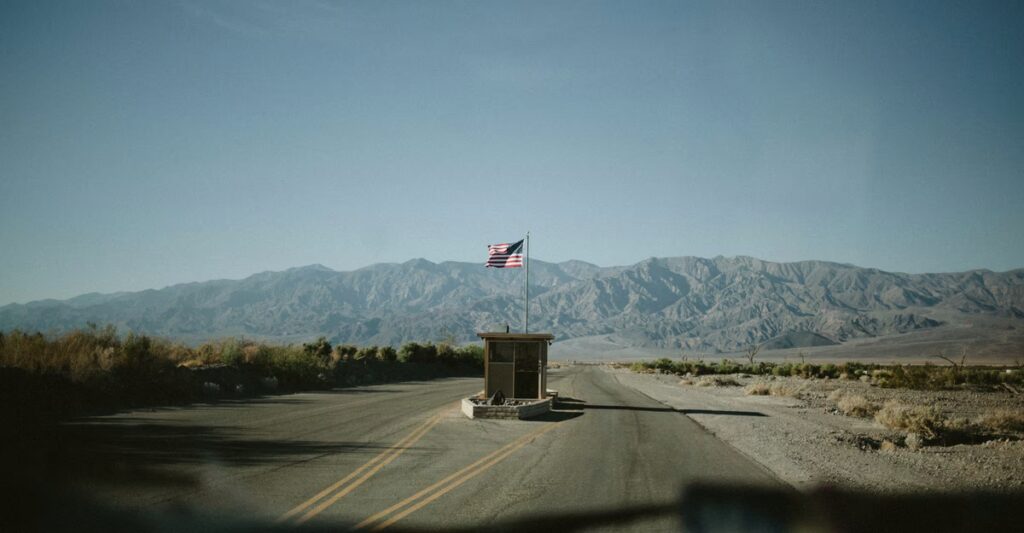
Driving on I-79 south from Pittsburgh toward Charlottesville, I started composing this birthday card in my head—a love letter to America on its 250th birthday. The hills of Pennsylvania were blanketed in glittering white snow from which bare-armed trees rose like the locals: lean, weathered, lined and stained like the earth. In a frozen sales lot beside the road, 50 John Deere tractors stood in formation, their booms raised toward the sky like eaglets waiting to be fed. At the crest of one hill, someone had planted an old shipping container painted with large letters: TRUMP. I drew closer, and more words appeared: GUNS. LIFE. JESUS. LOVE.
America is like a modern painting that looks different up close than from a distance. As both the prime minister and opposition leader of Israel, I worked directly with two American presidents and got to know two others. As the finance minister and foreign minister, I dealt with America’s financial and technology sectors. And in my youth, I spent a brief, unsuccessful period in Hollywood—the most memorable things from that chapter being a strange breakfast with Richard Gere and meetings with German bankers. But in between, I went to meet the real America.
For more than 35 years, at least twice a year, I have picked up a car somewhere in America and spent a few days on the road. It is my Vipassana, my way of disconnecting and reconnecting. Some of the most important decisions of my life have been made on those roads. My memories have blurred with the years, but I have probably visited 40 states. I have never made it to Alaska or Hawaii, and for some reason missed both Dakotas—but will get there someday. I know that the best onion rings in America are at the Crystal Beer Parlor in Savannah, Georgia; that the best gas-station coffee is found at the Love’s chain; and that the pharmacy in Walmart is always to the left of the registers. Once I drove toward what looked like a great gray mountain range blocking my way to Buffalo, New York, only to realize as I drew closer that it was a winter-weather front rearing above the highway, clouds swollen with hard hailstones. In November 1995, I sat on a hard bed in a Motel 6 in New Mexico and watched a television announcer report the assassination of Yitzhak Rabin. A Santa Ana wind carrying sparks of burning brush once bore down on me in California.
The journeys have taken me down highways and back roads. I have had short conversations, meaningless conversations, strange conversations, and long conversations that scored something into my soul. I always listen to music. In the beginning it was almost exclusively Bruce Springsteen and Johnny Cash, but over the years I discovered Jason Isbell, Zach Bryan, Ray LaMontagne—the poets of asphalt and the wounded heart of rural America. Most of the time, I have tried to honor the commandment of the French philosopher Simone Weil, who said that the most generous thing a person can do is truly listen.
And what I’ve learned is that the standard account of the current era is entirely wrong. The conventional wisdom is that the United States is violent, dispirited, trapped inside an identity politics of its own making—conspiracy theories, algorithms, incel forums, pornography, immigrant hatred in the land of immigrants, social networks that are a pathetic imitation of human society. The world has been turned upside down: Conservatives now want to change everything, while progressives want everything to go back to the way it was. Americans went looking for the light and were caught in the selva oscura, Dante’s dark wood.
[Watch: American democracy, 250 years later]
Everything has already been said about this dystopian portrait, except perhaps one thing: It is not true. The eulogies for America are not insight; they are more closely akin to malicious gossip. Perhaps it is easier to see this from the outside. America is not the pale boy who pulls the hood over his disheveled hair and then opens fire in a schoolyard. America is all of the other children. The ones who shield smaller kids with their own body, the ones who block the classroom door at the risk of their life, the ones who stand, embracing, at a funeral, talking about a new beginning.
The media world in which you live plays on an endless loop the story of a toxic and corrupt America—but is that also your immediate experience? Is that how the people you know, the people you work with, behave? It does not describe Bob and Earl, who fixed my flat tire in Tucson and refused to take money. Or the oiled-skin bodybuilder at Venice Beach who cheerfully taught me tricep exercises. In the real world, do you actually know any liberals who support ISIS? Have you ever actually met a conservative with a Hitler poster in his basement? Even the claim that families are being torn apart by political polarization—how anchored is it in the reality of your own life?
And to the extent dissension is visible, the intensity of the current American argument is less a weakness than a strength. Families are not torn apart over political questions in North Korea. There is no polarization in Afghanistan. Russia is far more united around its leadership than the United States is. But do you envy those countries? American life is not the product of a fixed formula but of free debate among equal citizens.
America is less a victim of the new age than its beneficiary. In the United States, digital chaos meets a society not built on the expectation of uniform order, but one accustomed to living inside a continuous experiment. The future is not a finished product arriving from a distant land, packaged like a tea bag; it grows through thousands of local adaptations, through argument, mistake, correction, and audacity. America thrives on this sort of individualism. In the U.S., every person is a business; every content creator is a broadcast network; every programmer is a factory. This is the strength of America, the weakness of America, the engine of America, the pain of America—the cradle of America and its means of reinvention.
In Kansas, deep in an endless forest of cottonwood, I pulled into a gas station with a small shop. A mother and daughter—alike in look, alike in dress—greeted me, both smiling. The daughter had a gold ring threaded through her nostril; the mother had the ruined ankles of her trade. The store gleamed with cleanliness and smelled of apple cider. Bags of beef jerky hung on iron hooks. The shelves displayed dozens of snacks, at least 15 types of bottled water, a bucket of bananas, sandwiches wrapped by a careful hand. There are hundreds of thousands of stores like this along every road in America—all of them the same, each of them distinct. The gas-station store is not just a workplace—it is a source of pride, of self-worth, of relief from the loneliness of the American frontier.
Because Americans have always been lonely. Ask the Census Bureau how many countries of the world have sent immigrants to America, and the official answer is: all of them. They all came—the tired, the poor, the yearning to breathe free, and also the brilliant, the ambitious, the restless, the unpredictable. They did not come to be together; they left togetherness in order to come. The founding experience shared by Americans, or by their forebears, is the severing of roots—the waiting for a yellowed letter to arrive from home as it tumbled across the sea for months. They were tormented by the same questions that plague immigrants everywhere: Why don’t I understand the rules here? When will I understand them?
But in America, distinctively, the answer is clear and singular: We wrote down the rules for you. They are plain. They belong to everyone. The loneliness you feel is not a weakness. It is a call to action.
People like me—the children of the non-American world—are accustomed to thinking of loneliness as a kind of slow sadness. Loneliness is the failure to connect, the disintegration of a family, the collapse of a community. Loneliness means you have fallen from a train and are lying beside the tracks, listening to the shriek of the whistle dying into the dark.
A Chinese diplomat once explained to me that in the Far East, the smallest human unit—he called it “the molecule”—is not the individual but the family. “We don’t start counting ourselves at one,” he said. “We start at three.” In the world I grew up in, loneliness was a form of nonexistence—not merely the absence of people, but the absence of witnesses to your being. Do you remember the question about whether a tree makes a sound when it falls in the forest with no one to hear it? In the forest where I grew up, it could not have fallen in the first place. The trees around it would have gently wound their branches about it to help it stand. In America, though, trees are just trees. You can cut them down or climb them.
The ancient East and Africa developed from the force of tribal dynasties; Europe grew from the power of great noble houses; only America was created by the force of the individual. Everywhere else in the world, the question that defines people is: Where do you come from? In America, it is: Where are you going? Americans are people who crossed oceans, fought the waves, reached the shore, and then burned the ship to make certain there was no going back. The country may be known for building strong communities around churches and sports teams, but the story of each individual American begins with the abandonment of what Thoreau called “quiet desperation.” Someone stood alone, stripped of illusions, and understood that the only way to truly live is to set out.
America is the place where the individual precedes the tribe and the story precedes history. Loneliness is not a glitch in the system; it is the raw material from which the system was built. The vastness of the land is part of this. The infinite emptiness forces Americans to decide whether they are lost or simply haven’t yet found what they’re looking for. Americans are not aware of how enormous America looks to outsiders. Texas alone is more than 30 times the size of Israel. Alaska is larger than France; Montana, larger than Germany.
When you travel through the immense American space, you discover that a community is not necessarily a group of people who have always lived together in a fixed spot on a map. You can build a community of people who have never met, bound to one another by the force of a shared story. Benedict Anderson called these “imagined communities”: people who do not know one another but belong to the same political and historical we. Americans tend to carry the same ancestral story: I came from far away. I worked harder than anyone. I beat all the odds.
The elderly Korean couple running a corner grocery in New Jersey, the girl from Tahiti working at a Starbucks in Des Moines, the Montana rancher who dresses exactly like a Montana rancher in a Taylor Sheridan series—all share a version of what Max Weber called the Protestant work ethic. Their forward motion reflects not merely ambition, but a religious and moral vocation. When they reinvest what they have earned to earn more, that is not an economic calculation—it is the road to salvation.
[Ron Chernow: What would Mark Twain think of America at 250?]
From the pressure of American loneliness came great entrepreneurs, inventions that changed the world, companies that generate unimaginable wealth. The American century gave us the computer, the internet, the smartphone, space travel, modern medicine, cinema, rock and roll, Hemingway and Faulkner, consumer culture, AI. And also: inequality, cultural aggression, religious fundamentalism, racial conflict, drug culture, and the sign on I-84 among the gray-silver sagebrush covering the high desert of Idaho: GUNS! ON SALE! NOW!
The motto on the eagle’s seal reads e pluribus unum—out of many, one. Americans are each responsible for their own fate, and only from that does the shared fate emerge. Loneliness created the first nation in history in which almost everyone has already changed the course of their life at least once—and can do it again.
After several hours behind the wheel, en route from Missouri into Kansas, I was ready to swear that what first appeared an optical illusion is actually empirical fact: The farther west you go, the bigger the sky grows. As I drove through the buckle of America’s Bible Belt, the evangelical heartland, a biblical reflection rose in me. My teacher and rabbi, Lord Jonathan Sacks, who served as chief rabbi of Britain, once wrote that in the middle of the long journey through the Sinai Desert, God commanded the Israelites to build him a portable sanctuary. Why did he do this? Sacks wondered. What need was there for a tabernacle when the Promised Land lay just ahead? His answer was that the people were fractured, furious, and full of dread, and this was God’s way of uniting them. “To turn a group of individuals into a covenantal nation,” he wrote, “they must build something together.”
Why does a man love his house? Because he built it—because he passes by the doorframe, and on the doorframe there are small lines, and only he knows that on that doorframe he once marked the height of his firstborn child.
Most nations grow from the earth and only afterward find the words to describe what had happened to them: Hunters and gatherers arrive at a place worth settling; families expand into clans, into tribes, into noble houses, into dynasties that will crumble under the weight of intrigue and desire. On their way to becoming a nation, human groups pass through wars, migrations, wanderings, settlements; forge covenants; adopt faiths. These are the founding materials of national myth. Stories are how we extract sequence from chaos—how we make the world comprehensible. Without a story, there is no nation. Switzerland has four official languages that demarcate four ethnicities, but one story that makes it a nation. Tuscany, far more homogeneous, gave the world Michelangelo, Dante, and Machiavelli—and never became a nation. A nation is not created from cultural brilliance, magnificent as it may be, but from a political agreement about a shared future.
In his magnificent 1882 lecture, “What Is a Nation?,” the French historian Ernest Renan compared the Swiss and the Tuscans to argue that a nation is built not only on shared memory but also on shared forgetting. Over time, he said, a mechanism of selection operates, allowing us to transform contingent or contradictory events into a coherent story, into the political organization of a common life, and even into moral value. As the years pass, partial history becomes complete story—and around it we create schools, ceremonies, monuments, an anthem, a flag, quarrels we are unwilling to drop.
On one of my earliest trips, I arrived in Tombstone, Arizona, a tiny town of fewer than 2,000 people. “Do you remember the Western with Kirk Douglas and Burt Lancaster, Gunfight at the O.K. Corral?” I asked my father in a collect call from a gas station. “Look up Gabi,” he replied. Gabi was a distant cousin from the kibbutz who fled after one of Israel’s wars and ended up, of all places, working in a silver mine near the town. I found him in the local phone book. (A collect call, a phone book—these concepts have long since passed from the world, and testify now mainly to my age.) “Meet me at the O.K. Café,” a surprised Gabi told me. “My wife waitresses there.”
The meeting did not go well. Gabi’s wife brought us sweet iced tea and a bowl of greasy fries and said one too many times that it was “on the house.” She was of German Swedish stock—that sturdy breed of fair-skinned, fair-haired immigrants—and he was small and awkward, trying to work out whether the relative who materialized from nowhere was about to ask him for money or a place to sleep. Over the years, it emerged, he left the mining business and moved on to teach Hebrew at a nearby college. “Did you know,” he asked me, “that Wyatt Earp is buried in a Jewish cemetery?” I did not. “He had a Jewish companion,” Gabi said, pensively. Gabi’s non-Jewish companion stared at the poster of a moustachioed Earp hanging behind us. What builds a nation, argued Ernest Renan in distant France, just months after that gunfight at the corral, is the capacity to turn an often violent and troubled past into a shared destiny.
In the beginning was the word: “We hold these truths to be self-evident, that all men are created equal, that they are endowed by their Creator with certain unalienable Rights, that among these are Life, Liberty and the pursuit of Happiness.”
Thomas Jefferson, 33 years old, wrote those lines in a fever with his quill pen, deleting and correcting almost to the last moment. He was younger than most of the Founding Fathers, but they recognized that he was the finest writer among them. This, too, is an American story: The Declaration of Independence was written not by Washington, the warrior, or by Adams, the constitutional expert, but by the man who knew how to breathe life into the story of the nation they had decided to create from nothing. Even Jefferson—young and arrogant as he was—had doubts about whether he was up to the task. “You can write 10 times better than I can,” Adams told him, dryly.
The story Jefferson wrote began with the shattering of the past’s chains. The American Declaration of Independence is not merely an announcement of a nation’s birth; it is also a detailed indictment of King George III. The first Americans needed a tyrannical father figure to rise up against. This is presumably what Ezra Pound meant when he wrote that American literature is built on the idea of rebellion against tradition. You cannot create something new while you are still a prisoner of the old.
[Gal Beckerman: The two kinds of American patriotism]
I thought about this during a long walk through Monticello, Jefferson’s historic estate in Virginia, among maple and pecan trees, lilac and magnolia blossoms. The prose of the Declaration is dazzling. Perhaps that is why we forgive Jefferson for the fact that at the moment he wrote, not a word of it was true. Men were not equal. They were not free. By the evidence of the time, they were far from happy. What they, Jefferson and the others, were telling the world was: Yes—but if we want it badly enough, we can be.
To the traveler from the East, America represents the apex of the arc: the man standing alone before the infinite spaces of his loneliness, before a wild nature and a silent God. He has no history to lean on. He has no place in the world—until he invents one. He was not cast out of Eden; he is riding toward it. He is a figure without a past, so he enlists the future on his behalf and writes history before it has happened.
In the winter of 2021, just before yet another Israeli election, I stole a few days on American roads—to think, to write, to gather strength and quiet before the storm. (I did not know then that the election would end with my forming a government.) Between Oklahoma and Nebraska, between enormous, white-winged turbines and infinite carpets of golden-brown grass, grazed by black Angus cattle, I translated Walt Whitman’s “Song of the Open Road” into Hebrew: “They go! they go! I know that they go, but I know not where they go, but I know that they go toward the best.”
The poem carried me down I-80 until I reached Gettysburg—where I found cast-iron Union cannons scattered across a serene field like a child’s toys. Tourists in khaki pants and white sneakers, their reddened noses barely visible above blue North Face puffer coats, stood with me at the overlook and gazed at, essentially, nothing. Our imaginations filled the green valley with 15,000 silent listeners. Before them stood a tall, gaunt, somber man who had come to dedicate a cemetery.
Lincoln spoke for fewer than three minutes. For Lincoln, too, loneliness was the raw material—the space of creation. From loneliness, words are born. The legend that he wrote the speech on the back of an envelope is probably untrue, but he wrote it alone, and quickly. He delivered the first draft of the nation’s story without anyone else editing it. He did not speak of the past, but of “the unfinished work.” The speech contained no quotation from scripture yet was soaked in religious consciousness. As in Genesis, the act of creation was an act of words: “And God said, ‘Let there be light.’”
This is the American formula: Say the words, then make them real. This is what turned it into a nation, then into a state, then into the greatest economic and military power humanity has ever known. In Europe, as in the East and the Islamic world, elderly leaders and stern clerics speak with contemptuous fury about the “Americanization” of their countries. They argue that ancient and proud civilizations should not have to bow before Coca-Cola and Taylor Swift’s Instagram. But their young people see something else entirely: They see a world in which the future is whatever you make of it. America is permission—permission to break a trail where no one has walked before.
A century later, the tormented leader had been replaced by an electrifying one: In September 1962, John F. Kennedy—the young, handsome president—arrived at Rice University in Texas to announce his space program. “We choose to go to the moon” and to set ourselves other tasks, he said, “not because they are easy, but because they are hard.” We have no limits except those we create for ourselves; nothing can stop us but ourselves. That was the peak of bright-eyed, white-toothed, buoyant American optimism—but the seeds of its undoing were already planted within it.
The moon mission drove forward microchip technology, which begat the personal computer, which begat the internet and the information revolution. But then something terrible went wrong. Information overflowed its banks. The river became an endless, violent Sambation of uncontrolled data. The age of doubt began.
The Austrian American economist and sociologist Joseph Schumpeter coined the term creative destruction in the 1940s to describe the mechanism by which capitalism clears way for new things by destroying the old ones. You do not harness a car to horses. You do not tie an email to the leg of a carrier pigeon. Progress can be brutal. It leaves whole ways of life on the roadside; entire professions vanish; parents lose their authority before their children. Faced with a world whose rules have been shattered, you feel—again, that word—loneliness.
These moments always produce fierce resistance. The Luddites were right when they broke into factories at night and burned the looms. They were defending their families, defending a God-fearing tradition of manual labor that had provided stability and a social order worth preserving. They were right, but it did not save them—because stability, like generosity and forgiveness, is a value in family life, not in the life of a state. We all live inside this double order, in which one value system, sentimental by nature, governs our families and communities, and a very different one—far more efficient and pragmatic—governs the economy.
Today, an economy and society built on industry, software-based services, and a Victorian educational system is being replaced almost overnight by an era of creativity, data, and digital chaos. The interstates of the ’50s are giving way to fiber optics; Starlink satellites connect even the most remote cabin to the centers of power and knowledge. Social media began the process; AI escalated it. Industries, nations, international systems—we are all feeling the collapse of the existing order, and we have only hints about what comes next.
At an IHOP on the outskirts of Memphis, I fell into conversation with a bearded truck driver eating pancakes with bacon and maple syrup. He was a large, pleasant man who looked like a cross between Nick Offerman and a Saint Bernard. Autonomous trucks worried him. He had read a few articles about them but still couldn’t quite understand how they would work. The one thing he knew about the future is that he had no idea what his life would look like in five years.
Not only systems such as robotics and data processing will change, but also education, security, transportation, and government. Drone swarms are replacing tanks and artillery; digital tutoring is taking over our children’s classrooms; the established press has already been transformed. In the political sphere, as Yeats foresaw, “the best lack all conviction, while the worst are full of passionate intensity.” It is not unreasonable to assume that the major political parties will fracture and then reconstitute themselves. Our past has ceased to be a reference point. Everything we have learned in our life provides little data about the future. Schumpeter called moments such as the one we are living through “gales of destruction.” The instability you are feeling is not cracking the process—it is the process.
In these circumstances, I am putting my money on America. Europe will exhaust its remaining strength in the effort to preserve its implausible quality of life. Europeans will want to keep living in the same palace, beside the same river, with the same workers in yellow vests going out on strike after strike. Russia has spent itself in one war too many. China will do everything in its power to preserve its centralized-leadership structure, trying to control the code while fighting to prevent mass job displacement that could ignite dangerous political unrest.
America, by contrast, has never been especially stable, ordered, or harmonious. It has relied on states, cities, communities, universities, churches, entrepreneurs, nonprofits, small businesses, private individuals—a dense web of centers, all competing, learning, failing, and trying again. In America, as the digital age dismantles institutions, professions, and habits, it encounters a culture already built psychologically around the idea that life is not an inheritance but a draft.
[From the July 2026 Issue: How America gave up on its own history]
One of the things that surprised me when I first began traveling in the U.S. was the ability of so many Americans to fix things with their own hands. The first cars I drove were from cheap rental agencies. Once, I even bought a rusty Dodge Diplomat for a few hundred dollars and disposed of its carcass somewhere near Boston. Cars, in those days, had a tendency to break down quickly. This is how I discovered that Americans don’t go to a mechanic before they’ve raised the hood and tried to fix the problem themselves. That was the first time I encountered the possibility that mechanical skill might be a cultural phenomenon. Americans fix things. It is part of their mythology. When the nearest garage is 200 miles away, it’s useful to know how to change a battery alone. What you are calling “the loneliness epidemic” is, in fact, your immune system.
America is not a cathedral—it is a workshop. Its people have always known how to learn fast, adapt fast, shed old habits fast. America is great because every few years, or decades, it has known how to change its story. To a visitor, what feels to Americans like polarization looks like the conversation the rest of us have never dared to have. Intellectuals on the right and left are now reviving the Federalist idea of “laboratories of democracy,” as pragmatic governors—Democrats and Republicans—insist on discussing complex problems in sentences longer than seven words.
Tocqueville, the founding father of the American road trip, said that Americans possess what he called “the art of association.” They set out alone—but faced with dangers and challenges, they define goals and then converge to work together to achieve them. I see that happening now. All across the country there are people building, repairing, arguing, praying, volunteering, enlisting, starting small businesses, writing groundbreaking research, giving to their community, opening their door to the brave, and inviting their neighbors to do again what America has always known how to do.
They are turning loneliness into a covenant.
The post The Surprising Source of America’s Success appeared first on The Atlantic.