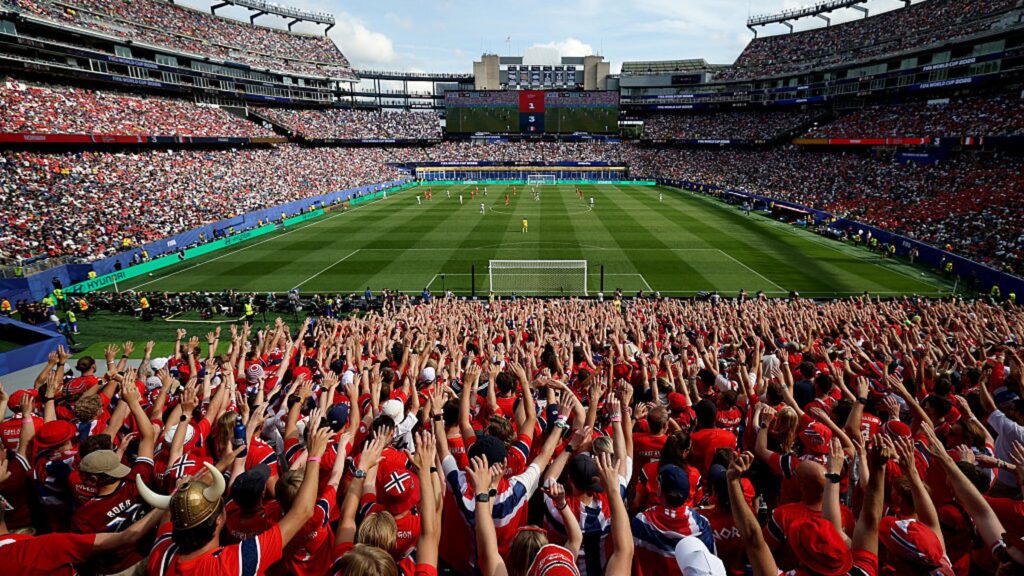
This World Cup, soccer fans are making a scene—and bringing people together, in the process.
At Boston’s South Station in mid-June, a group of Norwegian football fans created what could have been an awkward moment. The fans sat one behind another on an escalator, leaned forward and back in synchrony, “rowing” through the station as if the moving metal stairs were ferrying them across the North Sea.
Train stations are not forgiving stages. They are places of delay, impatience, platform changes, garbled announcements, and people trying very hard not to make eye contact. Escalators are even narrower social spaces, governed by a universal public etiquette: face forward, keep moving, and avoid becoming the reason anyone else has to stop.
By every ordinary rule of public life, the South Station scene should have induced annoyance or caused embarrassment. Instead, commuters stopped. Phones came out. Some locals took up an imaginary oar and joined in. The fans were performing the “Viking Row,” a ritual that has followed Norway through the World Cup. It carries the theatrical shape of something ancient, but its social force is contemporary. Its power comes from participation itself: people finding one another in public, copying a gesture, repeating it, teaching it, altering it, and making it feel like their own.
Unusual fan rituals like these show us how to actually create a sense of belonging. With communities across the country facing a “loneliness epidemic,” this lesson could not have come at a better time.
To be sure, the Norwegians are not alone in broadcasting their rituals during this FIFA World Cup. In Houston, thousands of Dutch supporters marched through the heat in a river of orange on the Oranje Fanwalk, joined by almost anyone willing to enter the procession. After matches, Japanese fans once again stayed behind to collect trash from the stadium rows, continuing a practice that has become one of the most recognizable rituals in global sport.
None of these practices was invented by FIFA. No central committee designed it. No consultant mapped the emotional journey. No brand strategist decided when Norwegian supporters should row through a train station, which city streets Dutch fans dressed in orange, or that Japanese fans should answer both victory and defeat with identical displays of respect and care.
These moments captivate us because they show shared identity becoming visible through behavior. At a time when the lack of belonging has become one of the dominant anxieties of public life, shared rituals are more than merely charming. Workplaces measure belonging. Schools design programs around it. Politicians invoke it. Digital platforms promise it while often leaving people lonelier. Across institutions, there is now broad recognition that people are hungry for connection, but far less understanding of how humans build connection.
The usual institutional instinct is to treat belonging as a product that can be created for people and delivered to them. Leaders design the program, issue the invitation, announce the values, decorate the room, and expect the feeling to follow. The World Cup suggests a different model. Our attitude to belonging, it suggests, works much more like our relationship to change. It invites a person to move from “this is happening around me” to “this is something I have chosen to be part of.”
In 1912, French sociologist Émile Durkheim gave us a language to understand why these moments have such force. Writing more than a century ago about religious life, he described the phenomenon “collective effervescence“: the emotional intensity that emerges when people gather, synchronize their bodies and attention, and experience themselves as part of a larger whole. Of course, Durkheim was not writing about soccer supporters in train stations, but the concept applies here as well.
Anyone who has stood inside a packed stadium appreciates how rituals produce collective effervescence before knowing the term. A song begins in one corner and spreads. A crowd breathes and holds its breath, together. People who arrive as strangers find themselves in a community, even temporarily. A 2022 meta-analytic review in Frontiers in Psychology found that collective rituals are associated with a stronger sense of “we-ness” that can persist after the gathering ends. The ritual itself does not need to be elaborate. A clap, a march, a chant, or a cleanup after the final whistle can carry meaning when people perform it together and understand it as theirs.
Magic, however, cannot be manufactured. Anyone who has sat through a mandatory team-building exercise knows the difference between a ritual that binds and a program that irritates. The missing ingredient is ownership.
Michael Norton of Harvard Business School, with Daniel Mochon and Dan Ariely, captured this in their work on what they called the “IKEA effect.” In one experiment, participants who assembled furniture themselves were willing to pay 63% more for it than participants who received the same item preassembled. In another, people who folded origami valued their own imperfect work nearly as highly as professionally folded origami.
Why? People value what they have had a hand in making.
The importance of co-creation is on vivid display in the most successful fan rituals. A chant that is borrowed, practiced, altered, and taught to others is not a finished product. It is a poem still being written. People do not simply consume it. They carry it, improve it, and invite others into it.
Organizations spend enormous resources trying to create a sense of belonging from the center through onboarding experiences, engagement surveys, retreats, values statements, and culture programs. Some of this work has value, but much of it begins from the wrong premise. It assumes belonging can be delivered fully formed to a recipient.
Sociologists Jean Lave and Etienne Wenger described “legitimate peripheral participation” as the way newcomers enter communities. People rarely begin at the center. They watch first. They imitate. They try a small version of the behavior. They learn what is admired, what is expected, and what is forgiven. Over time and with practice, participation becomes part of their identity.
What the World Cup leaves behind is mostly familiar: flags, painted faces, a month of national feeling. What’s worth keeping is smaller and stranger. On a Boston escalator, a few people pull imaginary oars, and the commuters around them reach for an oar of their own.
That reflex runs far beyond sport. Every company, school, and city trying to hold people together in a lonely, fractured age is hungering for the same thing, and most go about it backward, designing belonging at the top and handing it down, perfectly complete. The rowers point to another approach. A ritual becomes yours only after you have practiced it, changed it, and taught it to the person beside you.
No one handed the Norwegians a way to belong. They made one together, oar by oar, and left it open for the rest of us. We belong most deeply to what we help make.
The post The World Cup’s Strangest Rituals Reveal How Belonging Really Works appeared first on TIME.