Erling Haaland and SoFi Stadium, ladies and gentlemen. Your breakout stars of the World Cup.
We’ve all fallen for the blond forward who has rowed Norway to its first World Cup quarterfinal berth — and also for SoFi Stadium.
Or “Los Angeles Stadium,” FIFA’s designation for the $5.5-billion architectural masterpiece that welcomed the world to Inglewood.
I cover Rams and Chargers games there regularly, but the World Cup changed how I feel about the place. It has more soul now, more character.
There is more history attached, “core memories,” as Kevin Demoff, president of parent company Kroenke Sports & Entertainment, put it.
The exultation when the United States went up 1-0 in the seventh minute of its tournament-opening, 4-1 victory over Paraguay? “That’s now a core memory of this stadium,” Demoff said.
So is the proud Iranian diaspora showing up en masse to mostly support Team Melli twice, in draws with New Zealand and Belgium.
And the goal by LAFC’s Stephen Eustáquio in the second minute of second-half stoppage time to lead Canada to a 1-0 victory over South Africa in its first knockout game.
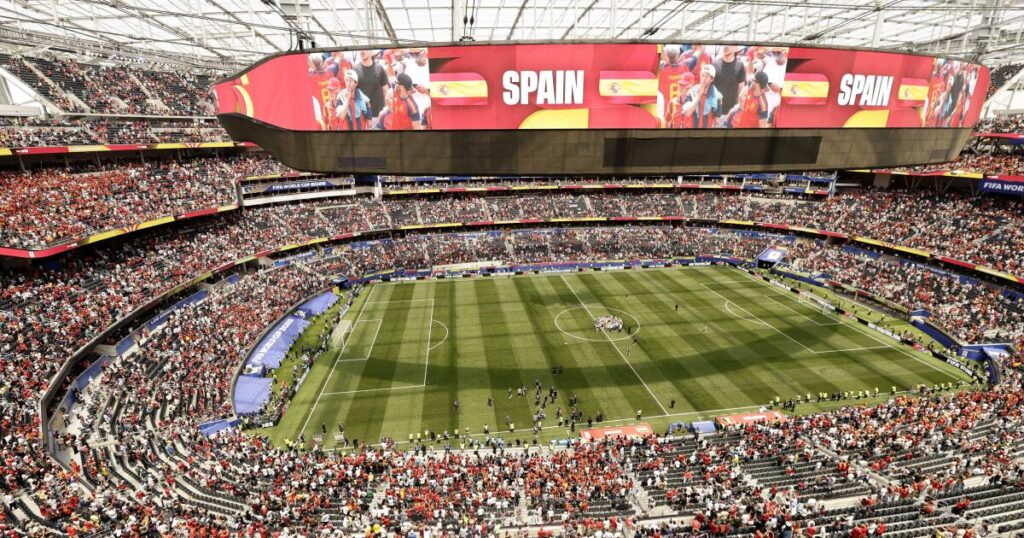
And Spain’s taut, 2-1 victory over Belgium in Friday’s high-stakes quarterfinals match.
FIFA might say these sensational scenes put L.A. — our tiny hamlet of more than 18 million people — “on the map.”
What they did was put SoFi Stadium on everyone’s radar as one of the world’s foremost football stadiums.
Jose Ovalle, a 34-year-old from Reynosa, Mexico, has watched matches at Estadio Azteca in Mexico City and Estadio BBVA in Monterey, both sites of World Cup action this summer.
“They’re amazing stadiums — a lot of history, so much history,” Ovalle said Friday. “But [SoFi Stadium] is one of the top stadiums in the world.”
Nah, said New Zealand coach Darren Bazeley: “This is the best football stadium I’ve ever been in.”
Swiss center back Manuel Akanji plays for Inter Milan and roots for the Atlanta Falcons. It was a big deal for him to play at their home field, Mercedes-Benz Stadium, in last year’s FIFA Club World Cup.
“It’s really nice, but this is the best,” Akanji said after Switzerland defeated Bosnia-Herzegovina in group play at Sofi Stadium. “This is the best I’ve seen overall among all the stadiums I’ve ever been to. It’s amazing.”
Eight matches, five group stage games, two round-of-32 knockout affairs, Friday’s quarterfinal and a partridge in a pear tree — it was a monthlong run that was everything SoFi Stadium’s team could have wished for when it began preparing to host eight years ago. And more.
“I don’t think you can envision the passion of national team fans,” Demoff said. “We’ve seen so many great events here, NFL games, concerts, but the pride of a national event and seeing people come to Los Angeles and the U.S. for the first time, and seeing this building for the first time…
“There’s something magical about 30,000 Bosnians in blue singing, marching from the airport to here. You can’t properly envision that, no matter how many times you’ve been here.”
People raved about sight lines and sound. They admired the architecture and the infinity screen and the way the canopy kept things cool. In line to buy merchandise Friday, Orange County’s Nick Valencia looked around and mused: “Wow, humans made this.”
Players had the run of the place on real grass, not the artificial turf in place for NFL games. (Don’t expect that to change, Demoff said, noting that upkeep would be doubly challenging at SoFi Stadium with two NFL teams using the field.)
Soccer fans amplified their positive reviews online, where the only complaint having to do with SoFi Stadium was that FIFA decided to give the World Cup final to the archaic-by-comparison MetLife Stadium — aka “New York/New Jersey Stadium” — instead.
The stadium popped in person and on TV, its distinctive, futuristic shape making it immediately recognizable in a way that not every stadium is.
Vibes were good among volunteers and visitors from around the world and every corner of the United States — and among stadium staffers, who won raises in a late-breaking contract agreement that resulted in increases to more than $30 per hour.
The Rams’ house — and Chargers’ — was full almost every match, with four sold-out crowds of 70,492 and an eight-game total of 561,656.
People paid thousands of dollars for tickets and got their money’s worth at the world’s most-expensive stadium, a modern marvel that’s only getting better with age.
Dodger Stadium is dripping in lore, from Kirk Gibson’s legendary walk-off home run in 1988 to more history, like Shohei Ohtani playing perhaps the greatest game ever last postseason.
Staples — er, Crypto.com Arena — is where Kobe Bryant dropped 81. Decathlete Rafer Johnson lit the Olympic flame in 1984 at the Los Angeles Coliseum. And we all can picture Brandi Chastain ripping off her top in her iconic celebration after scoring the game-winning penalty kick in the 1999 Women’s World Cup at the Rose Bowl.
“We may not have the Brandi Chastain moment from ‘99,” Demoff said. “But we’ve had so many great moments off this tournament that I think will be replayed over and over and over again.”
There are more moments to come, with SoFi Stadium slated to host Super Bowl LXI in February and then, in 2028, to stage the Olympic Opening Ceremony and the Olympic swimming competition.
“Where the U.S. scored the opening goal,” Demoff said, “is going to be the middle of the Olympic swimming pool. I think that contrast blows people’s minds. It certainly blows mine.”
And for the past month, Los Angeles’ stadium blew the world’s mind.
The post SoFi Stadium proves to be one of the biggest stars of the 2026 World Cup appeared first on Los Angeles Times.