This is an edition of The Atlantic Daily, a newsletter that guides you through the biggest stories of the day, helps you discover new ideas, and recommends the best in culture. Sign up for it here.
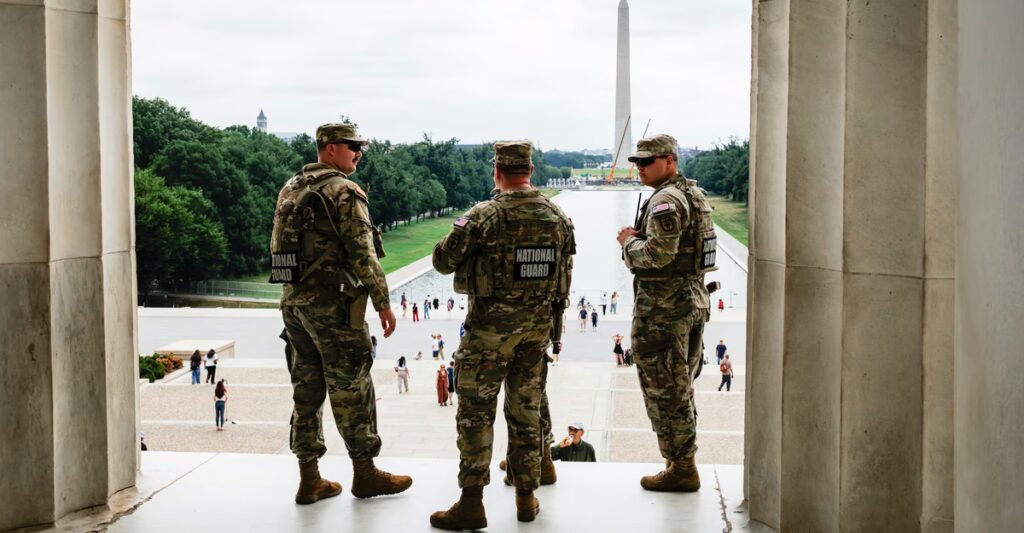
Donald Trump summoned the National Guard to Washington, D.C., last August in an attempt to “rescue” the city from “crime, bloodshed, bedlam and squalor and worse.” Since then, the number of soldiers in the capital has ebbed and flowed as states have lent their own Guardsmen to the cause. A month ago, there were just under 3,000 members of the National Guard in the area; now there are more than 5,000.
Officially, this “summer surge” was framed as a way to address an anticipated spike in visitors and activity around the capital for America’s ongoing 250th-birthday celebrations. But the National Guard is also involved in a much broader project known as the Safe and Beautiful mission—a federal initiative to clean up the city that Trump once described as a “rat-infested, graffiti-infested shithole.” Troops from across the country are currently stationed in the city, but their remit is not entirely clear, and their effect on violent crime remains limited. Eleven months into Trump’s experiment, they remain an ever-present symbol of the administration’s power.
Last year, Trump declared a “crime emergency” in the city. Crime is a real problem in D.C., as it is in all cities. But the president’s framing of the situation as an emergency meriting the immediate assistance of outside forces (which are usually called in for dramatic upticks in civic unrest) doesn’t align with the numbers: Around the time when Trump first sent in the National Guard, violent crime in D.C. was hitting 30-year lows, in line with a national trend.
The precise tasks involved in keeping D.C. “safe and beautiful” have so far been ill-defined; troops have spent time directing traffic, clearing out homeless encampments, raking leaves, and mulching flower beds. Their presence has had mixed results on crime in the city. In May, the Niskanen Center released data showing that the deployment seemed to have decreased opportunistic property crime, such as theft, by 24 percent—a notable downturn. The data also showed that the deployment had had no measurable effect on violent crime, which had already been declining when the National Guard arrived. (The Guardsmen whom Trump deployed to D.C. are not authorized to make arrests, but they can detain individuals.) The advantage of the National Guard is its flexibility, Richard Hahn, one of the study’s co-authors, told me. D.C. police have been “struggling to hire police officers for 10 years,” he said, but with the Guard, “you can command these soldiers to go to the city and police it.”
Trump’s decision to deploy these soldiers has thoroughly spooked a populace that already distrusts the president. Roughly 80 percent of D.C. residents opposed the arrival of Guardsmen last year, according to one survey. The fear, as my colleagues Ashley Parker and Nancy A. Youssef put it at the time, is that “Washington is being used as a test case—the blueprint for Trump to deploy the National Guard across the country as a paramilitary police force—and that Americans are being conditioned to accept authoritarianism.” In February, a report from the Senate Committee on Homeland Security indicated that the National Guard was using a variety of advanced data-collection tools (including the Defense Department’s AI-enabled Maven Smart System) in support of its duties, raising “potential privacy and civil liberties concerns.”
Ever since the National Guard arrived in D.C., troops have been criticized for seeming to spend a lot of time just standing around. Just standing around can be a component of law enforcement—being a visible presence on the street is one way to deter opportunistic crime—but it also generates unease. Jeffrey Butts, the director of the Research and Evaluation Center at the John Jay College of Criminal Justice, told me that the fear this deployment has created is likely part of the point. “This is not about crime, and it’s not about policing,” he argued. “It’s politics and demonstrations of state power.”
Many Republican-led states have dispatched their Guardsmen to the capital, but a few states with Democratic governors have also quietly lent their support. Michigan Governor Gretchen Whitmer sent approximately 170 of her state’s Guardsmen to D.C. as part of the summer surge. This week, a coalition of watchdogs and observers signed a letter urging her to withdraw the state’s troops and expressing concern that Guardsmen are carrying out operations unrelated to the July 4th celebrations. “When the governors put their Guard forces in the hands of the Trump administration, they are trusting the Trump administration not to misuse their Guard forces,” Elizabeth Goitein, a contributor to The Atlantic and a senior director of the Brennan Center for Justice—an organization that signed the letter—told me. “The administration, to put it mildly, has not earned that trust.”
Whitmer herself has expressed some skepticism about the administration’s plans for the troops. About two weeks ago, she wrote her own letter to the head of the Michigan National Guard warning him to “take all necessary measures” to keep the state’s troops focused on bolstering security for the festivities—and to keep them away from the more nebulous Safe and Beautiful mission. She added that if Michigan National Guard leadership is unwilling or unable to keep them focused solely on security for the anniversary festivities, she plans to withdraw the troops altogether.
Another blue-state governor, Tim Walz, recently made the decision to pull Minnesota’s Guardsmen from D.C. earlier than expected, although a spokesperson for the state’s National Guard told the AP that the decision was due to “the successful conclusion of festivities.” The AP also reported this week that the one member of the Kentucky Guard who’d been sent to D.C. had been diverted away from the 250th-anniversary celebrations “without the knowledge or consent” of the state’s governor or its Guard command, per a spokesperson for the Democratic governor. The Guardsman returned to Kentucky before the main events began. Hawaii’s adjutant general, Major General Stephen F. Logan, confirmed to me that the state’s troops, who began their duties in D.C. on Monday, will not be supporting the Safe and Beautiful mission either.
The longer these troops remain in the city, the more fear and anger they may inspire. The tension between the people and the troops has already exploded into violence; in November, two Guardsmen were shot and seriously injured. The deployment may have reduced some kinds of crime, but there’s more than one way to measure its effect on the city.
Related:
- A terrible and avoidable tragedy in D.C.
- Why is the National Guard in D.C.? Even they don’t know. (From 2025)
Here are three new stories from The Atlantic:
- CIA officers can sense the threat within.
- The timidity of America’s top generals
- Believe the hype about teen takeovers.
Today’s News
- The Trump administration has removed two members of the bipartisan Election Assistance Commission and accepted the resignation of another, leaving the independent election-oversight body without commissioners, the White House announced yesterday; the move, it said, was part of its effort to secure elections.
- President Trump said that he will not sign a bipartisan housing bill despite its passage by Congress. The housing measure will still become law without his signature.
- Trump said that the United States has agreed to Iran’s request to continue talks but that the cease-fire is “over” after days of escalating strikes between the two countries. Qatari negotiators met with Iranian officials today to discuss traffic through the Strait of Hormuz, according to Reuters.
Dispatches
- The Books Briefing: Emma Sarappo on what The Catcher in the Rye taught a teenage girl.
Explore all of our newsletters here.
Evening Read
The Rosenberg Boys
By Amy Weiss-Meyer
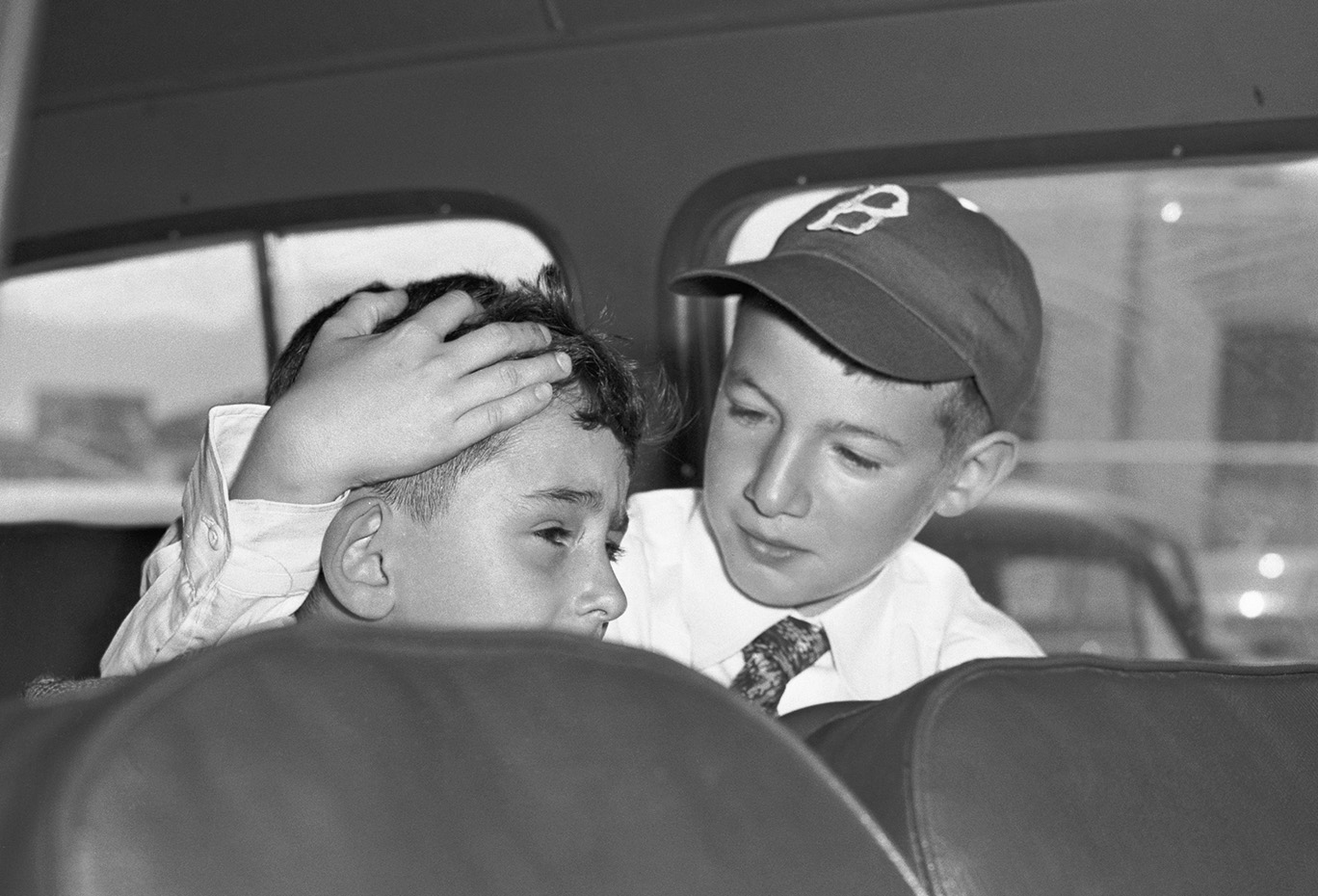
For those old enough to remember, Michael and Robby Meeropol will always be the Rosenberg boys.
I never knew them as such, but it’s not hard to imagine what they were like, in part because there are so many pictures. In one, from June 1953, they are sitting outside the White House in shirts and ties, wool coats, and Brooklyn Dodgers caps. Six-year-old Robby holds his grandmother’s hand; to his right stands a rabbi …
Out of the frame, but documented in other photos from that day, are the placards that protesters carried invoking Robby and Michael, the helpless boys made symbols of what many believed was a grave injustice about to be perpetrated against their parents. (Counterprotesters, carrying signs saying fry ’em and hang ’em, disagreed.) Similar scenes played out around the world. After Pope Pius XII called for clemency, the Vatican’s newspaper cited the “two little innocents on whose soul and destiny the death of their parents would forever leave sinister scars.”
I learned the broad outlines of the events that followed—the electric chair, and the orphans it left behind—half a century later, on a weekend visit to the home of my parents’ friends Robby and Elli in western Massachusetts.
More From The Atlantic
- Galaxy Brain: The hidden cost of optimizing everything
- The sports overload is here.
- A new phase of the AI-jobs panic
- The MIA caucus
Culture Break

Listen. Madonna’s new album is finally giving the world what it wants, Spencer Kornhaber writes.
Read. Jordan Harper’s new novel proves that noir can still channel the crises and neuroses of the moment, Carolyn Kellogg writes.
Rafaela Jinich contributed to this newsletter.
When you buy a book using a link in this newsletter, we receive a commission. Thank you for supporting The Atlantic.
The post What’s Behind the Latest National Guard Surge in D.C. appeared first on The Atlantic.