Summer is peak tick season, and with the pests comes the risk of Lyme, spotted fevers and other tick-borne illnesses. For decades, people across the United States have generally known what to expect from the ticks in their area. In the Northeast, where rates of E.R. visits for tick bites are the highest, for example, the blacklegged tick and the Lyme disease it spreads have long posed the greatest threat. And the lone star tick, which can cause the red meat allergy known as alpha-gal syndrome, has historically been a problem in the Southeast.
But some of those risks are changing as booming deer populations, shifting land use and rising temperatures bring different species of ticks — and their diseases — into new places.
We asked experts about the biggest threats in each region, as well as emerging risks.
In the Northeast, familiar illnesses increase as newer threats emerge.
Included in the region, as defined by the Centers for Disease Control and Prevention, is Connecticut, Delaware, Maine, Maryland, Massachusetts, New Hampshire, New Jersey, New York, Pennsylvania, Rhode Island, Vermont, Virginia and West Virginia
The main disease-causing culprit here is the blacklegged tick, commonly known as the deer tick, which carries the bacteria responsible for Lyme disease. Lyme can cause fever, fatigue and a bull’s-eye rash, as well as more serious complications.
An estimated 476,000 people are treated for Lyme disease nationwide each year, according to the C.D.C., and reported cases have risen over time in states such as Vermont and New York. So have other diseases transmitted by the tick, including the flulike babesiosis and the Powassan virus, a rare illness that can result in serious neurological symptoms.
Those changes are partly caused by a surge in white-tailed deer, a major food source for ticks, said Thomas Mather, who runs the Center for Vector-Borne Disease at the University of Rhode Island. The increase in deer has helped ticks thrive and hitch rides to new areas, including places closer to suburbs and cities, he said.
“It used to be a backwoods phenomenon, and then a suburban woods phenomenon,” Dr. Mather said. Now it’s possible to get some tick-borne diseases in a city park.
Dr. Mather added that the roving deer have also helped spread another threat: the lone star tick. A decade ago, reports of the lone star tick in New England were rare, he said. Now, their estimated reach is as far north as Maine.
In the Midwest, an expanding tick population brings Lyme to new states.
Including Illinois, Indiana, Iowa, Kansas, Michigan, Minnesota, Missouri, Nebraska, Ohio, Wisconsin
The blacklegged tick has long had a home in the upper Midwest, in states like Wisconsin, where reported Lyme disease cases have quadrupled in the last two decades. Now, the tick is traveling south, bringing Lyme disease into new states, including Ohio and Illinois. In 2010, Ohio saw 40 cases of Lyme disease, according to the state health department. By 2025, there were more than 2,900 cases.
Around half of the adult blacklegged ticks in the suburban Chicago area now test positive for the bacteria that causes Lyme disease, which was never the case before, said Johnny Uelmen, a disease ecologist and epidemiologist at the University of Wisconsin School of Medicine and Public Health.
Meanwhile, the lone star tick, established in Missouri, Kansas, Southern Illinois and Indiana, is traveling north. As in the Northeast, expanding deer populations are likely to play a role in the spread of both blacklegged and lone star ticks.
Warmer winters brought on by climate change are probably also creating a friendlier environment for ticks in the Midwest and New England, Dr. Uelmen said.
In the Southeast and South Central, human development creates more risk for tick encounters.
Including Alabama, Arkansas, Florida, Georgia, Kentucky, Louisiana, Mississippi, New Mexico, North Carolina, Oklahoma, South Carolina, Tennessee, Texas
The lone star tick is the biggest threat in the Southeast, with an established population across the region. Along with the risk of alpha-gal syndrome, the tick can spread illnesses including ehrlichiosis, which can cause fever, aches and nausea. (They can spread these illnesses anywhere, but the ticks are much more established in this part of the country compared to others.)
The blacklegged tick is also now inching into the area, bringing Lyme disease down the Blue Ridge Mountains into North Carolina, said Dr. Ross Boyce, an infectious disease specialist and epidemiologist at the University of North Carolina at Chapel Hill.
Beyond rising temperatures and changes in the populations of deer and mice, another food source for ticks, Dr. Boyce noted that more people in North Carolina and elsewhere are building houses in the woods. This has made encounters with ticks more common.
The American dog tick also lives here and nearly everywhere east of the Rocky Mountains, including the Northeast and Midwest. A small percentage of them carry the bacteria responsible for Rocky Mountain spotted fever. The disease can be fatal if not treated quickly. The Gulf Coast tick, native to states along the southeastern coast, carries another form of spotted fever. These illnesses are much less common than Lyme disease: Just over 1,200 spotted fever cases were reported in 2023, C.D.C. data show.
In the West, the risk of spotted fever is rising, though still small.
Arizona, Alaska, California, Colorado, Hawaii, Idaho, Montana, Nevada, North Dakota, Oregon, South Dakota, Utah, Washington, Wyoming
Brown dog ticks have increased the risk of Rocky Mountain spotted fever along the southern border, said Dr. Janet Foley, a veterinarian and disease ecologist at the University of California, Davis.
The tick, found across the United States, does not carry the bacteria that causes Rocky Mountain spotted fever in most places. But some dog ticks from Mexico do carry the disease. Cases in the United States started popping up in Arizona in the 2000s and have now spilled over from northern Mexico into the other border states.
“This tick, unlike the deer tick, loves the heat,” Dr. Foley said. “If you were to say, what’s one of the most important diseases that I have my eye on for climate change? It would be this.”
Rocky Mountain spotted fever can also be spread by Pacific Coast ticks and other species in the region. Along the West Coast, the western blacklegged tick can transmit Lyme disease and other illnesses.
State and local health departments routinely collect data on tick-borne diseases, and some of them even offer county-level maps or information that can give you a more granular look at the disease risks in your area.
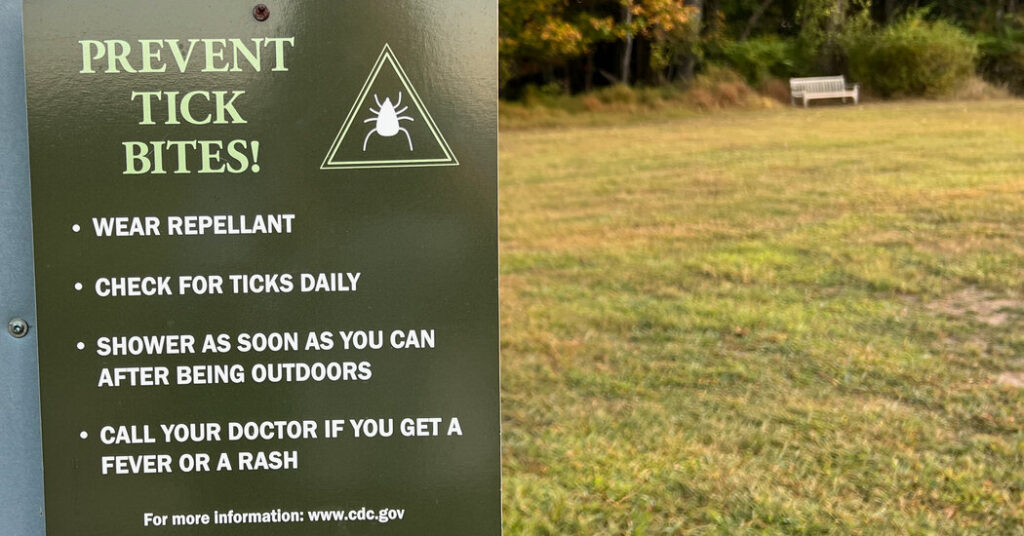
Even in lower-risk areas, infectious disease experts still recommend taking precautions, including wearing long sleeves or chemically-treated clothes in brush-heavy or wooded areas, showering and checking for ticks soon after being outside.
The post Ticks Are on the Move. Here Are the Risks in Your Region. appeared first on New York Times.