Paintings by Native American artists haven’t been shown often in D.C. museums, Indian artists having long been dismissively pigeonholed as working mainly in “crafts,” such as textiles and ceramics. The National Gallery of Art staged “Contemporary American Indian Painting” in 1953 but has not focused on Native painters since. (Its groundbreaking 2023 exhibition of contemporary Native artwork, “The Land Carries Our Ancestors,” featured some paintings but was not comprehensive.)
“Stretching the Canvas: Ten Decades of Native Painting,” now at the National Museum of the American Indian, aims to fill the gaps, charting the development of painting by Native Americans since World War I. The show includes more than 50 works by about 40 artists and spans several generations.
The exhibition notes that Native American painters not only faced indifference from the mainstream art world, but also, even when they were recognized, their output was expected to “look Indian.”
Quotations from about a dozen of the artists attest to those challenges. “My work tends to be less recognizable as Indian art … however people define that,” reads one from Mario Martinez, a Pascua Yaqui artist in Brooklyn.
Given those assumptions, visitors may be surprised by the substantial proportion of abstract works on view. The exhibition opens with Cherokee artist Kay WalkingStick’s striking 1975 painting “Homage to Chief Joseph (Chief Joseph #1),” named after 19th-century Nez Percé leader Chief Joseph. Made using encaustic, a mixture of pigment and wax, the piece has a central field of deep reds and browns that vaguely conjures a stormy sky, framed by several layers of geometric borders.
Two recent abstract works incorporate organic materials to strong effect, including “Thirteen Days” (2017-2019) by Athena LaTocha, who is of Standing Rock Lakota and Keweenaw Bay Ojibwe heritage. Over 13 days in the New Mexico desert, LaTocha left a 10-foot length of paper to be weathered by the elements and then stained it with ink, shellac and soil. The result is a dramatic composition of distressed and uneven surfaces in browns, blacks and tan.
In “Access Denied” (2021), Melissa Melero-Moose (Northern Paiute/Modoc) used pine nuts to add texture to a yellow-green painting of a captivating lattice of concentric circles — a statement on how private lands delineated by fences block access to cultural resources.
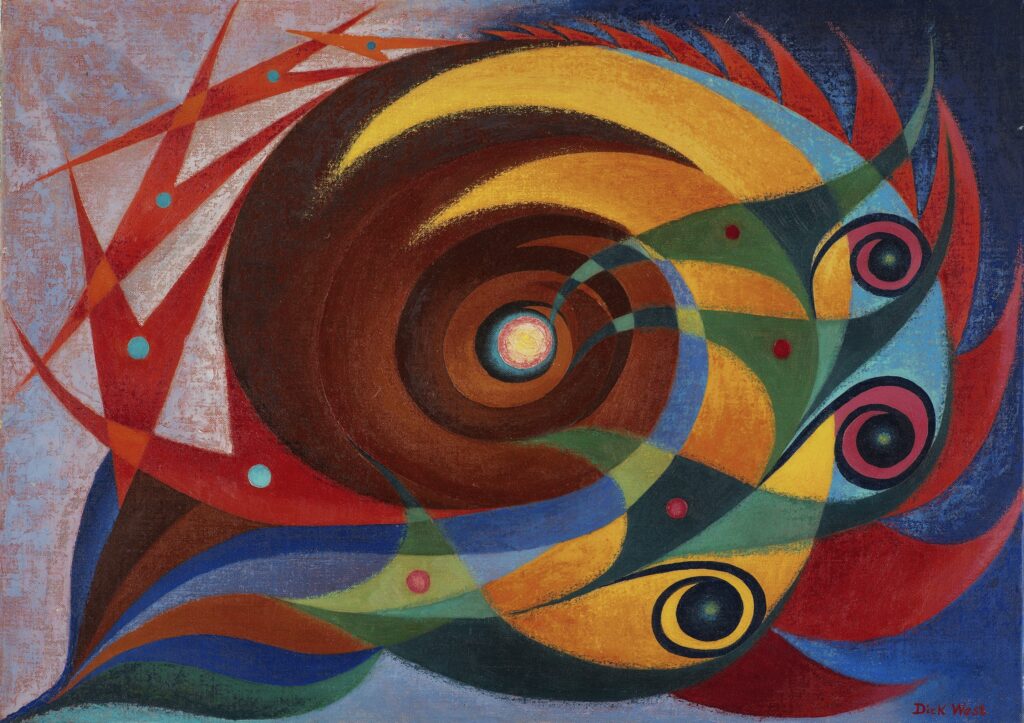
Earlier paintings show artists embracing modernist abstraction after World War II, such as in Southern Cheyenne artist Dick West’s multicolor “Spatial Whorl” (1949-1950), or abstract expressionism, as in the 1960 painting “No. 2” by Ojibwe artist George Morrison.
A side room provides an important counterpoint to the abstract pieces — and an indication of what some later Native artists have worked against.
Through artwork and documentary photographs, the display explores the effect that the government-run Santa Fe Indian School in New Mexico and colleges in Oklahoma had on Native artists in the 1930s. Students were taught uniform painting techniques to depict clothing, dances, ceremonies and other “traditional” aspects of Native life in a simple style lacking perspective or depth, usually against a blank background.
Although some of the pieces from that time, such as Pueblo painter Tonita Peña’s “Buffalo Dance” (ca. 1939), Hopi artist Fred Kabotie’s “Morning Kachinas” (1925-1930) and Kiowa artist Stephen Mopope’s “War Dancer” (1929), are colorful and well-rendered, they also seem to project idealized images of Native Americans in an unchanging historic past.
More recent figurative works in the show depart widely from the constraints of the Indian art schools, demonstrating personal styles as well as influences from modern art movements. “Spring,” a small 1961 work on paper by Gerónima Cruz Montoya, an Ohkay Owingeh artist who studied at and taught at the Santa Fe Indian School, renders animals and plants in a cubist style.
Hanging side by side, Cherokee painter Virginia Stroud’s “Water Play” (1990) and a 1989 untitled painting by Comanche artist Diane O’Leary make for an ingenious pairing. They both portray groups of Native women in outdoor settings, but Stroud depicts her subjects in an exuberant illustration characterized by almost Disney-like saturated pastels and greens, whereas O’Leary’s curvilinear cubism and hues give her piece a more serious tone.
At times, the exhibition is hampered by confusing timelines and art placement. The chronology jumps around disjointedly: A section on artists’ varied postwar trajectories includes works from 1968 to 2011 and is followed by examples of painters reclaiming abstraction in the 1950s and ’60s. A wall panel on several Native American art centers that were instrumental in the 1970s seems to have little discernible connection to what is displayed around it.
Nevertheless, in showcasing the dynamism and breadth of Native American painters over a century, as well as artists’ own voices, “Stretching the Canvas” affirms their place in the genre.
Stretching the Canvas: Ten Decades of Native Painting Through May 1 at the National Museum of the American Indian, Fourth Street and Independence Avenue SW. americanindian.si.edu.
The post Native American painters have long been overlooked. This show helps rectify that. appeared first on Washington Post.