Even the pasta of the day isn’t enough to get Fernando Sedano’s team to stop talking about fires.
As they dig into spaghetti or farinata for lunch at the sprawling research center where they work in tiny Ispra, Italy, the conversation drifts to burn rates, heat waves, drought. Other workers might talk about weekend plans; these folks talk about foliage.
Mr. Sedano’s 12-person wildfire team, part of the European Union’s disaster risk management unit, is on a mission. They want to stop Europe from burning. And while most firefighters put out flames with hoses and water, they do it with data.
From the cerulean shores of Lake Maggiore in the Italian Alps, they run the European Forest Fire Information System, which combines information from European Union and global satellites, weather models and expert analysis to track fires — and to predict where they might break out or worsen.
Over the past two decades, the system’s maps, forecasts and burn trackers have become indispensable to Europe’s centralized firefighting strategy. These fire wonks are, in an important way, the continent’s first line of defense as blazes grow more frequent, damaging and dangerous.
National authorities fight fires within their borders, but the European Union helps coordinate responses and sends additional responders, planes and helicopters to places in need. Should a firefighting team stay in Greece or move to Cyprus? The team’s forecasts and data help officials decide.
Every Thursday from mid-June to mid-October, someone from Mr. Sedano’s group gets on a 10 a.m. call with their colleagues from Brussels, fire responders and experts from across the 27-nation European Union to understand how weather conditions and existing fires are evolving.
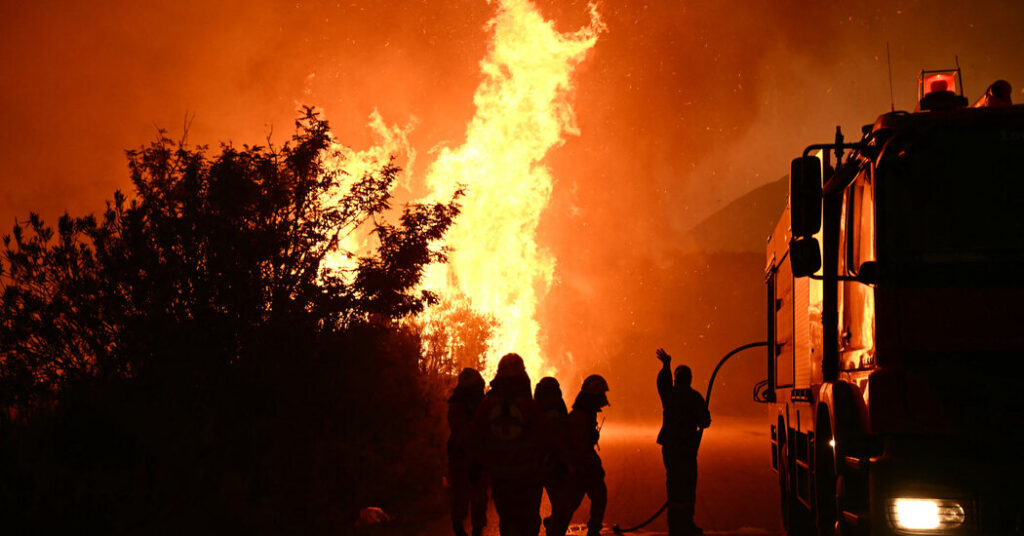
Last year, about 2.5 million acres burned across Europe. That was the worst year on record and nearly double the annual average from 2006 to 2024. And the weather bodes poorly for this season. In barely a month of summer, Europe has already endured several heat waves.
Already, the figures for fires and burned areas in 2026 are above average, especially after blazes across France, Portugal and Spain this month. Fire danger forecasts have been pronounced across France, Spain, and parts of Hungary, and a blaze that broke out in southern Spain had killed at least 11 people as of Friday, local authorities said.
Amid global warming, Europe’s fire seasons are starting earlier, ending later and expanding beyond the Mediterranean.
“Twenty years ago, when we talked about wildfires, we were mainly talking about Southern Europe,” Mr. Sedano said. “Now, we see larger fires, in more northern latitudes.”
It’s not clear whether even detailed information and careful planning will be enough to stop Europe from suffering serious damage as global warming makes it tough to keep up with the pace and ferocity of wildfires.
Mr. Sedano, who is from Spain and was originally a forester by training, declined to speculate about whether the fires in 2026 were likely to look worse than the ones that ripped across Cyprus, Germany, Spain and even Slovakia last year.
Whether this year will be as bad as last “depends on many factors — the weather, the temperatures and how the heat waves happen,” he said.
On the mid-June day when he showed me around his research facility, he was wearing a linen button-down and pants to combat the heat. The temperature was stifling, despite a breeze from the lake.
The scorching start to summer, he acknowledged, “is a reason to be careful.”
Though fire season is only just beginning, the European Union expects to field its largest-ever firefighting operation this summer. Officials are positioning 777 firefighters from 14 European countries in high-risk areas across Cyprus, France, Greece, Italy, Portugal and Spain.
The bloc is also deploying 22 firefighting airplanes and five helicopters, stationed across 12 countries from Cyprus to Sweden. Already in July, they have sent more than 100 people, dozens of vehicles and several airplanes to fight blazes in Portugal and Spain.
Private groups and national authorities also provide fire tracking data and tools, which can be more granular about their specific regions. Most firefighters come from and work within the nations themselves.
Fire experts said that the European Union’s role is important as the menace of wildfires grows and sometimes outstrips national resources.
“Must, or can, every country be prepared for extreme fire situations?” said Johann Georg Goldammer, director of a fire-monitoring service at Freiburg University in Germany.
The E.U. authorities are racing to improve their ability to track fires as the blazes become bigger and more destructive. Mr. Sedano’s team are hoping to soon incorporate satellite data that updates every 10 minutes, making their fire-tracking maps closer to real time. They are using artificial intelligence to further improve their speed and their tools.
The researchers are also trying to beef up their models to better forecast where fires might head and where they might intensify. They are analyzing vegetation across Europe, mapping the location and type of trees and identifying areas with dead undergrowth to try to understand how those areas might burn.
“We want to be able to answer the ‘what if’ questions,” Mr. Sedano said. As we talked, engineers, computer programmers and other fire experts popped in and out of his office.
That shift toward prevention is in line with the European Union’s overall strategy. After years of focusing heavily on responding to fires, the bloc has shifted more attention to prevention.
E.U. officials and fire experts are thinking about how to plant and maintain forests so that they’re less fire-prone, including by adding fire breaks. They’re thinking about what regions might be at biggest risk because of the way climate change affects their flora.
The European Union’s data-driven approach and focus on sharing resources matches what other regions are doing, said Chris Field, a climate scientist at Stanford University.
In California, for instance, state and federal authorities work together, he said. California and Australia have also historically shared firefighters, though that has become more challenging as fire seasons grow longer and overlap.
The difficulty, globally, is keeping up.
“With climate change, every year has the potential to be a record-breaking fire year,” Mr. Field added. “2026 looks like it has the potential to be really scary in Europe — but every year does, until we can make enough investments to get ahead of this problem.”
The post Fighting Fires With Figures, These Experts Are Trying to Stop Europe From Burning appeared first on New York Times.