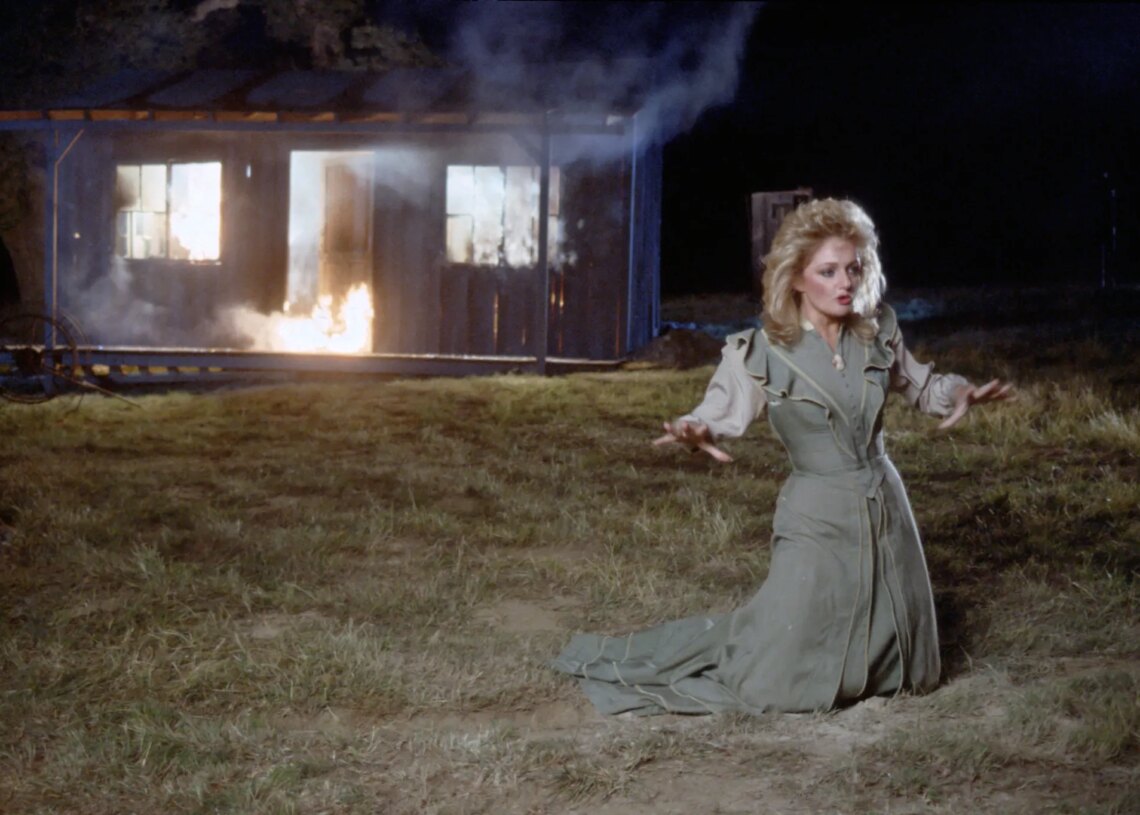
I have many memories attached to “Total Eclipse of the Heart”, which form into a blurred composite of being in my late teens, surrounded by mates and drunkenly wailing it—at house parties, in the backs of cars, at the beach, on the side of the road, or anywhere else you could hang out at night for free in the South Wales Valleys. Heads thrown back, black eyeliner smudged like tire marks across our temples, passing round a 2L bottle of lemonade half-emptied and re-filled with Glen’s, absolutely fucking butchering the key change. If you’ve never accidentally smacked someone in the face while flinging your arms open like Christ on the cross singing “EVERY NOW AND THEN I FALL APART,” then you’ve never sung it right.
I suspect this is a fairly universal experience, in spirit if not specifics. The UK’s number one favorite song to sing in the shower and one of the most globally recognizable power ballads of all time, Bonnie Tyler’s 1983 hit single is a timeless paean to an impossible love. Perhaps the only pop single with a video shot in an abandoned asylum in Surrey, it hit number one on both sides of the Atlantic, went platinum in nine countries, and has retained a cultural omnipresence ever since, from Hollywood needle-drops to KTVs in the Philippines. It has billions of streams on Spotify and YouTube, which has racked up while remaining completely impervious to trends. At the same time, Bonnie Tyler—who died unexpectedly yesterday, aged 75—represents a kind of yearning that is deeply and inextricably Welsh.
In Erotic Vagrancy, his biography of Richard Burton and Elizabeth Taylor, journalist Roger Lewis writes that “the Welsh are supreme at being actors and actresses because flamboyance is suppressed; it is the guilty secret, which bursts out now and again in lunatic ways, quick and fierce.” The same might be said about our music. Whether it’s Tom Jones issuing suicidal threats after witnessing someone he fancies going around with another man, John Cale’s intense weirdo melancholia, or the disproportionate amount of emo bands the nation was spitting out in the 2000s, Wales has a reputation for melodrama across all genres. It’s known as “the land of song” for a reason, and while that reputation in the present day is attached to colorful bunting-laden celebrations of the arts like the Eisteddfod and Hay Festival, it stems largely from the nonconformist revival—that is, good old-fashioned, fire and brimstone Bible bashing—in the 18th century. Clustering around mining towns in particular, it bucked the Church of England’s kill-yourself-boring sermons with cracking hymns, days-long outbursts of religious fervor, and the mass formation of male voice choirs. Pair that with our natural tendency towards nostalgia (we famously have a word for that) and general reluctance to discuss our feelings until a sixth pint has hit the bloodstream, and you have the optimal conditions to foster a population that largely expresses itself through singing and scrapping.
In that sense, Wales is a bit like the American South of Britain, but with (slightly) less guns and slavery and more Italian cafés. Every year thousands of impersonators and superfans pile into caravans in Porthcawl for the world’s largest Elvis festival, while “Total Eclipse of the Heart” made Bonnie Tyler the first Welsh woman to reach number one on the U.S. Billboard 100. Speaking to the BBC after her death, producer Pete Waterman said: “If you think of Tom Jones, he was the closest Britain had to a soul star, and Bonnie was that too and she was as good as Tina Turner. You could imagine Tina singing ‘Heartache’.” It came as no surprise at all when Dolly Parton released that documentary tracing her ancestral roots back to Conwy. The structural DNA between the two regions is not dissimilar, rooted as they are in a mix of tight-knit hospitality, outlaw mentality, and rich artistic history, while also being stereotyped from the outside as deprived sinkholes of substance abuse and teenage pregnancy. “The Valleys and the Deep South are seen by the wider world as being populated by a bunch of shit-kickers, but what we produce is from the heart,” as my friend Elijah Thomas, who photographs the Valleys under the name Rhondda in Colour, once put it.
In other words: we love to love, and we love loudly and without apprehension. With her iconic rasp and enormous blow-dried hair like golden candyfloss, Bonnie Tyler—known to many, simply, as Gaynor from Neath—embodies that message to a tee. A biblical voice for neighborhoods that run on gossip and 2-stroke, you can just as well imagine her shouting at some kids to stop kicking a football against her front door as you can singing “Holding Out for a Hero”. Her voice literally sounds like that because she had nodules removed from her vocal chords in 1976 and botched the recovery. “Was supposed not to talk for six weeks afterwards,” she explained. “Can you imagine!”
For me, the thing that defines Tyler’s music is that it cannot be sung half-heartedly. She didn’t like songs that “anybody” could do, which leaves two options remaining: sing it brilliantly, or sing it badly but with windscreen-shattering gusto, because there is nothing more humiliating than a bad rendition that is also meek. If you’re going to sing like shit, you have to do it with 100 percent commitment. That’s what makes “Total Eclipse of the Heart” such an enduring karaoke staple, and that’s what underscores almost every notorious song that Wales has produced, whether it’s the national anthem or “A Design for Life”.
There is conflict at the heart of the Welsh character. That’s what makes us such great yearners, because that’s what yearning is: conflict, tension, the agonizing drag between one state and another. We will enter a years-long war over a parking space and then meet a devastating personal blow with, “Ah, well, there you are then.” We long to spread our wings but we get homesick easily. We are overwhelmed with aspirations but make fun of anyone who does anything a bit “flashy,” like drive an Audi, or whip out one of those dips with four trays during a buffet. In our everyday lives we laugh at everything and long quietly—not necessarily for a person, but for something. A place, an idea, a feeling, that may or may not exist. That’s what makes us such potent yearners. We are proud, daft, and passionate, and where the first two are plain as fucking day at all times the latter comes through most unmistakably in song. And Bonnie Tyler—who made her name belting about being in “need” and “holding out” and taking “trains to nowhere” in the fullest face of make-up this side of Drag Race—will go down in history as one of the most powerful yearners of us all.
Follow Emma on Instagram @emmaggarland
The post Bonnie Tyler and the Agony of Welsh Yearning appeared first on VICE.