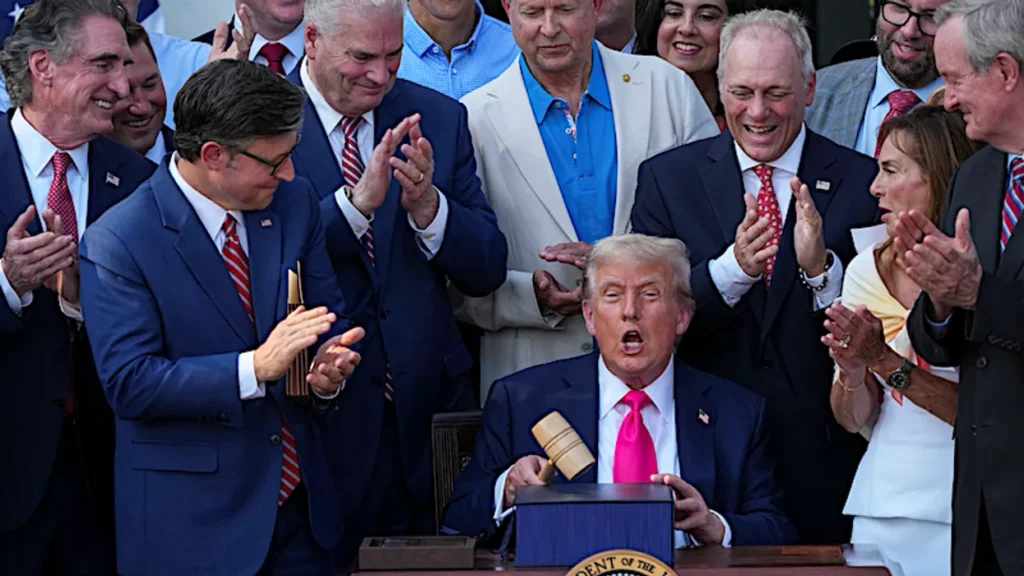
The past weekend’s 250th Independence Day celebration also marked another anniversary: the first year after President Donald Trump signed HR 1, otherwise known as the One Big Beautiful Bill Act.
Many of its sweeping policy changes, including work requirements for certain Medicaid recipients and reduced federal aid for administering food benefits, haven’t yet taken effect. But roughly 98,000 Pennsylvanians no longer receive food benefits due to newly imposed requirements under the law, as estimated by the state Department of Human Services.
Between July 2025 and May 2026, the latest month available, enrollment in the Supplemental Nutrition Assistance Program fell from 1.96 million to 1.74 million, an 11% decrease. DHS attributed less than half of those losses to HR 1.
Pennsylvania had one of the highest SNAP participation rates in the country in 2022 (the latest data available), meaning that nearly every eligible resident participated in the program. In the commonwealth, over half of those beneficiaries are families with children.
Democratic U.S. Rep. Brendan Boyle (PA-2) called the law “morally and ethically and economically the exact opposite” of the semiquincentennial in a Wednesday press call with advocates.
“At its essence, you have the largest tax cuts for billionaires in American history, over $5 trillions worth paid for by the deepest cuts to healthcare and food assistance in American history,” said Boyle. “This bill truly was Robin Hood in reverse: it is robbing from the poor, taking away their healthcare (and) their food assistance in order to give money to the ultra and mega wealthy.”
In the fall, Pennsylvanians relying on the program who didn’t start documenting their time devoted to work, volunteering or education could lose their benefits if they didn’t report at least 20 hours a week. Parents with children under the age of 14 and those with certain disabilities were exempt.
Veterans and former foster youth who previously had a pass are also no longer exempt from additional requirements.
Republicans later rebranded the bill as the Working Families Tax Cuts law because it permanently enacted 2017 Trump tax brackets and saved taxpayers an average of $800.
The nonpartisan Congressional Budget Office estimated it would add $3.4 trillion to the national deficit over the next decade, or $4 trillion when accounting for interest on the national debt. Progressives have repeatedly criticized the bill for disproportionately benefitting the wealthiest by focusing on marginal tax rates and estate taxes — though it does also eliminate taxes on tips and overtime.
What’s coming next?
States haven’t yet felt the biggest impact, primarily the shrinking federal funds for SNAP and Medicaid. Under the former, Pennsylvania and others will have to pick up a larger part of the tab for administrative costs, as much as $400 million.
The commonwealth still has time to reduce its 9.21% error rate before penalties start next fall and lessen the impact, but the same can’t be said for Medicaid.
Felix White, of Montgomery County, shared that Medicaid pays for his health expenses related to lung disease and diabetes while he’s caring for his 92-year-old mother.
“I went to college for a computer science degree and was employed until a few years ago. I’ve been looking for work, but my field has changed rapidly over the years and it’s been very difficult to find a job at my age,” said White, 62. “Currently, I cut a couple of lawns and do any odd jobs that I can get.”
He credited Medicaid for covering a hospitalization associated with a blood blister, saying that without his policy, “I would have lost my foot.”
“There’s no way I would be able to pay to see any doctors or pick up my medication,” White continued. “Thanks to Medicaid, I’ve controlled my type 1 diabetes, but I still live in fear of my (lung) disease and the complications it brings. Medicaid saves lives, and losing it would be a death sentence for me.”
State officials estimate Pennsylvania could lose as much as $20 billion over the next decade, while other sources put the cut between $34 billion and $57 billion. A fraction of that will be offset by incoming dollars devoted to rural health, though advocates worry it won’t be enough to prevent hospitals from shuttering.
Advocates say that most Medicaid enrollees who are capable of working have a job, or have another life circumstance — such as parenting or schooling — that prevents them from participating in the workforce. They liken new work rules to “paperwork requirements,” calling them “significant obstacles” to health coverage.
“Medicaid is the backbone of our behavioral health system. When people lose that coverage, they lose access to treatment,” said Jeannine Lisitski, the CEO of Mental Health Partnerships, which specializes in treating substance use disorders. “People do not stop experiencing mental health or substance use disorders just because they lose insurance, but they will stop receiving medications.”
That coverage loss can have a domino effect, she continued, rippling out the providers and health systems that fuel communities and the economy. Several others noted concerns with newly released definitions for medical frailty, which the state is suing to overturn.
A recent RAND analysis predicts that there will be 7.6 million fewer Medicaid enrollees by 2034, including just under 370,000 Pennsylvanians. It also estimated that implementing various provisions — including but not limited to work requirements and more frequent reverification — will cost the state nearly $15 billion in that time.
“I truly fear for our health systems, particularly in rural areas as well as urban areas. They will not be able to withstand the full amount of these cuts once the bill is finally phased in,” said Boyle.
Medicaid work requirements are set to begin in January 2027.
The post Trump bill strips 98K voters of essential aid months before crucial swing state election appeared first on Raw Story.