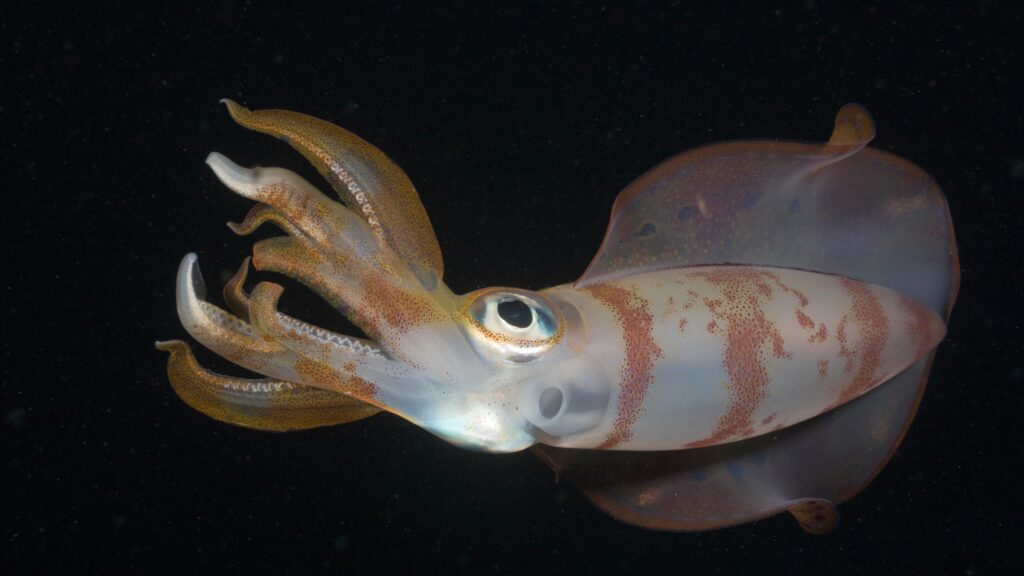
Squid are among the scholars of the deep. Distributed across all of the world’s oceans, the 375 squid species can navigate mazes, cooperatively hunt, communicate via color change, recognize individual humans, and learn from past experiences—such as remembering how to escape from an enclosure. Neuron by neuron, squid have brains about as complex as that of dogs, and along with octopuses and cuttlefish, are the most intelligent invertebrates in the world. But the squid brain is in danger.
According to a new study presented at the Society for Environmental Biology conference in Florence, Italy, in early July, as levels of oceanic carbon dioxide grow greater, the brain of at least one species of squid is growing smaller.
High CO2 levels were already known to affect squid behavior—and, by extension, the state of their brains. According to a January 2026 paper in Communications Biology, seven days of exposure to increased carbon dioxide resulted in a 65% reduction in hunting behavior in adult squid. Newly hatched squid exposed to high CO2 for the first 90 days of their lives hunted 42% less.
To determine what is behind this change, two of the authors of that paper—Garett Allen, assistant professor of biological sciences at Acadia University in Nova Scotia; and Yung-Che Tseng, assistant research fellow at the Academia Sinica’s Institute of Cellular and Organismic Biology in Taiwan—reared newly hatched big fin reef squid in two different tanks of water, one matching the carbon dioxide levels in current oceans and one at the increased levels predicted for 2100. After 90 days the squid were removed from the tanks and euthanized, and their brains were scanned using magnetic resonance imaging. The results were striking.
The brain volume of the squid in the elevated-carbon dioxide tank was 49% smaller than that of the group in the tank with current CO2 levels. No area of the brain was spared from the shrinkage, but the change was especially pronounced in the optic lobes and the optic tract—the bundles of nerves that carry visual signals to the brain—with reductions of 52% and 62% respectively.
Just what the mechanism behind the change was is unclear. The researchers’ initial hypothesis was that the squids’ brains were somehow denied energy during development, which limited growth, but that wasn’t the only possible answer. “Our alternative hypothesis,” Allen said in an email to TIME, “was that the brain may be reduced in volume due to damage, perhaps oxidative stress—essentially, atrophy of the brain.”
Since the squid did not survive the experiment, it was impossible to observe them and determine how the brain shrinkage affected their behavior, but Allen has some guesses. “Considering our [earlier] work found that squid reared under the same conditions for the same duration experienced reductions in willingness to feed,” he says, “it seems reasonable to propose that reduced brain volume carries some influence on decision-making—seemingly making them more hesitant, rather than less effective as predators.”
Oceans absorb up to 30% of emitted carbon dioxide, according to the National Oceanic and Atmospheric Administration (NOAA). That has raised ocean acidity—a direct result of CO2 absorption—by 30%. The effect has been especially damagingon corals, oysters, and free-swimming snails and slugs. NOAA predicts that acidification will increase by 100% to 150% by the end of this century. As that happens, whole populations of squid are likely to suffer the same change as the ones in the experiment, and that could dramatically affect the structure of their societies, especially since it’s the optic regions of the brain that suffer the greatest damage. “If they are experiencing challenges in how to interpret visual stimuli, amongst other stimuli, it would seem that reliance on visual displays for communication and mating rituals could be impacted,” Allen says.
The loss of or injury to any animal as a result of human activity is a tragedy, but it’s particularly so when the creatures being harmed are smart, sentient, clever, complex. The squid sit atop the invertebrate world; humans could yet push them over.
The post Squid Are Among the Most Intelligent Ocean Creatures. Climate Change Might Shrink Their Brains appeared first on TIME.