I first met Jacqueline Zúñiga in the port city of La Guaira, just as Venezuela was beginning its descent into an economic quagmire from which it has never emerged.
It was 2014, and I had recently moved to Venezuela as a rookie reporter. I wanted to know how the ruling Socialist Party’s base was reacting to the downturn, and came across Ms. Zúñiga’s work on the internet.
A lifelong believer in social causes, Ms. Zúñiga ran a women’s rights project in La Guaira, one of thousands of so-called social movements that formed the foundation of the government’s power pyramid.
Ms. Zúñiga had just managed to arrange for dozens of members of her group to get apartments at new government-built housing towers in eastern La Guaira, a scruffy, narrow stretch of concrete between Venezuela’s coastal mountains and the Caribbean Sea.
Despite the growing economic troubles, it was a moment of immense pride and, for some, the achievement of their lives.
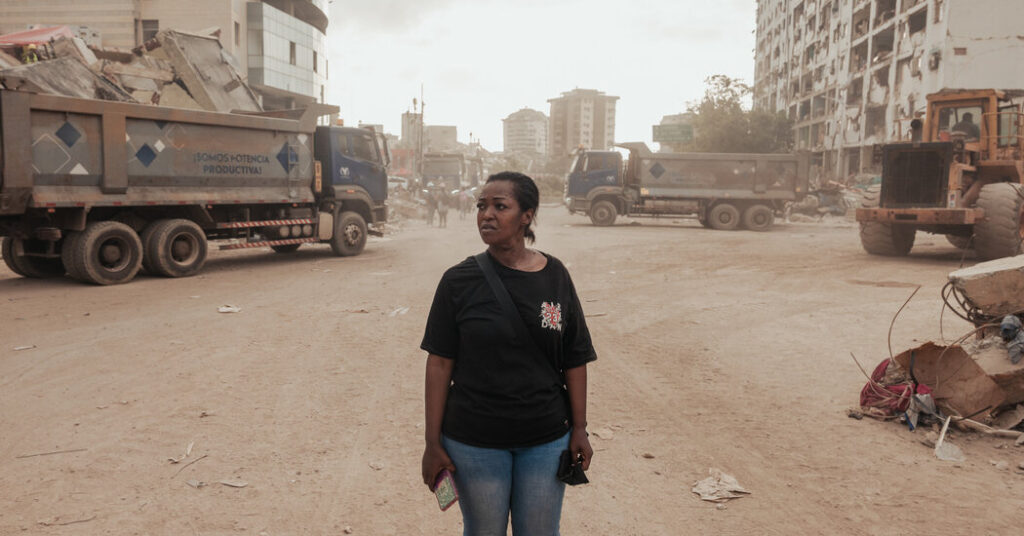
Last week, I found Ms. Zúñiga again, and we returned to those towers. Almost all had been reduced to rubble. We watched as rescue workers carried body bag after body bag from the ruins.
They were among the sea of buildings that were destroyed by powerful twin earthquakes that struck Venezuela last month, killing over 3,800 people, mostly in La Guaira.
Ms. Zúñiga, now 52 and with a few gray hairs, had met many of the quake’s victims over her three decades of social activism in a small state where everyone seems to know each other. As we drove through the destroyed city, the landscape evoked a raft of memories.
She mentioned close friends, neighbors and distant acquaintances. She spoke about people she saw regularly at bakeries, banks and street markets. There were also political enemies, people with whom she had competed for the shrinking resources of the bankrupt state.
All were dead or missing.
La Guaira’s physical destruction followed the unraveling of the political project to which Ms. Zúñiga had dedicated her life. Hugo Chávez had died the year before I met her. The revolution he declared after becoming Venezuela’s president in 1999 was already waning.
Venezuela’s economic model, based on price and currency controls and inspired by Cuba’s state-run system, tumbled like a house of cards when oil prices collapsed in 2014. The corruption and incompetence of the Chávez government became glaring when the oil bonanza stopped.
Venezuela, once the world’s biggest oil exporter, lost most of its economic output and, over the next decade, millions of its citizens dispersed around the world.
The U.S. raid in January that led to the capture of Mr. Chávez’s handpicked successor, Nicolás Maduro, was a coda to a socialist experiment that, by last year, existed largely on paper. The Socialist Party remains in power, but is now under the thumb of the Trump administration, which is focused on exporting Venezuelan resources to the United States.
Over the past decade, Ms. Zúñiga’s group has tried to continue its work. Members created furniture workshops and tourism and urban farming projects, all aimed at empowering working-class women.
Most of these initiatives failed.
As Venezuela’s economic crisis deepened, Ms. Zúñiga and her group became involved in disputes with rival factions of the ruling party over the diminishing spoils of the government’s patronage system. She fell out of favor with La Guaira’s current authorities.
Some of those political conflicts were intense, involving evictions and police raids. Others were tragicomic. One of Ms. Zúñiga’s friends, Joanna Corro, recounted how their group once briefly kidnapped a housing official to obtain a larger apartment quota.
These were some of the same homes Ms. Zúñiga and I visited in 2014, shortly after the first residents moved in from nearby slums. These buildings are known as OPPPE, an abbreviation that reflects the complexity of Venezuela’s bureaucracy. It stood for “the Presidential Office for Special Plans and Projects,’’ though few residents knew that.
Many residents had been victims of flash floods in 1999 that swept away their previous homes in La Guaira’s hillside slums, a disaster those who lived there simply call “La Tragedia,” the tragedy.
Overall, Ms. Zúñiga figured 120 of the roughly 600 members of her activist group, the José María España Women’s Movement, had received government housing in La Guaira. They lived there with their children and sometimes extended family.
For most families, who had lived in shacks they built themselves, the apartments were their first formal accommodation. When I visited in 2014, about two years after their construction, the paint was already peeling in the tropical heat, the wall plaster was nonexistent or of dismal quality, and only some of the elevators worked.
But the apartments had running water, flushing toilets, washing machines, garbage chutes and air conditioning. And the government gave the apartments away and did not charge rent.
Free housing was the apex of a sprawling patronage system that helped keep the Socialist Party of Venezuela in power for nearly three decades.
Ms. Corro, Ms. Zúñiga’s friend, recounted the perks: “Cars, apartments, food, TVs, bank credits, school supplies.”
“There was everything, everything, everything,” she added.
All free.
In return, recipients were expected to attend government rallies, vote for its candidates and pressure others to do so as well. Those who supported the opposition risked losing benefits, including their apartments.
The high occupancy of government housing is one reason it appears to account for a significant share of the earthquake’s death toll. There are also questions about their structural integrity.
“Look where we ended up sticking you,” Ms. Corro, 43, said to no one in particular as she looked at the rubble of one tower. “We never imagined it would end up like this.”
Her sister Isamar, 35, was somewhere between the concrete slabs that tumbled like pancakes, presumed to be dead.
The relationship between the Socialist Party and Venezuela’s poor was deeply transactional. But the sense of political empowerment among its supporters was real and has outlived the handouts.
Ms. Zúñiga recounted the racial discrimination she felt before Mr. Chávez, who was mixed race and came from a poor rural family, took power.
“I always felt uncomfortable going into formal places. Should I be here? Can I even be here?” she said
“Now, I am proud to be Black,” Ms. Zúñiga said. “The people know they have value, that they are visible.”
Ms. Zúñiga was born in a working-class neighborhood of Caracas, the Venezuelan capital, into a Colombian family that had escaped their homeland’s civil war.
She often came to La Guaira to visit her father, who worked in construction.
She became involved in local projects, organizing a public transport cooperative and lobbying for street paving. When Mr. Chávez became president, she enrolled in one of his first poverty-reduction programs and received a subsidized loan. She used it to buy an apartment in a middle-class neighborhood in La Guaira.
She lived in that apartment for nearly 27 years, until it was destroyed last month by the back-to-back earthquakes. She escaped unscathed, but lost all her possessions.
“Do you know how much I fought for that house?” Ms. Zúñiga asked me as she looked at the damaged building, called “La Marina.” A green curtain flapped in the window of her sixth-floor apartment. A red letter “D” was sprayed by the entrance, signifying a demolition order.
“We have done so much together only for him to come and destroy the house,” she said, referring to God. “So many people I know have died. This has me so confused.”
Ms. Zúñiga and her friends’ belief in the Venezuelan government has long faded. But they have maintained their commitment to social justice and their distrust of the free markets. Above all, years of activism have given them a sense of community that has helped them weather repeated adversity.
They had each other, and their mutual support was clear during the latest and, for most of them, their greatest tragedy.
We stood by piles of rubble and watched U.S. military helicopters fly overhead and heavily tattooed, muscular American rescue workers in cargo pants working among the destroyed buildings.
Ms. Zúñiga said she was wary of the Americans and had little faith in Venezuela’s interim government, which is led by Mr. Maduro’s former vice president, Delcy Rodríguez. She said she would still vote for a left-wing candidate when the next elections are held, but not necessarily one from Ms. Rodriguez’s party.
I asked Ms. Zúñiga if the decades spent campaigning for Mr. Chávez’s anti-imperialist and socialist slogans were worth it.
“Chávez had the best intention in the world, but there was a lack of education,” she said. “But we had the opportunity to do very beautiful things. So many women have gained tranquillity, opportunity, visibility.”
Since the earthquakes, Ms. Zúñiga has been sleeping in an open-air market stall in La Guaira’s downtown. She has outfitted the stall with a mattress, makeshift curtains and an electric fan. At night, she locks the market’s gate to keep herself safe.
The market is part of Ms. Zúñiga’s long-running food distribution initiative, which allows La Guaira residents to buy fresh produce directly from regional farmers. The farmers whom she has befriended over the years have given Ms. Zúñiga a place to sleep, food and modest pay for helping serve customers.
She has turned a community canteen that she founded near her house into an aid distribution center and a temporary shelter for children who have lost homes or relatives in the quake.
She said she is depressed but forces herself to go because people are hungry and need help. I cry a little bit, and then I get up,” she said in her makeshift room.
We got up to visit friends who were still looking for relatives in the rubble. As we walked out, a farmer’s wife took Ms. Zúñiga by the arm and gave her a hug.
“You’re going to lift yourself up like a warrior,’’ the woman said, “the one that you are.”
The post Sifting Through Quakes’ Rubble, and the Ashes of a Revolution appeared first on New York Times.