Paul Thek’s art was built around transience, damage and loss. His precarious life was, too. A native New Yorker, he came home in 1975 after a series of high-profile exhibitions in Europe to live in the East Village. There he foundered, bagging groceries and working as a hospital janitor to survive. But he never stopped painting. Always sure of his importance, he would not be surprised that long after his death from AIDS at 54 in 1988, he is being acclaimed as a very-of-the-moment rule breaker, the subject of two gallery shows in Manhattan.
They mine an enduring legacy that ranges from gruesome wax sculptures of meat sealed in transparent boxes to paintings on newspaper pages of idyllic seascapes. In his lifetime, he collaborated with the theater director Robert Wilson and gave Susan Sontag the title of her essay collection “Against Interpretation,” which she dedicated to him. His work continues to influence new generations of artists.
Thek welcomed decay. He loved how Polaroids fade, and he made sculptures out of latex despite or because of the way it becomes brittle and brown. An epiphany came to him on a trip he made to Sicily, Italy, in the summer of 1963 with the photographer Peter Hujar, who was then his lover. (Hujar has also achieved posthumous glory, as witnessed by “Hujar: Contact,” an exhibition and catalog at the Morgan Library and Museum of more than 110 of his contact sheets, the kind of reverential scrutiny accorded to masters like Henri Cartier-Bresson and Robert Adams. Hujar and Thek are also the subjects of a recent dual biography.)
In the Capuchin catacombs of Palermo, Thek gazed in wonder at the thousands of dehydrated, mummified and embalmed corpses, dressed and posed by the monks. Some were in glass cabinets or windowed coffins. “I opened one up and picked up what I thought was a piece of paper; it was a piece of dried thigh,” he said in an interview in 1966. “I felt strangely relieved and free. It delighted me that bodies could be used to decorate a room, like flowers.”
As soon as he was back in New York, he began making the “meat pieces,” which later acquired the more highfalutin name of “Technological Reliquaries.” He enclosed them, like the Palermo corpses, in clear boxes (of Plexiglas, not glass) that mimic and mock the minimalism of Donald Judd and Larry Bell.
“Paul Thek: Dream of Vanishing” at Pace and “Paul Thek” at Galerie Buchholz primarily explore his career as a painter. The larger Pace exhibition is a kind of homecoming for Thek, who was included in a 1965 Pace group show, “Beyond Realism,” and had a solo exhibition there the following year.
Recalling his first encounter with the meat pieces, which reproduce chunks of flesh marked by veins, fat and sinews with uncanny verisimilitude, Pace’s founder Arne Glimcher told me five years ago, “How often do you go into a studio and see something you’ve never seen before? It’s very rare.” But he didn’t maintain his connection to Thek. “He went to Europe and everything fell apart,” Glimcher said. “He became paranoid. He was doing a lot of drugs. He wasn’t sweet anymore.”
Repairing that break, Glimcher has curated the beautifully installed current exhibition with Noah Khoshbin, director of the Paul Thek Foundation at the Watermill Center in Water Mill, N.Y., and Oliver Shultz, chief curator at Pace. It charts the arc of Thek’s career. Raised in a Roman Catholic family in Brooklyn, he graduated from Cooper Union in 1954 and bounced between Miami and the Northeast, doing set design and odd jobs before settling in New York in 1959.
In the early 1960s, he was painting gorgeous abstract oils on canvas, like “Untitled (the Rhinemaidens/Wagner),” circa 1962, which show an affinity with the second-generation Abstract Expressionists. By 1969, he was using newspapers as his ground. (The International Herald Tribune was a favorite). Unlike Robert Rauschenberg and Jasper Johns, who collaged scraps of newspaper in the 1950s before covering them with paint or wax, Thek composed his pictures in gouache or oil directly on a page, leaving part of the paper exposed so that it would yellow as it aged.
At Pace, some of Thek’s earliest body casts made with molding materials are on view, including a plaster one he made between 1959 and 1962 of the finger of the photorealist painter Audrey Flack, who was working alongside him then in a textile design studio. (“He was so beautiful,” she told me. “He had this sun-washed blond hair. I couldn’t stop looking at him.”) Encased in a glass butter dish on a Plexiglas plinth at the gallery, the facsimile of her finger is a precursor of such “Technological Reliquaries” as “Untitled (Hand With Ring),” 1967, in which Thek cast his own hand and painted it with a colorful pattern as groovy as any by Peter Max.
Although the show includes a couple of wall-mounted meat pieces, there are none of the bravura ones like “Hippopotamus Poison,” 1965, made to look like a slab of rotting flesh, which is in the permanent collection of MoMA (and on view there). Unavoidably absent, too, is his masterpiece, “The Tomb,” a 1967 installation of a pink ziggurat that contained a life-size wax effigy of himself, painted pink, a blackened tongue protruding and the fingers of the right hand cut off. “The Tomb” was lost after Thek failed to claim the sculpture on its return from a show in Rotterdam in 1982. At Pace, a photograph Hujar made in Thek’s studio of a waxen hand that was part of the installation hints at its creepy power.
It is also impossible to recreate Thek’s unconventional and influential approach to installations as unstable and evolving displays, starting in 1968 after a shipment of his objects was damaged in transit for a gallery show in West Germany. Working nightly, he kept issuing new work, so the exhibition changed on almost each day of its six-week run. He called it a “procession.” The word evokes both “process art,” in which the making of a piece is more important than the finished product, and religious ritual, which figured increasingly in his imagination, especially in the Roman Catholic forms he remembered from his childhood. A cross covered in white feathers from 1969 looks ready to be carried.
The Pace show includes many works exhibited for the first time, such as five beautiful 10-foot-long black-ink scroll paintings, each conveying a different mood simply through wavy lines, clouds of dots and white space. (They were owned by Wilson, the Watermill Center founder, whom Thek, on his deathbed, chose as his executor.) The scrolls are a reminder of Thek’s devotion to painting, which has been overshadowed by the shocking power of some of his sculptures.
Thek’s talent with a paintbrush is further demonstrated at Galerie Buchholz, which boasts seven ravishing blue seascapes he painted daily on newspaper sheets while living on Ponza, an Italian island he returned to many times during the ’70s.
Thek’s endearing goofiness is also on view. He had a childlike love of dinosaurs, something he shared with Wilson. They collaborated on the set for a 1972 outdoor performance staged near Shiraz, Iran, which included a volcano and a pink dinosaur skeleton. A smile-inducing high point of this exhibition is an assemblage in the style of a Rauschenberg combine painting that holds a chunky figurine of a dinosaur, spotted like a giraffe, and a painting of dinosaurs on a terrain of erupting volcanoes.
Although Thek possessed impressive skills as a draftsman and painter, he was an early practitioner of the crude figuration of “bad painting” (a term coined by Marcia Tucker, the founder of the New Museum). An inveterate punster, he enjoyed creating a painting inspired by a play on words. “Bread and Buttocks,” 1979-80, at Buchholz, shows just what the title says, and “Church of the Holy Molar,” 1971, at Pace, depicts four extracted teeth. Both exhibitions include small paintings that Thek placed low on the wall opposite a child’s schoolroom chair, as if thumbing his nose at that clichéd dismissal “My kid could do this!” Giddily transgressive, his work has been championed by such contemporary artists as Robert Gober, Kenny Schachter and Alex da Corte.
Always hostile to the art market, Thek as he grew older became increasingly paranoid and irascible. Wilson told me that he brought Fred Jahn, a Munich art dealer who wanted to buy Thek’s paintings, to see him in his apartment. Although Thek couldn’t afford the $225 monthly rent and Jahn offered to pay at least $750 for each newspaper painting, Thek wouldn’t let him in. “Paul said, ‘I don’t want to sell my work to him, he only wants to go to bed with me,’” Wilson recalled. “I said, ‘No, he doesn’t, he’s not gay.’ We went back on another day at 11 in the morning and Paul wouldn’t let us in. He said, ‘My clothes are all wet.’ He was complicated. It was not easy.”
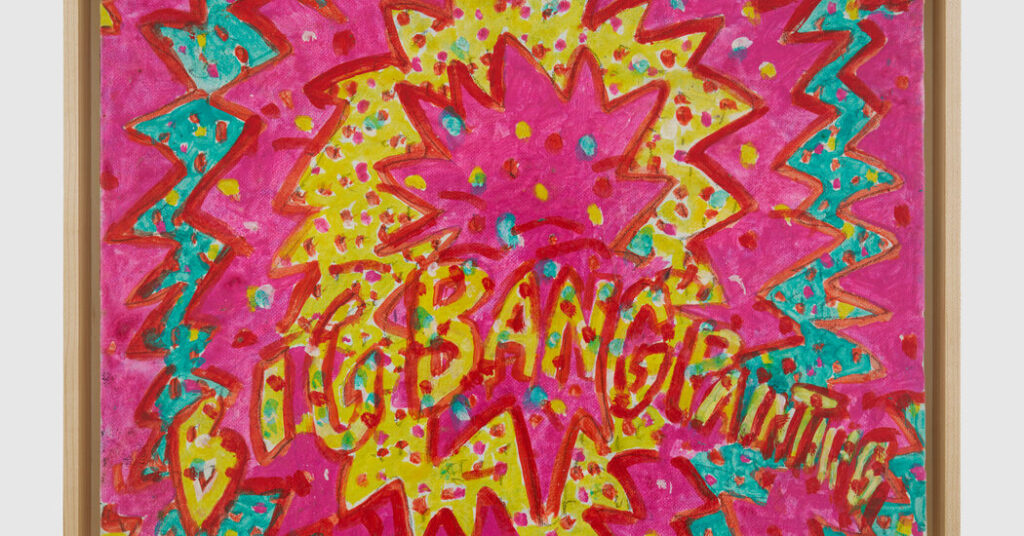
As he confronted death, his clowning acquired a manic tenor. With cheery pink, purple and turquoise, he made paintings that lampooned the AIDS epidemic that was ravaging his community. “It’s better than dying alone for your own silly little reason!” he wrote to a friend. “This way we get to go out with a real BANG!” Two of his “Big Bang” paintings, from the last year of his life, are in the Pace show, mocking mortality, saluting the end with a shriek and a giggle.
Paul Thek: Dream of Vanishing Through Aug. 14, Pace Gallery, 540 West 25th Street, Manhattan; 212-421-3292, pacegallery.com.
Paul Thek Through July 25, Galerie Buchholz, 31 West 54th Street, Manhattan; 212-328-7885, galeriebuchholz.de.
The post Paul Thek’s Art Legacy: A Shriek and a Giggle appeared first on New York Times.