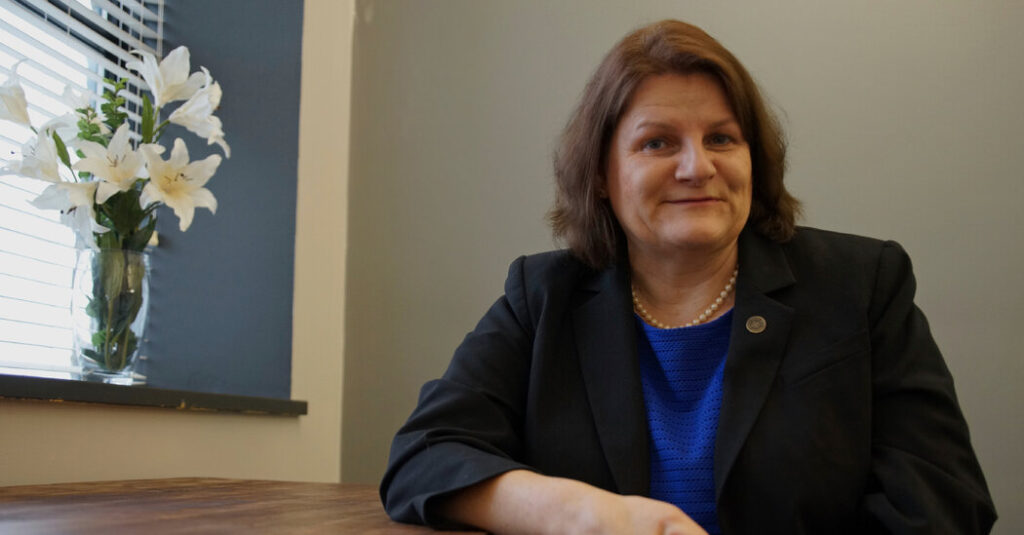
In a Milwaukee courtroom last year, Judge Hannah C. Dugan drew the ire of the Trump administration when she was accused of helping an undocumented immigrant evade federal agents.
In a Milwaukee courtroom on Wednesday, Ms. Dugan, a judge no longer, was fined $5,000 but spared prison time, months after a federal jury convicted her of obstructing those agents.
The case against Ms. Dugan, who served on the Milwaukee County Circuit Court, was among the first tests of the Justice Department’s wide-ranging efforts to punish local officials standing in the way of President Trump’s policies. From the start, the prosecution of Ms. Dugan drew the attention and support of high-ranking federal officials, while protesters rallied to the jurist’s defense and decried the case as a political attack.
In court on Wednesday, Ms. Dugan defended her actions.
“For more than a year, the circumstances of this prosecution have been politicized,” she said before the sentence was announced. “I have been cast as both a scofflaw and a hero. I am neither. I am a public servant who was just trying to do my job.”
At Ms. Dugan’s trial late last year, prosecutors argued that she had crossed a line when she directed an undocumented immigrant appearing before her to leave the courtroom through a side door not used by members of the public. Before doing so, Ms. Dugan had learned that federal agents were waiting in the hallway to arrest the man, Eduardo Flores-Ruiz, who was accused of domestic battery.
Mr. Flores-Ruiz, a citizen of Mexico, made it out of the courthouse, but was arrested nearby after a chase. He was deported months later.
After hearing evidence for four days, jurors convicted Ms. Dugan, 67, of obstructing federal agents, a felony that carries up to five years in prison. She has since sought unsuccessfully to vacate her conviction.
In a sentencing memo, prosecutors said that federal guidelines called for a prison term of 15 to 21 months in prison. They did not ask for a specific sentence from Judge Lynn Adelman, who was nominated to the U.S. District Court by President Bill Clinton.
“Rather than uphold the rule of law, the defendant used the power and prestige of judicial office to obstruct federal agents carrying out their lawful duties in order to help an individual evade arrest,” prosecutors wrote. They added: “This was a serious offense, and it warrants a correspondingly serious sentence.”
Speaking to a packed gallery in his wood-paneled courtroom, Judge Adelman said on Wednesday that prison was not necessary. He described Ms. Dugan as “an otherwise good person” who was “upset by immigrant enforcement” and who had “made a bad decision in the moment.”
“This isn’t like cases of public corruption where an official sells her office,” Judge Adelman said before announcing the sentence.
Ms. Dugan’s lawyers had argued that their client should receive no added jail time, noting that she had already resigned from her judgeship and had no prior criminal record. They said she had been “intentionally shamed from coast to coast by the leadership of the U.S. Department of Justice and F.B.I.”
“Whatever the merits of the ongoing dispute between ICE and the authority of local judges, that dispute will continue without any participation from Hannah Dugan,” her lawyers wrote. “Given her resignation from the bench, there is no possibility of the acts being repeated.”
After the sentence was announced, Brad Schimel, a federal prosecutor, said in a statement that Ms. Dugan’s “reckless and illegal actions” had “created unnecessary risks for all involved.” He added: “For that there needed to be serious consequences.”
Alan Karr, the special agent in charge of the Milwaukee office of the F.B.I., said in a statement that “the jury verdict and today’s sentencing reflect how Dugan endeavored to obstruct an official proceeding and betrayed the trust placed in her as a judge.”
Despite her conviction, Ms. Dugan will likely be eligible to keep her state pension. Though officials declined to discuss her specific case, they said state law generally allows former employees convicted of crimes to retain their pensions.
Ms. Dugan’s Wisconsin law license also remained active as of early this week. Wisconsin lawyers found guilty of crimes are required to report their convictions to the state for potential disciplinary action. Officials with the state court system declined to provide any information about Ms. Dugan and whether her license was in jeopardy.
The conviction of Ms. Dugan came amid a broader effort by the Trump administration to crack down on state and local officials accused of obstructing the president’s agenda, especially on immigration issues.
The Justice Department has sued several states and cities with policies that limit coordination on immigration enforcement, and the administration has flooded some of those places with agents.
During an immigration crackdown in Illinois last year, Mr. Trump mused about jailing the Democratic mayor of Chicago and governor of the state. And during a crackdown in Minnesota over the winter, federal prosecutors subpoenaed immigration-related records from the state’s Democratic governor and the Democratic mayors of Minneapolis and St. Paul as part of an investigation into possible obstruction. A federal judge quashed those subpoenas last month, ruling that they were politically motivated and unlawful.
In court on Wednesday, Ms. Dugan, dressed in a black coat, spoke for several minutes before Judge Adelman announced her sentence.
She described her actions that day as an effort to preserve the “sanctity of our state courthouse.” She said she had taken her oath as a judge seriously. She said she hoped to return to public service. And she said that “it is with a heavy heart that I am before you as a defendant.”
Julie Bosman contributed reporting.
The post Judge Convicted of Obstructing Immigration Agents Faces No Prison Time appeared first on New York Times.