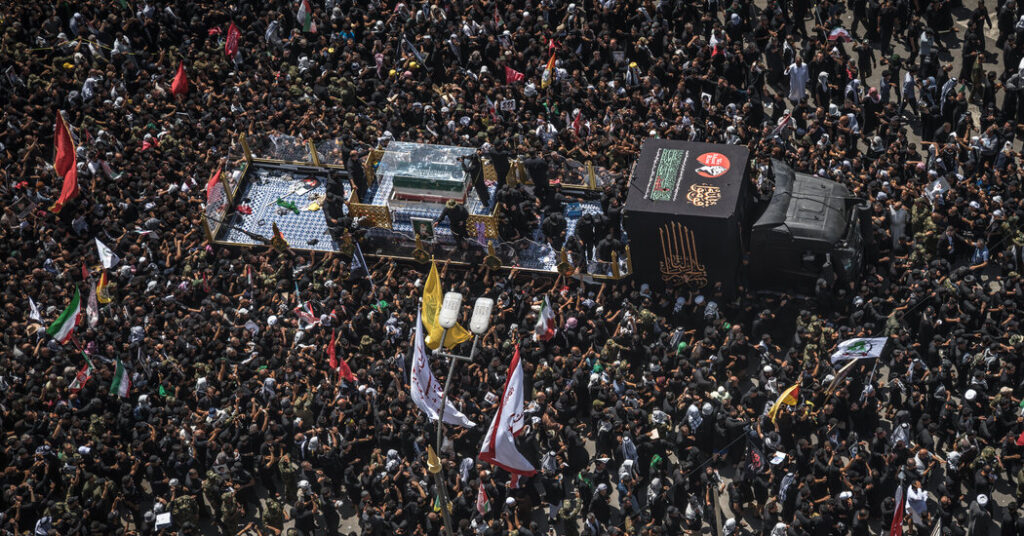
Hundreds of thousands of mourners filled the streets of the Iraqi city of Najaf on Wednesday, chanting, praying and weeping for Iran’s supreme leader, Ayatollah Ali Khamenei, as the crowds pushed up to the truck carrying his coffin.
It was a mass outpouring of grief for another nation’s ruler — one who, as a pre-eminent Shiite Muslim cleric and political strategist, spent decades extending Iran’s influence deep into Iraq, and across the Middle East.
“He was our guardian and protector, and we are here today to return the favor,” said Rabab Jassim, a 45-year old homemaker, who arrived at 3 a.m. from Baghdad to join the procession. “My heart is on fire,” she said, bursting into tears.
The procession followed five days of funeral ceremonies and mass mourning inside Iran for Ayatollah Khamenei, who was killed in U.S.-Israeli strikes at the outset of the war on Iran in February. His body was set to be flown back to Iran after the commemorations, and he was expected to be buried on Thursday in his hometown, the northeastern city of Mashhad.
As supreme leader, Ayatollah Khamenei oversaw brutal crackdowns of opposition to his clerical rule at home, and he also leaves behind a divisive legacy in Iraq.
The country is home to the Middle East’s second-largest Shiite Muslim population, after Iran. Some Iraqis praise Ayatollah Khamenei for his role in providing Iranian support to Iraq’s Shiite militias, who fought against the eight-year U.S. occupation. Others say Iran’s intervention stoked two decades of sectarian bloodshed with Iraq’s Sunni minority that has only recently ebbed.
People from all over Iraq have spent days awaiting the commemorations in the cities of Najaf and Karbala, home to two of Shiite Islam’s holiest sites.
Some had come from even farther afield — among the crowds were Nigerian women, holding up their babies, and Yemenis wearing traditional scarves and daggers.
“I chose to come here, instead of Iran, because this is a much more powerful religious experience, standing at our holiest sites,” Samir Rabyani, a medic from Sanaa, Yemen, said. “Khamenei died a martyr. And no matter how many of us they martyr, we will be the victors.”
The crowds, drenched in sweat after walking for hours in searing temperatures, turned into a crush when attendees tried to follow the coffin as it was carried into the golden-domed Imam Ali shrine in Najaf. Some mourners fainted and had to be carried out on others’ shoulders.
There is little historic precedent for one country holding an official funeral for the leader of another nation, as Iraq’s top officials did on Tuesday evening, when the ayatollah’s coffin arrived in the country. That makes the event as unusual as it is symbolically potent.
“Iraq is the holy land of the Shiite faith, and this is an attempt by Iran to underscore Khamenei as belonging not just to Iran, but to the broader Shiite community,” said Arash Azizi, a New York-based historian and author of several books on Iran.
It was also a political message at a pivotal moment in the region, projecting the reach that Iran and its allies claim still to have.
For the past three years, the United States and Israel have sought to dismantle the network of mostly Shiite militant groups that Iran cultivated during Ayatollah Khamenei’s nearly 37-year rule.
Among those groups is Hezbollah in Lebanon, which Israel has been at war with, and the Houthi militants in Yemen, against whom the Trump administration fought a short campaign. Since June 2025, the United States and Israel have also started two wars on Iran itself, battering but failing to topple the country’s Shiite theocracy.
In Iraq, Tehran has maintained its alliances with many Shiite militias, and the funeral is a sign that those bonds are far from broken. Iran’s resilience in the recent war has emboldened those militias enough to hold a procession for Ayatollah Khamenei in Iraq — a regional ally of the United States.
“The message here is that we defied the world: America, Israel, and the great global powers,” said Ali Ramadan, a fighter in an Iraqi Shiite militia who had brought his family of four to Najaf for the funeral.
“We are with justice, and we are with Iran,” Mr. Ramadan added. “Khamenei stood for truth against imperialism.”
The ayatollah’s coffin, draped in an Iranian flag and encased in glass, was escorted by a procession of trucks emblazoned with the words, “By god, rise up.”
“No one can humiliate us,” the mourners chanted in unison, while the speaker at the procession shouted, “Today, we take pride in our tears as we mourn your coffin.”
Thousands of Iraqis camped out in the streets overnight to await the procession — enduring temperatures that topped 90 degrees before sunrise.
Some had pictures of Ayatollah Khamenei pinned to their chests, while others waved Iranian and Iraqi flags. Funereal pop songs commonly heard at Iraqi Shiite processions blared out. Older participants hobbled up to the procession route on crutches as militia fighters sprawled out in the shade below bridges.
Iranian and Iraqi officials have made the funeral in Iraq an exercise in modern-day mythmaking, repeatedly comparing Ayatollah Khamenei to figures in Shiite Islam’s most sacred stories.
Along the procession route in Najaf, Ayatollah Khamenei’s face was emblazoned on black-and-red banners commemorating Hussein, the Prophet Muhammad’s grandson. Hussein’s martyrdom in nearby Karbala is a central theme of Shiite Islam, representing the willingness to fight tyranny.
Iranian officials and Iraqi militias have likened Ayatollah Khamenei to a modern-day Hussein, saying that he died opposing the United States and Israel.
One mourner, Ghassan Abdul Karim, from the Dhi Qar region of southern Iraq, said, “We are like the followers who fought alongside Imam Hussein.”
“Khamenei used his own blood to draw our path toward freedom,” he added, “and we will follow it for the next hundred years.”
For many Iraqi Shiites, Ayatollah Khamenei is most remembered for being the first leader to send weapons and support to help Iraq fight back against the jihadist forces of the Islamic State, or ISIS, in 2014. The Islamic State, a Sunni militant group, seized swaths of Iraq, slaughtering many Shiites as they advanced.
Many mourners said that stood foremost in their memory when they decided to attend the commemorations for Ayatollah Khamenei.
“I lost a dear friend to ISIS, and that was like losing the ribs that protect your heart,” said Ibrahim Enad, a 30-year-old engineer, tearing up. “We cannot forget the Iranian stance toward Iraq. In all of our crises, they have never abandoned us.”
Falih Hassan and Shirin Hakim contributed reporting.
The post Iraqis Turn Out in Droves to Mourn Khamenei and Show Solidarity appeared first on New York Times.