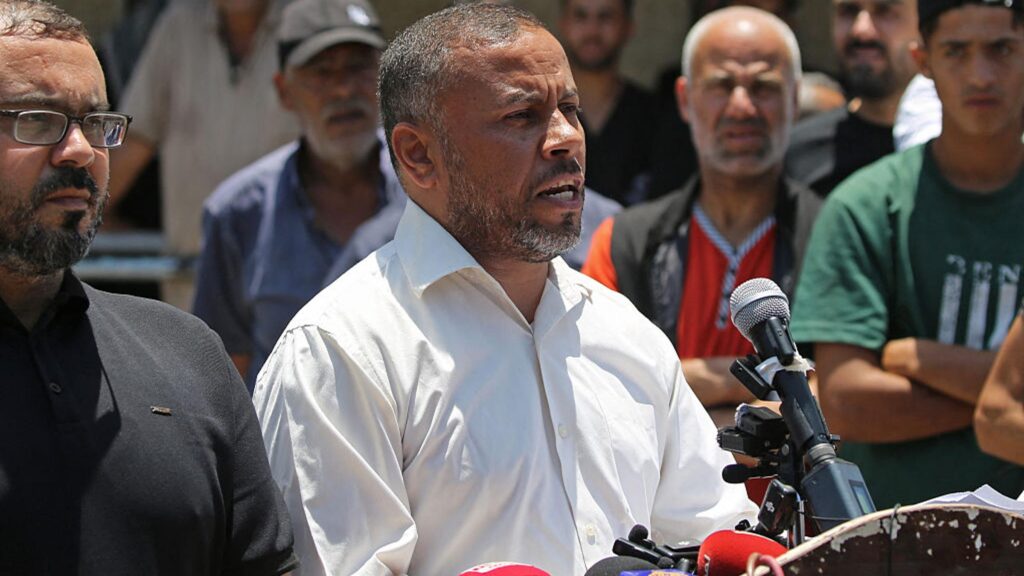
Hamas announced Monday that after nearly two decades of governing the Gaza Strip, it will dissolve its government and hand over power to a Palestinian technocratic governing authority.
The move is part of the U.S.-brokered peace plan that paved the way for an October 2025 ceasefire between Hamas and Israel. The militant group said it was prepared to hand over governmental responsibilities as part of the deal, but did not pledge to disarm—a key demand of both Israel and the United States.
The timeline for the leadership handover remains uncertain. The body set to take control—the National Committee for the Administration of Gaza, or NCAG—has not yet been allowed to enter Gaza. The committee, led by Chief Commissioner Ali Shaath, was established in January under the framework endorsed by United Nations Security Council Resolution 2803.
As that transfer of power formalizes, a limited number of Hamas employees will remain in their positions, according to Ismail al-Thawabta, general director of the Hamas-run Government Media Office.
“All employees working in service provision are ‘state employees’ and are fully prepared to work under the National Committee for the Administration of Gaza,” he said in a statement Monday. If Israel tried to obstruct the power transition or keep troops in Gaza, he said that mediators would need to push for “international and global pressure on the occupation to abide by what it signed.”
Read More: How Faith Leaders Can Heal the Wounds of Gaza
Israeli politicians dismissed the premise of the transition, arguing that it allows the group to retain power via its military wing.
Comparing the proposed model to Hezbollah’s role in Lebanon, where the Iran-backed militant and political group holds significant power, Israeli Foreign Minister Gideon Saar wrote on X that “a technocratic administration would be responsible for garbage collection and other municipal services, while Hamas would remain the dominant military force.”
But “as long as Hamas retains its weapons, any civilian government will of course operate as Hamas dictates,” he said.
Hamas spokesman Hazem Qassem told Agence France-Presse that relinquishing power was intended to “remove any pretext for the occupation” of Gaza by Israel.
The move marks the biggest shift in power in the territory since Hamas seized control of Gaza from rival Palestinian movement Fatah in 2007.
The general commissioner of the NCAG, Dr. Ali Shaath, welcomed Hamas’s announcement of dissolution in a statement on X, writing that the body “stands fully prepared to assume its national responsibilities.”
The Board of Peace, the international body established under the ceasefire framework and chaired by Trump, said on X that its response would be “guided by actions, not promises.” The Board of Peace would oversee NCAG’s administration of Gaza.
American attitudes toward Israel are shifting
The proposed transfer of power comes as public sentiment toward Israel and Gaza has shifted among Americans. A poll from the Associated Press, published Tuesday, found that about one-third of U.S. adults believe Israel has committed genocide against Palestinians in its war with Hamas. Just 2 in 10 said that Israel has not.
Gallup released a separate poll earlier this year showing that 41% of Americans say they sympathize more with the Palestinians, while 36% sympathize more with the Israelis. From 2001 to 2025, Israel consistently held double-digit leads over Palestinians.
Read More: Is What’s Happening in Gaza a Genocide? Experts Weigh In
Humanitarian crisis facing new leadership
The committee would be tasked with governing Gaza at a time of severe humanitarian crisis. An update from the United Nations Relief and Works Agency for Palestine Refugees at the end of June said there are 116 active emergency shelters in the region, hosting 76,000 internally displaced persons.
Gaza is also facing widespread hunger, driven by Israeli restrictions on aid and the destruction of food infrastructure, according to the Integrated Food Security Phase Classification (IPC). Famine is declared by the body when at least 20% of households face extreme food shortages, at least 30% of children suffer acute malnutrition, and at least two adults or four children per 10,000 people die each day from starvation or the interaction of malnutrition and disease.
“Over half a million people in the Gaza Strip are facing catastrophic conditions characterised by starvation, destitution and death,” IPC said in a report at the time of Gaza’s classification.
Despite the ceasefire, at least 1,005 people have been killed in Gaza since October 2025, according to the Gaza Health Ministry. The ministry estimates that at least 73,000 people have been killed in total since Israel’s war on Gaza began in October 2023. The war began after Hamas launched a terrorist attack on Israel on Oct. 7, 2023, killing around 1,200 people.
The Health Ministry is one of the ministries within the Hamas government. Its senior leadership was appointed by the Hamas administration, while its hospitals and public health services were staffed largely by career doctors, medical workers and civil servants.
In the absence of independent monitoring on the ground, the ministry is the primary source for casualty data relied upon by humanitarian groups, journalists, and international bodies. Its figures do not differentiate between civilians and combatants and cannot be independently verified by TIME.
The peace plan has also stalled for months at phase two, which requires Hamas’s disarmament and plans to rebuild Gaza. Among the most difficult issues in the peace process is Hamas’s claim that Israel has not implemented the first phase goals of allowing “sufficient” humanitarian aid into Gaza, allowing displaced Palestinians to return home.
Israel, for its part, has denied claims that it is not allowing humanitarian aid into Gaza, saying that the military has facilitated the entry of thousands of tons of food, medical supplies, and baby formula since the war’s start.
“The issue at hand is not whether aid should enter Gaza, but how it can be delivered in a secure and transparent manner, without diversion or interference by Hamas, so that it reaches the civilian population it is intended to support,” the Israeli Defense Forces said in a statement in February.
Meanwhile, Israeli Prime Minister Benjamin Netanyahu said in May that Israel is “tightening” its grip on the Strip and that he had directed troops to take control of up to 70% of Gaza.
The post Hamas Says It Will Cede Power in Gaza. What Comes Next? appeared first on TIME.