Just two weeks ago, opening the Great American State Fair, President Trump triumphantly declared: “For the first time in 3,000 years, we are going to have peace in the Middle East.”
It was typical bravado for Mr. Trump. But the “peace” he was celebrating — the cease-fire with Iran that on Wednesday he declared “over” after less than a month, as the two sides exchanged strikes — was already beginning to unravel. The result was perhaps predictable for a 14-paragraph memorandum of understanding that skirted major issues and was hastily assembled so Mr. Trump could declare he had reached a deal, any deal.
Now Mr. Trump appears to be confronting the consequences of his haste, and of his assumption, born of his time in the real estate business, that his adversary would prize economic benefits over the revolutionary ideology that has driven its politics since the 1979 Iranian revolution. That has left him facing a range of unpalatable options amid seemingly intractable sticking points over the fate of Iran’s nuclear program — to say nothing of its missile program, its support for terrorist groups and its repression of its own people.
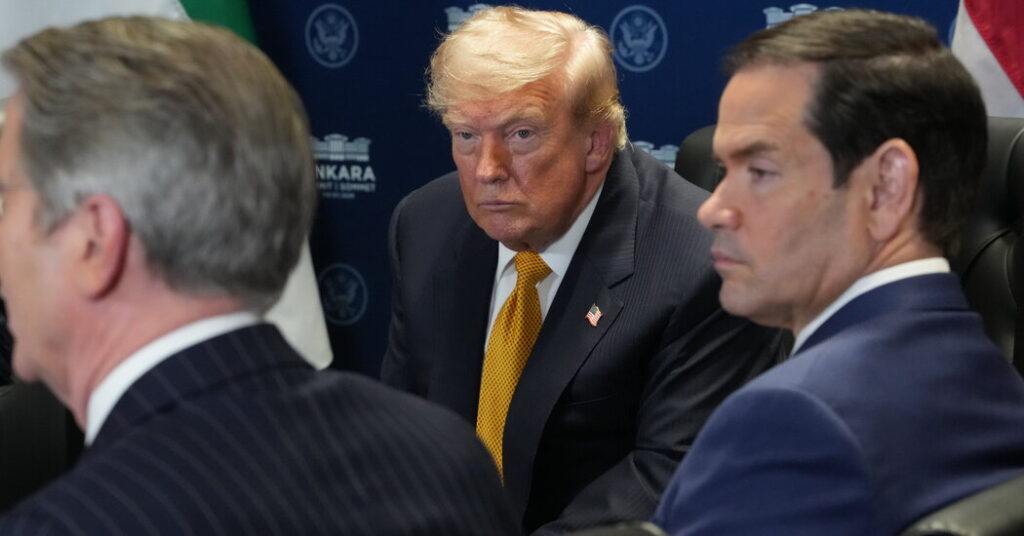
At the NATO summit in Ankara, Turkey, on Wednesday, he threatened major new combat operations, including seizing a key Iranian oil processing island and attacking the country’s infrastructure and desalination plants, which experts have said could constitute a war crime. (Mr. Trump did say he was most hesitant to hit the desalination facilities.)
But Mr. Trump has made such threats without following through before, and he added on Wednesday that he did not anticipate a return to full-scale war. Such a move has little domestic support, and some of Mr. Trump’s Republican allies fear the economic and political consequences less than four months before the midterm elections. No one is more aware of that calendar, or Mr. Trump’s hesitation to repeat the experience of the spring, than the Iranian leadership.
The president could instead reimpose the American blockade of Iranian ports, an attempt to cut off the country’s economic lifeline. But that would require a continued, intense American presence in the region, and while Mr. Trump contended in April that it would lead to Iranian economic collapse, his earlier imposition of it did not.
Or he could elect to live in a world of neither war nor peace, an era of episodic skirmishes in the Persian Gulf, punctuated by periodic negotiations, with traffic through the Strait of Hormuz, a key oil-shipping route, greatly reduced from the 130 or so ships that passed through each day before the war. The energy markets would most likely adjust; to some degree they already have.
But for a president who promised a quick, cost-free confrontation with an old adversary — “four to six weeks” was the White House prediction in the opening weeks — an ongoing conflict would amount to near-total failure on the mission he initially set out upon. And the price would be staggering: The Pentagon has already asked Congress for about $70 billion to cover the early operations around Iran, and the cost rises every week.
“The problem is that all the options — endure, escalate or agree — are unattractive in different ways,” Richard Fontaine, the chief executive of the Center for a New American Security and a former aide to Senator John McCain, said on Wednesday. “The likeliest outcome is a continuing series of low-level, tit-for-tat attacks, followed by frantic diplomacy by mediators, the emergence of a new and fragile cease-fire, and then probably another round of strikes.
Mr. Fontaine added: “It will be a long oscillation between cold war and low-level hot war.”
Many of the problems Mr. Trump is facing today were exacerbated by the cease-fire deal itself. It left unresolved, for a later negotiation that Mr. Trump now says he has little interest in pursuing, the fate of Iran’s stockpile of near-bomb-grade nuclear fuel, the most prominent among the administration’s shifting reasons for attacking Iran on Feb. 28.
The agreement appeared to hand Iran at least some control over passage through the Strait of Hormuz, the superweapon that Tehran, and specifically the Islamic Revolutionary Guards Corps, has skillfully manipulated to drive up oil prices, and now has used to justify attacks on tankers and cargo ships not hewing to its new rules.
“What we’re seeing now is Iran, and more specifically the I.R.G.C., trying to exert control over the strait and declaring that this control is their sovereign right,” said Kevin Donegan, a retired Navy vice admiral who served as a Navy commander in the Middle East. “That’s the main card they have to play, and as a result we can expect they will continue to try to disrupt any ship traffic that uses routes different from the ones they have published.”
The deal was silent on Iran’s missile arsenal, the key issue for Israel. And it depended on a cease-fire in Lebanon, though the parties to that conflict, Israel and Hezbollah, were not signatories of the agreement. And it set an unrealistic deadline, 60 days, to deal diplomatically with those and other issues that months of active combat had failed to resolve.
There are, of course, many more turns ahead in this drama. Mr. Trump threatened again on Wednesday to try to seize Kharg Island, where giant tankers collect Iran’s oil and head to world markets. He may seek to seize the 60 percent enriched nuclear material deep underground at Isfahan, a mission for which Special Operations forces have trained extensively, though he dismissed the need for it on Wednesday.
“We’ve already got the nuclear material, because it’s so far underground,” he said, noting that the Iranians do not have the heavy equipment needed to unearth it.
If Mr. Trump is right about that, and many nuclear experts agree that the material would be enormously difficult to recover, it raises a fundamental question: If the nuclear fuel was successfully buried in the June 2025 American bombing of three major nuclear sites, why did he go to war to begin with? His statement on Wednesday, a repeat of comments he has made several times in recent months, undercuts the argument he made in the days after the initial attack in February that there was an “imminent” threat.
That initial justification has been overtaken by subsequent contradictions. Mr. Trump has periodically praised the new Iranian leadership, and even its new supreme leader, Mojtaba Khamenei, the son of the slain ayatollah, as more “reasonable.” He has said many times that, unlike their predecessors, the new leaders would open up the strait and dilute the nuclear stockpile because it will be in their economic interest.
Vice President JD Vance sounded exactly that note last month, when he was signing the memorandum of understanding in Switzerland.
“The coolest thing about the progress we’ve made over the last few weeks is that you see people within the Iranian system, senior leadership, even I.R.G.C. officials say, ‘You know what, we may have some animosity, we may have some mistrust, but we recognize the way that we’ve done business with the United States for 47 years is a mistake,” he said.
On Wednesday, Mr. Trump had a different word for those leaders: “scum.”
“They are sick people. They’re led by sick people, and they’re vicious, violent people,” he said, adding: “As far as I’m concerned, it’s just a waste of time dealing with them.”
Eric Schmitt contributed reporting.
The post As Cease-Fire Frays, Trump Faces a Muddled War and Unpalatable Options appeared first on New York Times.