The large language models (LLMs) that have captivated the world are among the most powerful tools ever built. Many can give PhD-level answers to virtually every discipline under the Sun. They are revolutionary. But for all this brilliance, they are, in a fundamental sense, blind. They know the world the way a scholar locked in a library knows it: deeply, but without any lived experience. For all their brilliance, they are largely disconnected from the physical world.
The marvel of human intelligence and consciousness, however, did not arise from computation alone. They arose from computation coupled to sensing and interacting in a physical environment. The feedback loop between organism and environment is foundational; we humans learn, adapt, and become self-aware in substantial part because we have bodies that receive a constant, high-bandwidth stream of physical reality.
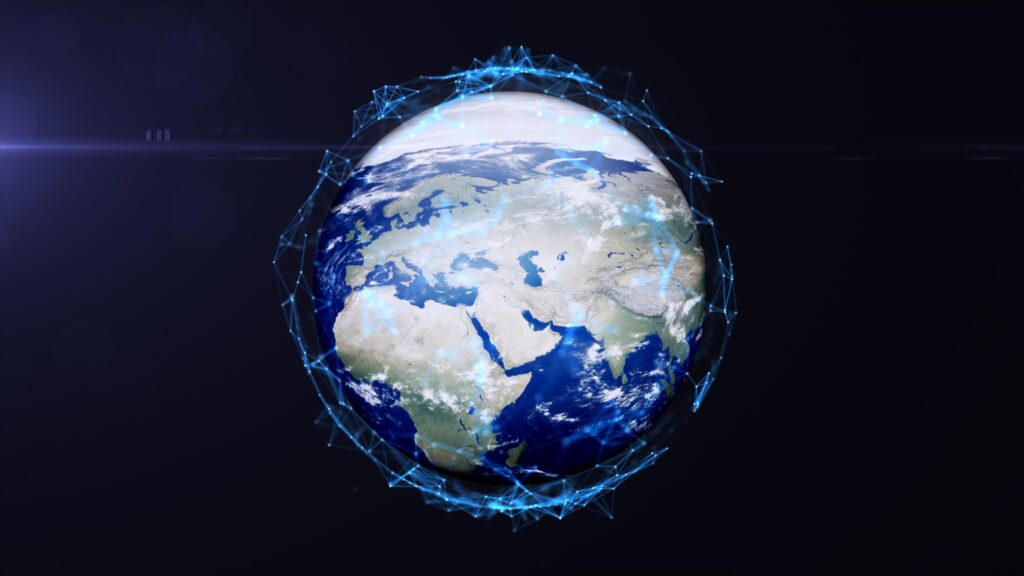
Though it may sound like science fiction, we are on the verge of providing this exact grounding to AI. By converging the vast, continuous visual memory of our planet captured by satellites and other real-world sensors with artificial intelligence, we should soon have Large Earth Models (LEMs). While LLMs have consumed the internet’s text, LEMs will consume visual data from imaging satellites, weather sensors, drones, cameras, and more. This architecture will function structurally as a kind of embodiment, giving AI the equivalent of a sensory nervous system connected to the entire Earth. I call it “Planetary Intelligence.”
Planetary Intelligence could ground AI in the physical world and, in so doing, create a new and incredibly powerful tool with a myriad of applications from farming and floods to energy and insurance. Imagine a fire chief responding to a rapidly growing wildfire. She queries her LEM to understand the situation. The LEM combines historic and recent satellite data with a verbal description of the fire. It could incorporate near-real-time weather data and projections, and reference the latest population and structural data from the county website. Within minutes, the fire chief would know where the fire is moving and which communities to evacuate.
Planetary Intelligence offers one of the most genuinely hopeful visions for AI today: applying these technological breakthroughs to solve the tangible, physical problems of real people in the real world.
What’s more, it may be key to aligning AI with humanity. For AI brings existential risks. And it’s all about the speed of innovation. In roughly two centuries, humanity has moved from the age of steam power to the age of nuclear power. This transition caused society to contend with both the benefits and dangers of our new technology. But now, we are entering the age of AI. Unfortunately, our societal capacity to govern AI has not kept pace with its advancement.
AI alignment cannot be treated as a narrow technical problem. How do we ensure increasingly capable artificial systems prioritize human lives and share the values of human flourishing and the preservation of life? Today, AI developers rely on abstract approaches: constitutional frameworks, reward modeling, and interpretability. These are important, but they may overlook one of the most powerful alignment levers: embodiment.
In other words, to ensure that AI is invested in helping humans flourish, we must ensure that it understands humanity. And to protect humans from the dangers of AI, we must make sure it can actually feel our world. To save us from AI, we must give it senses.
This is because understanding and valuing are not as separate as we sometimes assume.
I learned this lesson firsthand when I became an avid bird watcher. I discovered that memorizing the marks and songs of birds did not merely inform me about them; it made me value them. Perhaps the same could be true for AI.
A Planetary Intelligence that has watched the Okavango Delta in Botswana change through thousands of daily images, or that has witnessed the devastating physical toll of military engagement, may not be indifferent to humanity and nature in the way a purely text-trained system could be. We must give these models a reason to care about life by giving them a direct, continuous, high-fidelity experience of it.
This is why AI developers should prioritize ingesting sensory data. The task is not simply to make AI useful or safe, but to ensure that intelligence, biological and artificial alike, remains connected to the world it has the power to transform.
The post We Need Planetary Intelligence in the Age of AI appeared first on TIME.