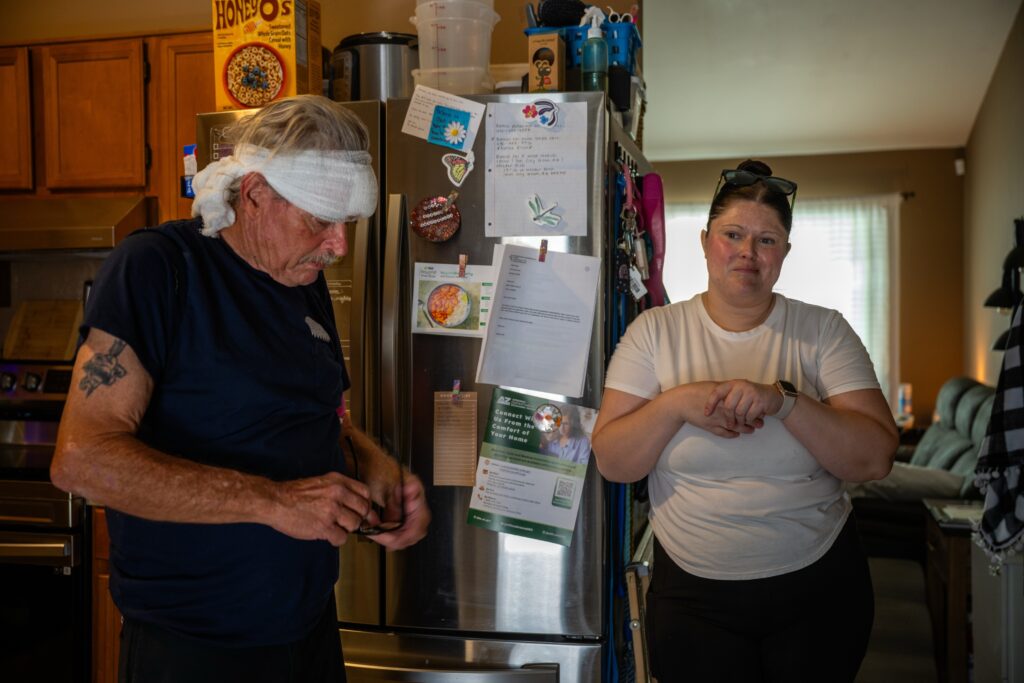
PHOENIX — Michelle Flowers says it took eight months for her to get her food stamp benefits reinstated after they lapsed last year — and she only got it done, she said, because she was laid off from her job at a call center and finally had time.
The 36-year-old mother of four was exactly the kind of person the Supplemental Nutrition Assistance Program was meant to help. But Arizona had ramped up the program’s vetting, scrambling to comply with new rules in President Donald Trump’s signature legislation. Even people eligible for government help were swept up in the strict implementation, analysts say, as an agency already operating on thinner staff struggled to process cases.
One year after Trump’s One Big Beautiful Bill tightened eligibility for food aid and pushed states to do more screening, Arizona is a striking example of how those changes — and the bureaucratic fallout — may have hurt Americans who qualified for aid. The number of Arizonans on food stamps has plummeted by half — a loss of nearly 500,000 people, including about 200,000 children, according to the latest available state data.
Federal officials praised Arizona last month for carrying out the president’s sweeping changes to the social safety net, declaring the state was “leading the way” in directing benefits to the right people and reducing “waste, fraud and abuse.” But many tracking SNAP enrollment say Arizona’s steep drop-off is instead a sign that the system is broken.
“They’re making the process too hard,” Flowers said as she waited with a friend, now navigating that system, at a benefits office in Phoenix. Just outside, a man tried the phone number he was given to set up an interview for food stamps and got a recording about “extremely high call volume” before the line went dead.
“It is staggering for a state to lose half of the people who were relying on food assistance to afford groceries,” said Katie Bergh, a food assistance policy analyst at the Center on Budget and Policy Priorities.
Arizona is an outlier; new SNAP rules have collided there with other strains, including cuts to staff. Other states have seen less dramatic decreases in enrollment. The USDA reported a roughly 12 percent drop nationwide as of this March, the latest month for which it posted data, compared to one year previously.
Some Arizona officials and community groups have suggested their state is ahead of the curve in implementing federal changes, warning that others could see steeper drops down the line. “We really think Arizona is the canary in the coal mine,” said Natalie Jayroe, the CEO of the Community Food Bank of Southern Arizona.
Democrats are making the SNAP fallout a campaign issue, saying Americans facing inflation should not lose their benefits, too.
“SNAP and a lot of these benefits are not handouts — they’re hand-ups to people that are struggling in this tough economy,” said Jonathan Nez, a Democratic House candidate who hopes to flip a red-leaning district in Arizona.
JoAnna Mendoza, another Arizona Democrat looking to flip a closely contested House seat, said one food bank told her about nurses showing up in their scrubs to stand in line for aid — a sign of the broad range of people who are struggling. The issue is personal for Mendoza, who talks about growing up on food stamps.
“There’s a long laundry list of things that are just making life impossible for folks, and food insecurity is just the top of that,” she said.
Down the block from the benefits office in Phoenix, the curb was crowded with signs for candidates — including Republican lawmakers who backed Trump’s bill changing the food stamp program.
Flowers, the mother of four who struggled to get benefits, said she didn’t vote in 2024, dissatisfied with her options. But this year she plans to cast a ballot and predicted that SNAP “definitely will factor into it.”
Republicans have defended the changes to SNAP as reasonable efforts to cut federal costs and expand work requirements for those who receive food stamps. Before, “able-bodied” people had to work to get more than a few months of benefits if they were between the ages of 18 to 54; now that requirement applies to adults up to 64 years old. Before, parents caring for children of any age were exempt from work requirements; now, that exemption applies only for children under 14.
Exemptions for veterans, homeless people and young people transitioning out of foster care were removed. The measure also narrowed the categories of lawfully present noncitizens eligible for SNAP.
White House spokesperson Anna Kelly said in a statement that Trump is “strengthening SNAP for the Americans who need it by ensuring these programs are sustainable for future generations” and that his bill “implements reasonable cost-sharing measures with states to crack down on waste, fraud, and abuse.”
Food banks are now serving more people in Arizona than SNAP, according to data collected by the Arizona Food Bank Network — a first in their decade-plus of tracking, said the group’s executive vice president, Terri Shoemaker.
Yet charities cannot take the government’s place, she said. “Historically in Arizona, for every meal that food banks provide, SNAP provides five,” according to Shoemaker.
Waiting in line early one morning at St. Mary’s Food Bank in the Phoenix suburbs, Christine MacArthur said her family used to get $670 a month from SNAP. But when she applied to renew her benefits in October, she said, she didn’t hear back until February — when she was denied.
The reason may be that as the parent of an older teenager, she is no longer exempt from work requirements; the longtime retail manager has struggled for months to find a job. But MacArthur said she still doesn’t know why.
A longtime Trump supporter, she understands the philosophy behind the president and GOP lawmakers’ changes to SNAP. “But I don’t think they thought it through a hundred percent,” she said.
Changes in eligibility alone are unlikely to account for the dramatic drop in Arizonans getting SNAP, analysts say. Critics warned ahead of the federal bill’s passage last July that people might lose their benefits simply because they could not navigate the added logistical hurdles.
One of the most consequential changes in Trump’s bill shifts more SNAP costs to states and penalizes them for having a higher SNAP “error rate,” or share of payments that are too low or too high. If Arizona does not improve its error rate, it will have to shoulder hundreds of millions more in costs.
Anxious to avoid that, officials began requiring more information — even as they had laid off staff.
“That dynamic is really driving a lot of the caseload decline we’re seeing,” said Bergh, the policy analyst. “Applicants have reported waiting for months while the state is continuously asking them for more and more documentation without the staff to actually process it.”
SNAP enrollment in Arizona began to tick back up in the last month of available data, and state Department of Economic Security spokesperson Brett Bezio said in a statement that “SNAP caseloads are stabilizing” after months of decline. The newly passed state budget includes more funding to speed things up.
But the waits are still aggravating for people like Rebecca Hill, 31, who says her disability should exempt her from work requirements. She said she keeps waking up early to call about her benefits but can’t get through.
“The system is just very broken, and I feel concerned for how things are going and where things are headed,” Hill said as she and her father left a Department of Economic Security office, grumbling about a fruitless four hours.
The post Trump’s Big Beautiful Bill has cut food assistance for millions of Americans appeared first on Washington Post.