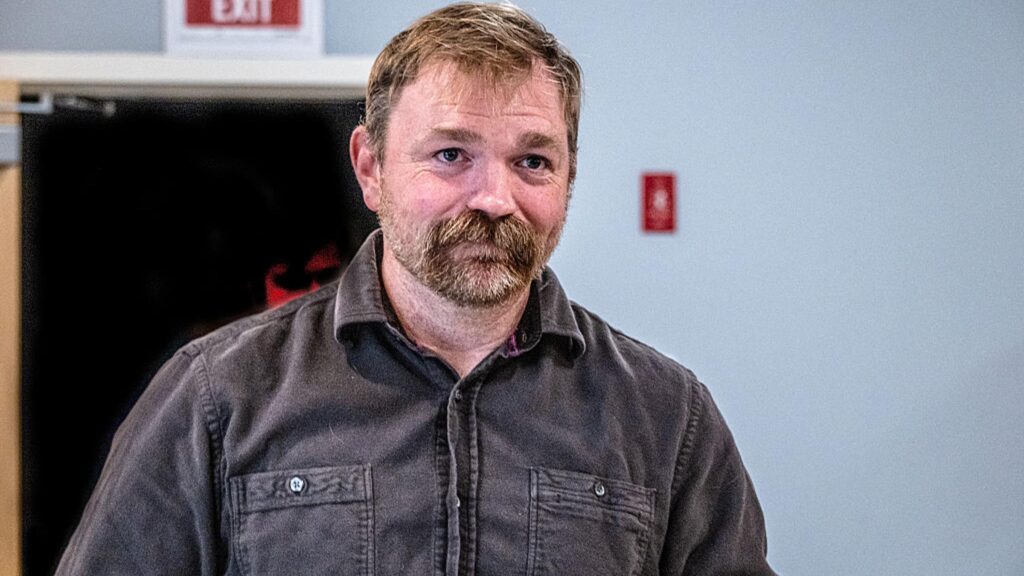
A day after allegations of sexual assault upended his political career, Graham Platner remained Democrats’ nominee for Senate in Maine. But the jockeying to replace him on November’s ballot was well underway up north. It’s not just a race against time, but, in the eyes of some, against the Democratic Party’s left flank—who cheered on an unvetted first-time candidate for the party’s best Senate pick-up opportunity of the midterms, and are now trying to undo the damage.
Platner, a Marine veteran and oysterman whose campaign has been pocked by a constant stream of revelations about his past, still has a say over the situation. He convincingly won the June primary and will be on the ballot come November unless before 5 p.m. Monday he formally consents to Maine Democrats replacing him. He and his progressive allies are holding firm that they will not allow his campaign’s implosion to be a way to backdoor a more moderate pick, such as Washington Democrats’ favored pick—Gov. Janet Mills.
Around Washington, the assumption is that Platner’s exit is inevitable. But he has to be convinced that the movement he built will not be shelved. Conversations are about who might be an acceptable candidate to assure Platner that his supporters will have a voice going forward—and that it won’t be Mills, who was an early warner of Platner’s vulnerabilities.
If Democrats can convince Platner to take the exit ramp before Monday, they would then have two weeks to formally name a replacement. But progressives are chirping reminders about how a similar process played out almost exactly two years ago when President Joe Biden transferred his nomination to Vice President Kamala Harris without letting voters have a say. That’s why there have been some floated ideas up in Maine about having an emergency party convention or caucus, if not to debate a replacement nominee then at least to convey legitimacy.
Among the Democrats being considered are three Democrats who fell short in last month’s Democratic primary in Maine for Governor: Troy Jackson, a former president of the Maine Senate; Nirav Shah, a head of public health in Maine; and Shenna Bellows, Maine’s Secretary of State. Supporters of all three argue they are well-positioned to hit the ground running, after having just ended a statewide campaign.
Retiring Rep. Jared Golden, a moderate, issued a statement on Tuesday that toyed with the idea of being an option. “In the aftermath of yesterday’s story about Graham Platner, I think Ms. Racicot’s testimony speaks for itself,” he posted online—but did not directly call on Platner to step aside or address whether he is interested in taking Platner’s spot.
Dan Kleban, a brewery owner and political newcomer who briefly ran in that race, is still on the sidelines, as is state Rep. Valli Geiger. Kleban cut an intriguing figure when he first emerged last year, but Maine Democrats might be gunshy about nominating another candidate who’s totally untested in the political arena.
And then there’s Jordan Wood, a former Capitol Hill chief of staff who ran unsuccessfully for Golden’s open House seat, coming in third. A true progressive, he may be the most Platner-minded candidate in the mix, but he, too, is largely untested.
The still-unfurling Platner disaster is exacerbating the internal divisions inside the Democratic Party. Democratic socialists are winning nominations in deep-blue House districts while more moderate Democrats are giving hopes to party leaders that Senate races in North Carolina, Ohio, Iowa, and even Texas might carry opportunities. It’s an open feud that reflects just how unmoored—if not toxic—the standard Democratic identity is to many voters at the moment. And it’s defining the conversation in Maine, a state where Democrats see a real opportunity to deny Republican Sen. Susan Collins a sixth term.
Platner’s allies are trying to accept the Platner boom is over while pushing for his brand of populism to define the Democratic ticket.
“To the Democratic establishment: This is not your opening,” said Joseph Geevarghese, the head of Our Revolution, a group that came out of the ashes of Sen. Bernie Sanders’ 2016 campaign. (Late Tuesday, Our Revolution announced it was “rallying behind” Jackson, who took steps Tuesday to form a fundraising committee for the seat.)
Meanwhile, Mills remains a force in Democratic politics in the state, although no one is really championing the 78-year-old to make history as the oldest first-termer elected to the Senate. And all the while, in a sign that politics in this era is anything but rules-governed, actor Patrick Dempsy’s name is being bandied about as an option with high name ID and zero voting history.
The consequences to all this are real, and could impact toss-up races around the country. Democrats’ de facto super PAC operation said it would nix $24 million in earmarked spending there if Platner remains the nominee. The official campaign arm for Senate Democrats also said there would be no party cash for that race unless he exited. Allied interest groups across the Democratic spectrum also rescinded their endorsements and urged Platner to step aside. Even Platner’s strongest backers in Washington, including Sanders and Rep. Ro Khanna, urged him to realize his race was done.
Platner still has leverage. If he were to choose to, he could battle on to November and leave Democrats with a deeply wounded candidate. He would essentially be a zombie candidate, but it wouldn’t be the first. While everyone is acting as if his campaign is over, Platner is truly the only one who can call the time of death.
The post List of Democrats Who Might Replace Graham Platner Grows—as Platner Weighs His Future appeared first on TIME.