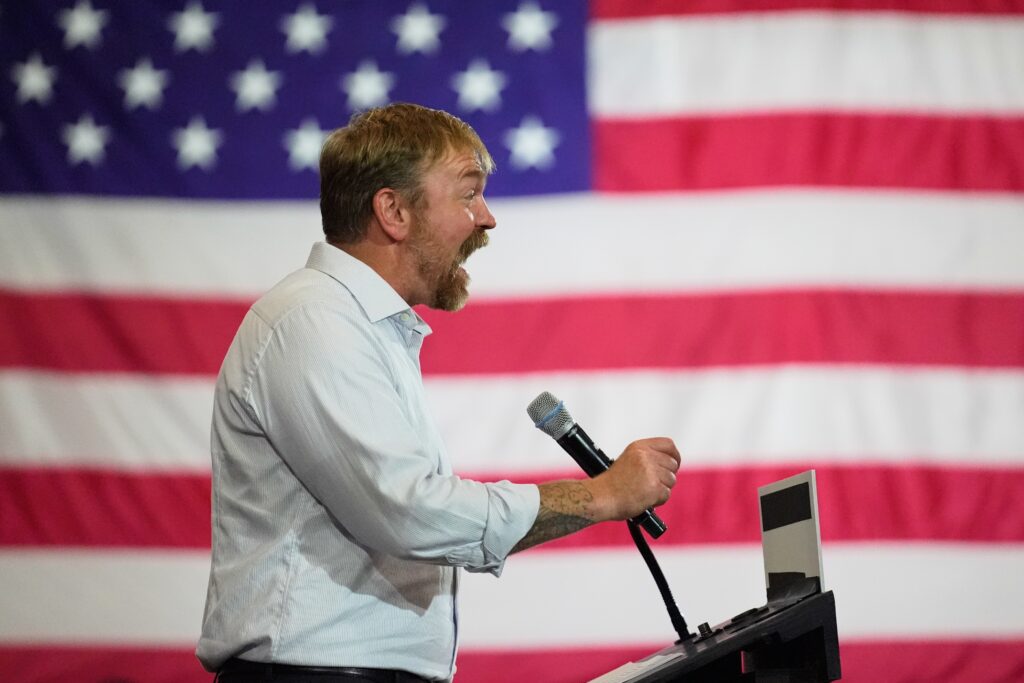
State and national Democrats were engaged in an intense ideological battle Tuesday as they sought a replacement for Graham Platner in the pivotal U.S. Senate race in Maine, even as the oyster farmer has yet to withdraw from the contest.
The Platner campaign, as it deliberates when and whether to withdraw, is expressing a desire to influence who replaces him on the ballot, according to a person close to Platner who would only reveal strategy on the condition of anonymity. That posture has annoyed many Democrats, who blame Platner and his team for endangering the party’s chances of winning a race against Sen. Susan Collins (R) that could determine control of the Senate.
In the meantime, notable Maine Democrats began privately jockeying for position, calling state party leaders to better understand the process for picking a new nominee if Platner drops out, multiple top Maine Democrats told The Washington Post.
Amid all the maneuvering, state and national Democrats were scrambling to devise a process for selecting a replacement, given the rarity of the circumstances and the vagueness of state law.
The positioning among Democratic factions, candidates and interest groups began almost immediately after Platner said in a video on Monday that he was “taking the time to reflect on the best path forward” in the face of a new sexual assault allegation, which he denied.
Platner, who lost a string of top endorsers on Monday, is facing pressure to withdraw from the race by Monday, the state deadline to finalize the November ballot. If he drops out, the state party would have two weeks to name a replacement.
The latest and perhaps most consequential nudge to leave the race came Tuesday from Sen. Bernie Sanders (I-Vermont), one of Platner’s most vocal, loyal and influential supporters. He released a statement saying that he urged Platner to step aside “in light of these very serious allegations.”
The person close to Platner said his campaign wants a say in his replacement if and when he exits the race. Platner won the primary by positioning himself as a liberal fighter who pushed back against the Democratic Party establishment.
“There is a widespread recognition within the campaign that this is likely to end in the near future,” the person said. “And there is a desire to ensure the organization built around this campaign does not dissolve.”
The person said campaign leadership hoped to “have input on the decision” about how a replacement would be selected.
Platner’s initial response to the allegation set off a frenetic scramble at the state and national levels. National progressive organizations, following the Platner campaign’s wishes, swiftly attempted to leverage his onetime standing with Maine voters to ensure that, if he ends his campaign, his replacement is ideologically aligned with Platner’s progressive policies.
“To the Democratic establishment: This is not your opening,” Joseph Geevarghese, executive director of Our Revolution, the political group born out of Bernie Sanders’s 2016 presidential campaign, said in a statement.
But state and national Democrats roundly mocked Platner’s allies for attempting to make demands after they chose to elevate the scandal-prone candidate. Platner, before the latest allegation, faced scrutiny for old social media posts dismissive of sexual assault, a tattoo resembling a Nazi symbol that he has since covered up, sexually explicit text messages he sent to other women after he married in 2023, and allegations of physical violence by ex-girlfriends.
“People who got us into this mess — who vouched for this candidate after 3 different scandals and kept telling us there were going to be no more — may want to take a break from Maine strategizing,” Neera Tanden, the head of the Center for American Progress, a more establishment liberal think tank, said in a social media post.
“The Democratic nominee, if there is a new one, has to be someone who is independent minded from Platner, otherwise they will be viewed by voters as a protege,” state Sen. Joe Baldacci, who lost his congressional bid this year, wrote on X. “Any connections to Platner will doom that person’s campaign from the very beginning.”
Maine Democrats spent the hours after Platner’s announcement determining what a process to replace him would look like. It would most likely resemble the procedure the state party uses to select delegates for state party conventions, according to multiple Democratic officials. That process allots delegates to each county party, who then vote on the nominee.
But considerable questions about how that process would play out remain unanswered, in part because Platner has not dropped out.
“I am definitely concerned we could have a process where it looks like party leaders are determining who the nominee is. That would be the wrong way to go,” said Maine House Speaker Ryan Fecteau, who added he was not putting his name forward, in an interview. “I don’t think the Platner campaign or me as a party leader as speaker or leaders at the party itself should be the ones making the decision.”
“It needs to be driven by the people who are the heart and soul of our party,” he added.
That uncertainty around the process has exposed a lack of trust between the party’s insurgent wing, represented by Platner, and the more establishment figures who had long viewed the political newcomer skeptically. Those close to Platner worry that party insiders will pick someone at odds with his political base.
“This is a s— show,” said a top Maine Democrat familiar with the party’s planning.
The potential candidates gaining the most attention ran in last month’s crowded gubernatorial primary, in which former Maine House Speaker Hannah Pingree prevailed.
Nirav Shah, the former top Maine health official who finished second in the gubernatorial contest, is interested in running, a person close to Shah said. Shah laid out the process he would like to see to possibly replace Platner, including a televised debate and multiple town halls, in an X post on Tuesday.
But Shah is viewed skeptically by some Platner supporters. Many have gravitated to former state Senate president Troy Jackson, who also mounted a failed bid for governor and called on Platner to end his campaign.
BJ McCollister, a longtime adviser to Jackson, posted a promotional video of Jackson on Monday and launched a campaign to draft him for Senate.
Jackson did not respond to The Post’s request for comment, but he told the Bangor Daily News that he viewed himself as the “best person” to replace Platner, should he end his campaign.
Rep. Ro Khanna (D-California), a former Sanders surrogate weighing a presidential bid in 2028, said in a text message that Democrats should rally around Jackson because he shares Platner’s opposition to foreign wars, support for Medicare-for-all and focus on removing money from politics.
Maine Gov. Janet Mills, who challenged Platner for the Senate nomination but withdrew this year after polls showed her far behind in the race, has not commented on her interest in running. A Mills spokesperson did not respond to a request for comment.
Maine Secretary of State Shenna Bellows, who also ran for governor, is considering a run should Platner drop out, a person close to Bellows said.
David Costello, who finished third in the Democratic Senate primary in June, said in a statement Tuesday that he’s “back in, if Graham Platner withdraws.”
And Dan Kleban, who ran for Senate but withdrew last year, is also considering vying for the job, said a person close to the Maine Brewing Company owner, who argued that his lack of a relationship with Platner was a positive in his possible bid.
“He never endorsed him,” the person said of Kleban’s relationship with Platner. “He never even liked the guy.”
The post Democratic factions vie to pick Platner replacement before he leaves Maine race appeared first on Washington Post.