On most mornings, deep in the San Fernando Valley, Mercado Buenos Aires is quiet. A few older Argentine men might sip coffee with medialunas and chat about soccer and politics in the family-owned deli.
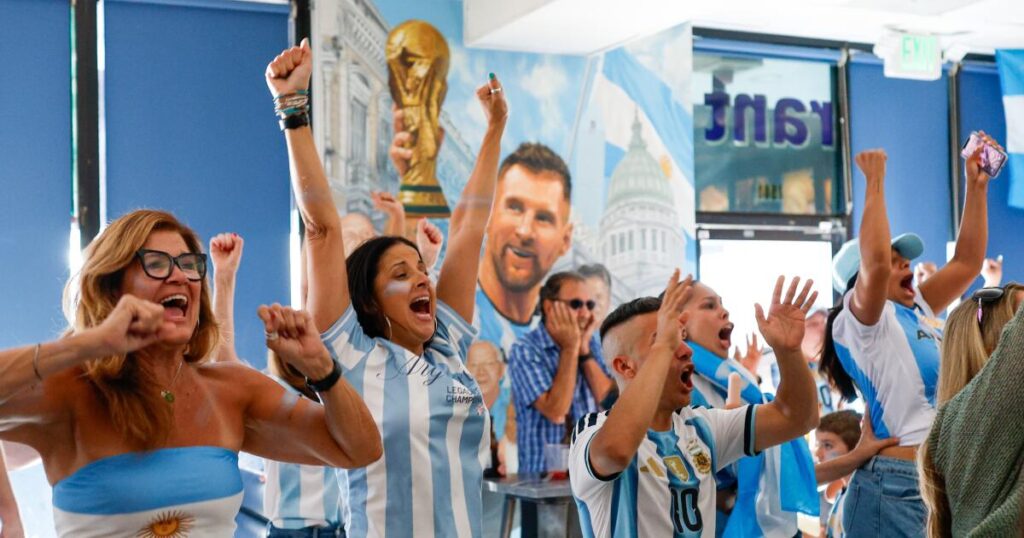
But on a recent June afternoon, as Argentina faced off with Algeria in a group-stage match at the World Cup, soccer fans stood on tables, families in sky-blue-and-white Lionel Messi jerseys chanted in unison, and every goal sent the room into gleeful mayhem.
A line of World Cup fans formed outside the packed deli, forcing restaurant owner Paul Rodriguez to apologetically turn eager customers away.
“One drove all the way from Long Beach,” he said. “Another drove from Palmdale just to watch the game.”
Above the meat counter, framed soccer jerseys hang over rows of bright-red steaks and house-made sausages. An espresso machine vibrates in the background. On one wall, there is a mural of Messi holding a World Cup trophy in victory.
The Argentine deli has served as a gathering place for the local Argentine community for decades. Now it’s World Cup central for loyal fans waiting on the edge of what they hope will be Argentina’s fútbol glory.
“When Argentina’s Pope Francis was elected, the community gathered at the restaurant to celebrate,” Rodriguez said. “Every time there’s something involving Argentina, we gather here.”
For many Argentines, soccer occupies a place in their hearts somewhere between pastime and national religion. This year, Argentina is defending its World Cup title, with Messi widely regarded as one of the greatest players the game has ever seen.
“Having Messi’s last World Cup here, right after Argentina became defending world champion, is a really big thing for us,” Rodriguez said. “In Argentina, we have one sport, and that’s soccer.”
The restaurant’s cultural pull extends beyond the matches. Marianella Montenegro, who emigrated from Argentina roughly a year ago and now works as a server, describes walking into Mercado Buenos Aires as a homecoming to a place she left behind.
“You open the door, and you’re in Argentina,” she said. “Everything reminds you of the place — the food, the vibe, everything. It’s that sensation of coming back home.”
For immigrants, especially recent arrivals, such spaces can serve as anchors. Rodriguez has watched generations of Argentines pass through the restaurant’s doors.
“Argentines are very social people. We like to sit down, have coffee and talk for hours. When you come to the U.S., you lose that,” said Rodriguez.
Mercado Buenos Aires was founded by Manolo Rodriguez in June 1989. Before opening the deli, Manolo had worked as a butcher in Argentina since age 12. The business began as a market and deli specializing in Argentine products and fresh sausages. Then Rodriguez’s mother, Clelia “Cle” Rodriguez, started making empanadas from beef trimmings left over from the butcher counter.
“My mom started making empanadas with all the trimmings from the beef,” Paul Rodriguez said. “That led us to put in a little table, then two tables. Then we started serving coffee and little sandwiches.”
Soon, Mercado Buenos Aires evolved into both a market and a restaurant. Today, it still offers deli meats, wine, chimichurri, alfajores filled with dulce de leche, yerba mate and other Argentine specialties.
Paul Rodriguez spent much of his adolescence at Mercado Buenos Aires, inside its booths and pacing its black-and-white checkered floors. “Every day after school, I would work in the restaurant, washing dishes,” he said.
As an adult, Rodriguez attended Le Cordon Bleu before opening his own Argentine restaurant, Buenos Aires Grill in Northridge, at age 25.
When his father developed health problems and decided to retire, Rodriguez took over Mercado Buenos Aires in 2009. His parents have since died, but their presence remains embedded in the spirit of the restaurant.
Argentine cuisine is known for its meat-forward cooking, and Mercado Buenos Aires is no exception.
“We have 40 million people living in Argentina, and millions and millions of cattle. We’re a big cattle country ever since the beginning,” said Rodriguez.
One of the mercado’s most beloved dishes is entraña, or skirt steak, a cut that Rodriguez said his father championed long before it became fashionable.
“We started grilling it many years ago. It wasn’t very popular at all, but my dad was a butcher and understood that it was a very good piece of meat.”
Rodriguez explains that the menu serves as a family archive.
“From an emotional standpoint, the sausages we make are our own Argentine sausages made fresh every week, and that’s something that reminds me of my dad.”
The empanadas remain one of his mother’s lasting contributions to the restaurant.
“Empanadas hit home emotionally because it’s something that boosted business for us,” Rodriguez said. “It reminds me of my mom, her recipes and making them by hand with my aunts.”
The restaurant’s commitment to Argentine tradition extends to its collection of wine. Years ago, after extensive tasting and experimentation, Paul Rodriguez worked with winemakers in Mendoza to create a specialty Malbec — a grape variety that has helped cement Argentina’s status as a wine powerhouse — exclusively for Mercado Buenos Aires.
The restaurant also has become a safe haven for immigrants arriving in the San Fernando Valley.
“Most Argentines, when they come here, are a little lost,” said Rodriguez. “Our people — artists from Argentina, soccer players — come in and don’t know where to go, where to stay, or who to ask for advice.”
Generations of Argentines have patronized Mercado Buenos Aires. During the World Cup match, Rodriguez moved through the crowd, greeting customers whose families had been coming for decades.
A woman approached Rodriguez. “She said, ‘I remember you when you were 13 and working at the cash register.’ ”
“We’ve been around for so long,” Rodriguez said, “we have grandchildren of original customers that come in.”
Mercado Buenos Aires will host the next raucous watch party when Argentina plays Egypt on Tuesday. Pandemonium is expected, so are wins.
“Since I was a little kid, I used to watch Diego Maradona. He was the best in the world. That gave us so much pride and so much passion for the sport,” Rodriguez said. “Then Messi shows up, and Messi turns the game upside down.”
Within the walls of Mercado Buenos Aires, the appeal of Argentina’s legendary soccer culture extends far beyond Argentines. Rodriguez spoke to customers cheering for Messi — from Mexico, Jordan, Israel and Egypt, all chanting Argentine songs in unison with bottles of Quilmes beer in hand. The scene surprised him; the tensions that often divide people seemed to dissolve inside the deli.
“It was very beautiful to see how soccer unites people,” Rodriguez remarked. “Everybody is just looking at that round ball go from one side to another. Nothing else matters.”
The post With World Cup glory on the line, Argentina fans flock to this family-run Valley mercado appeared first on Los Angeles Times.