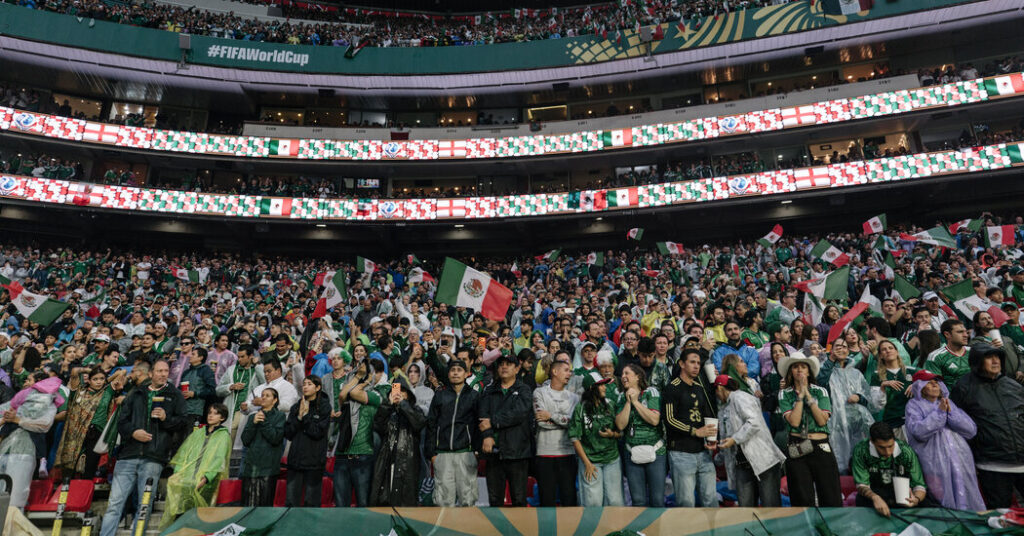
In Mexico, the World Cup has been a chance for the country to come together in an embrace combining patriotism, color and sound.
With each win by the national team, those colors became more vibrant, the volume pushed up a notch, and the celebrations grew even more intense. Throughout the country, people (and their pets) dressed in what has become a national uniform: green soccer jerseys.
The form and promise of Mexico’s four straight victories, in which they did not concede a goal, unleashed an energy that even torrential rain in the capital on Sunday did little to dull. The emotion reached fever pitch before Sunday’s round-of-16 loss to England in Mexico City.
“We are living something completely new,” Diego Martinez, 23, said as he took in the scene at Paseo de la Reforma, a thoroughfare in Mexico City where thousands of people had begun to gather 10 hours before the game against England kicked off.
The avenue — where more than a million people celebrated on Tuesday after the team advanced to the round of 16 by defeating Ecuador — became an emblem of Mexican passion. The wave of nationalism also became a magnet for people living outside the city who were determined to join a communal expression of what it meant to be Mexican.
“We wanted to be part of it,” said Fernando Guillen, who traveled to Mexico City from the southern state of Chiapas with three generations of his family to experience the party.
The days and weeks the country has lived during the World Cup have allowed for a rare reprieve from life’s harsh realities. The national team’s success had provided a reason to fill the streets for celebration rather than for fear, grief or protest.
Mexico, the first country to host the World Cup three times, is a place of contrasts. It is a country of over 130 million residents with a globally important economy, and a major international tourist destination with vibrant culture and history. But it is also a country synonymous with cartel violence, disappearances (more than 130,000 people are officially missing) and corruption.
Recently, its economy has sputtered and its relationship with the United States, Mexico’s neighbor and most important political and economic partner, has frayed since President Trump took office for his second term. He has applied immense pressure through his words, tariffs on Mexico’s economy and indictments of Mexican officials.
The national team’s success offered an escape from all that.
“Today we can forget all our problems and think about football,” Mr. Guillen said. “Tomorrow we will be confronted with the same old challenges.”
With each Mexico win during the World Cup, the country’s hope grew stronger. Everyone, including President Claudia Sheinbaum, had been cheering.
The national team’s unofficial slogan of “¿Y si sí?” — which roughly translates to “What if they can?” — has become a popular refrain. It rang out at the Azteca Stadium on Sunday as fans willed the team back into the contest, even as England, a player down following a red card, desperately clung on to its 3-2 lead.
Even though this World Cup was hosted by three countries — the United States got 78 games and Canada, like Mexico, got only 13 — it felt as if Mexico was brought to a standstill whenever its national team played. There were widespread school closures, and government data showed a significant drop in the national homicide rate on the day of the national team’s first World Cup match.
The intensity of the revelry was, at points, overwhelming. Four people died during celebrations following the victory over Ecuador. The authorities imposed an outdoor drinking ban downtown on game days, and instituted bag searches. But many people still found ways to drink, partying until the early hours even as the work day approached.
The fervor was not always wholesome. Mexican fans had hoped to disrupt England, making noise and setting off fireworks outside its team’s hotel the night before the game — a ploy they had used against other opponents.
But the feeling for their own players only grew, turning a team that had struggled for popularity in recent years into national darlings and magnets for advertisements, and breaking domestic television ratings for the World Cup.
Before Sunday, the zeal was so widespread that name brands moved to stop using English — even if that was how their brands were known. Office Depot became Depósito de Oficina, and Uber Eats was translated into Uber Come.
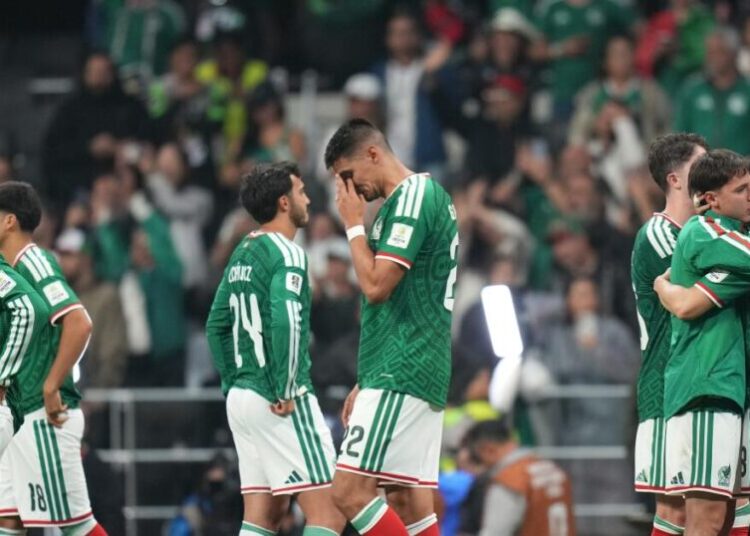
Even with their team eliminated from the World Cup, Mexican fans took one final moment to show their support at the Azteca, waving flags and applauding as the players took a final bow.
“Keep your spirits up!” Ms. Sheinbaum, Mexico’s president, said on social media after the game. What the young players on the team achieved, she said, “will live in the hearts of Mexicans forever.”
“To everyone,” she added, “we showed that Mexico is the best host in the world, with a joyful and united people.”
The post The World Cup Gave Mexicans a Fantasy They Won’t Soon Forget appeared first on New York Times.