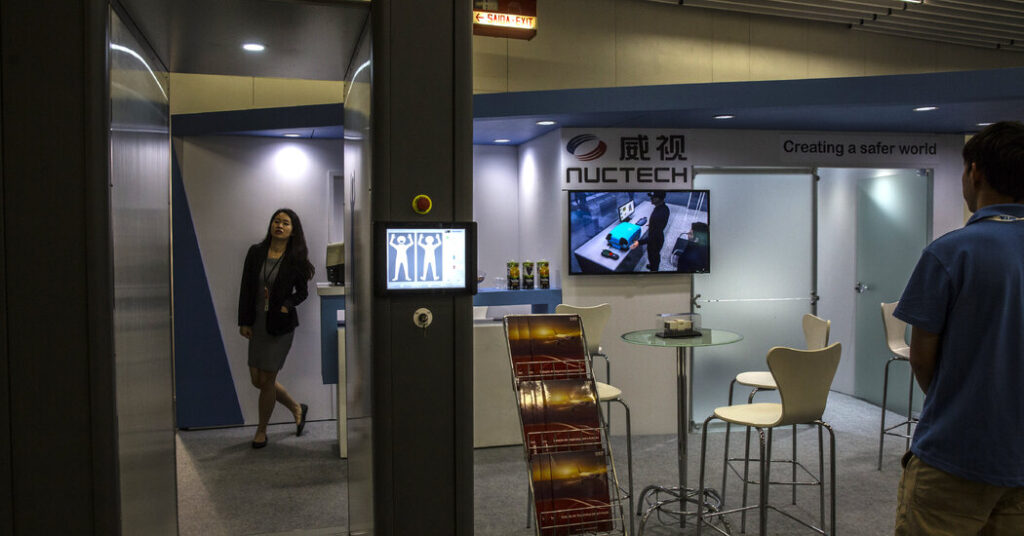
On a brisk April morning in 2024, investigators raided two European offices of Nuctech, a Chinese security equipment company with a vast global footprint. The officials from the European Union seized laptops, confiscated employees’ mobile phones and sifted through documents.
They were searching for evidence that the state-backed company, once led by the son of China’s former president Hu Jintao, had gained an unfair advantage while competing to install X-ray scanners and explosive detection systems at border checkpoints in more than two dozen European countries.
Nuctech’s footprint is wide. Its equipment has been installed at airports and seaports in more than 170 countries. The company is also no stranger to scrutiny. It has been implicated in corruption investigations in Namibia and the Philippines, flagged in Canada for data security concerns and placed on a U.S. national security blacklist.
Today, frustration in Europe over the dominance of Chinese companies across many industries is growing, and Nuctech has become a lightning rod for politicians under pressure to protect local companies and jobs. Concern over industries with potential spying or hacking vulnerabilities is mounting, too.
The European Commission, the executive arm of the European Union, is investigating whether government support has given Chinese companies an unfair advantage. It is using a new legal tool to scrutinize public bids by Nuctech and other Chinese manufacturers of electric vehicles, solar panels and wind turbines.
At the same time, China has denounced the investigations as “illegal” and an “unjustified suppression of Chinese enterprises.” Since the 2024 raids, the European Commission has opened an in-depth investigation into Nuctech that could lead to divestments and bans. For the first time, China’s Ministry of Justice responded by publicly ordering Nuctech not to cooperate.
The European Commission had investigated Nuctech in 2009 after a complaint by its British rival, Smiths Detection, and imposed anti-dumping tariffs on the company. Beijing retaliated with its own investigation into Smiths, ultimately imposing anti-dumping duties.
What happens this time could shape the future of relations between China and the European Union, as each side embraces increasingly divergent visions of free trade.
Nuctech embodies China’s first generation of companies to go global: state-backed, well connected and deeply financed. Its rise over the past three decades reflects both the ambitions of China’s ruling Communist Party and its willingness to pursue them over the long term.
“The Chinese model is very different from the Western model when it comes to private-sector development,” said Heiwai Tang, director of the Asia Global Institute at the University of Hong Kong.
“State-owned enterprises went out first, laying the groundwork, building infrastructure and ensuring that the private-sector firms, when they go overseas, can share some of the resources,” he added.
‘All of us will serve as your salesmen.’
As China’s economy opened to the world and shipping containers began piling up at its borders, the country needed technology to inspect cargo for contraband. The government brought together researchers from Tsinghua University, and in 1997 the group became known as Nuctech.
The company was granted access to state research bodies such as the China Institute of Atomic Energy and instructed to work closely with customs authorities, according to a paper published in a Chinese journal that cited interviews with Nuctech executives.
By 2000, Beijing had started urging Chinese companies to expand overseas.
Wu Yi, then one of China’s top leaders, visited Nuctech’s facilities and implored employees to “develop the international market.”
She added, “All of us will serve as your salesmen.”
During its early overseas push into Nepal, Syria, Lebanon, Mauritius, Suriname and Ecuador, Nuctech had no competitors, according to Chinese government documents examined by The New York Times. China’s Ministry of Commerce arranged the deals through a foreign aid program that provided assistance to developing countries to cultivate diplomatic good will.
The ministry also assisted Nuctech with commercial deals. Nuctech was viewed as an important instrument of China’s efforts to deepen its global influence through trade.
One document described a contract in Malta as being secured “under the strong support” of the Ministry of Commerce “through government matchmaking.” The 3-million-euro lease deal in 2007 between Nuctech and the Maltese government covered eight years and included a €291,000 grant from Beijing for projects agreed upon by both countries.
Nuctech also won contracts through the Belt and Road Initiative, the signature infrastructure program of China’s leader, Xi Jinping, that has directed roughly $1 trillion in loans toward projects around the world.
As Nuctech expanded overseas, it was accused of bribery and corruption in Namibia and the Philippines — allegations the company denied.
From 2000 to 2024, Chinese state-owned lenders and aid agencies made 66 grant and loan commitments worth more than $1.2 billion to buy and install Nuctech scanners and customs inspection equipment worldwide, according to AidData, a research institute at the College of William and Mary in Williamsburg, Va.
“Foreign aid projects are of profound and far-reaching importance to Nuctech’s expansion,” Miao Qitian, senior vice president of Nuctech, said in a news release about a visit by an agency under China’s Ministry of Commerce. The company, he added, “is a bright and beautiful calling card for China’s foreign aid work.”
‘Using trade to weaponize dependency’
Nuctech has since captured a large share of the global market for border inspection equipment. It says it holds the leading position in Africa, more than half the market in the Americas and a more than 90 percent share in Europe.
This dominance has raised concerns in Europe, where lawmakers question whether Chinese companies should have access to sensitive sectors that are potentially vulnerable to hacking and espionage.
What’s more, Nuctech’s Western competitors have argued that they struggle to compete on price, citing auctions in which the Chinese company’s bids were up to 50 percent below their bidding price.
In an interview with The Times, Robert Bos, deputy general manager of InsTech Netherlands, one of Nuctech’s two European subsidiaries, rejected the criticism.
The company’s European entities “did not receive any subsidies from the Chinese government that would enable them to offer unfairly low bids in E.U. public tenders and distort competition,” he said.
Mr. Bos added that winning government contracts did not always come down to price. “Sometimes we’re cheaper; sometimes we’re more expensive. In some cases, we also lose,” he said. Nuctech can offer lower prices because it manufactures equipment at a factory in Poland, he said.
Many of the European contracts won by Nuctech were recognized as the “most economic,” according to The Times’s review of European procurement records.
“They are using foreign subsidies to nestle themselves into our critical infrastructure,” said Bart Groothuis, a Dutch member of the European Parliament and former cybersecurity director at the Dutch Ministry of Defense. “They are using trade to weaponize dependency.”
China heightened those concerns last year when it restricted exports of critical minerals that European manufacturers relied on. Nuctech could similarly gain leverage over security operations, Mr. Groothuis said.
Mr. Bos defended Nuctech’s position, saying, “Nuctech has no leverage over either the Chinese government or European critical infrastructure.”
Criticism is mounting beyond Europe, too.
In 2020, the Canadian government scuppered Nuctech’s $6.8 million deal to supply X-ray equipment in 170 embassies, and a parliamentary committee recommended barring state-backed Chinese companies from federal technology and security contracts over data security concerns.
Mr. Bos denied that Nuctech stored or processed customer data. “Most of our customers have their own I.T. structures, and data handling is not up to us,” he said.
That same year, the United States added Nuctech to a blacklist, saying it had sold equipment that “impaired efforts to stop illicit international trafficking in nuclear and radioactive materials.”
As the European Union considers a tougher approach toward China, Nuctech has become a proving ground where both sides are seeking to draw lines.
By instructing Nuctech employees not to cooperate with the European investigation, China is pushing the limits of what Europe is willing to do, said Tobias Gehrke, a senior fellow at the European Council on Foreign Relations.
“China is using Nuctech as a test case for how much the Europeans will want to stick to their regulations and laws.”
The post The Chinese Company That Could Start a Trade War With Europe appeared first on New York Times.